Stadler shows one of 21 narrow-gauge hydrogen trains for Italy at InnoTrans
Stadler has shown its narrow-gauge hydrogen train at InnoTrans 2026, part of a series of 21 units it is building for regional operators in Sardinia, Calabria and Sicily.
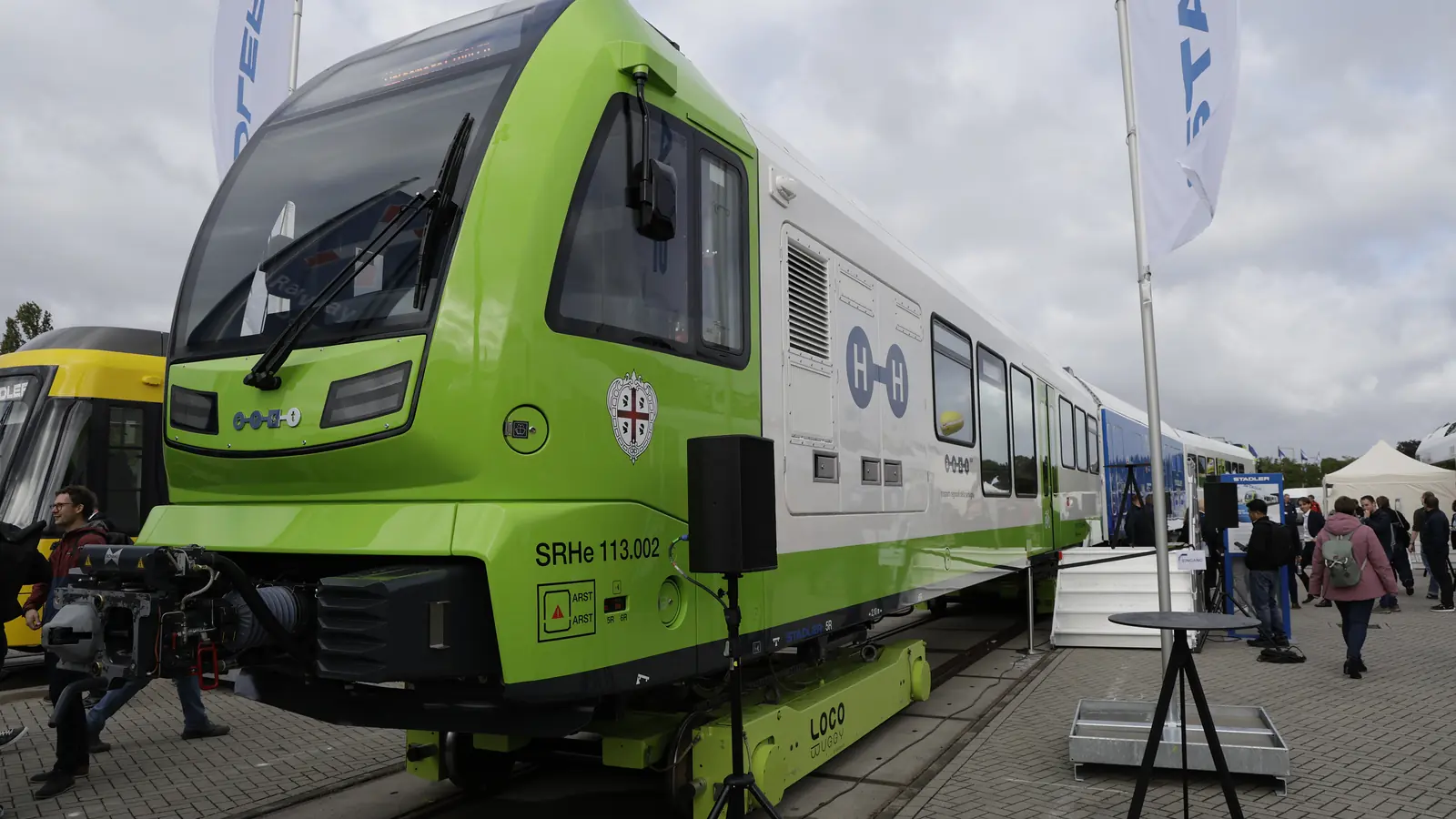
Stadler describes the vehicle as the first hydrogen train in the world built specifically for narrow-gauge lines. It is presenting the train at the fair in collaboration with the three southern Italian operators that will run the fleet. They are Azienda Regionale Sarda Trasporti (ARST) in Sardinia, Ferrovie della Calabria (FdC) in Calabria and Ferrovia Circumetnea (FCE) in Sicily. Stadler had already announced the unveiling of the train in June 2026.
Ten trains for ARST, nine for FdC and two for FCE
The first unit was built for ARST, whose framework contract with Stadler covers the design and development of ten vehicles. Production of nine trains for FdC and two for FCE is also under way at Stadler’s head office in Bussnang, in eastern Switzerland. All of them are intended for regional and local services. The InnoTrans announcement gives no start date for passenger services. In June 2026, Stadler said ARST’s trains were due to carry passengers from 2028.
For FdC, the order continues a relationship with Stadler that Sole Director Aristide Vercillo Martino said goes back around 20 years, to the first vehicle developed for Italy’s narrow-gauge railways. He said the new trains are part of a wider investment programme with the Calabria Region to modernise rail infrastructure and digitalise regional transport.
Stadler says it designed each version around the conditions of the network it will serve. These range from coastal routes in Sardinia and mountain tunnels in Calabria to the steep climbs of the Etna Nature Park in Sicily. Maurizio Oberti, Stadler’s Sales & Marketing Director for the Italian market, said the manufacturer worked with Italy’s Ministry of Transport and the three operators on a modular design. It can be adapted to the different requirements of the country’s narrow-gauge networks.
“All the trains are based on the same technological platform and combine a compact profile, lightweight mechanical structures, and an innovative hydrogen propulsion system.”
Fuel cells and batteries in a central Power Pack
The drive system sits in the middle car, which Stadler calls the Power Pack. It houses fuel cells and hydrogen tanks that work together with traction batteries, and the batteries are topped up with electricity produced from the hydrogen. This lets the trains run continuously on lines without overhead wires.
Stadler estimates that ten of the hydrogen trains will cut carbon dioxide emissions by more than 2,100 tonnes a year compared with diesel vehicles. It likens this to about 450 journeys around the world by car. Elsewhere in the same release, the company gives the saving as up to 2,100 tonnes.
Solar-produced hydrogen and the operators’ power stations
The hydrogen is to be produced entirely with solar energy. ARST, FdC and FCE are each developing their own power stations, which are now being built. Carlo Poledrini, General Director of ARST, said the vehicles are central to the operator’s plans to decarbonise its narrow-gauge network. He called the project the first step towards turning ARST into an energy company.
Quieter trains with low-floor access
According to Stadler, the hydrogen trains are noticeably quieter than diesel units, which benefits both passengers and people living near the lines. The interiors are bright, with large panoramic windows, and low-floor entrances let passengers with reduced mobility board easily. Salvatore Fiore, Managing Director of FCE, said the new trains would make the Circumetnea route around Mount Etna more comfortable for passengers while making transport more sustainable.
Alstom’s hydrogen trains for the Brescia–Iseo–Edolo line
In northern Italy, FNM and Alstom presented a hydrogen-powered Coradia Stream train in October 2023 for the non-electrified Brescia–Iseo–Edolo line, where Trenord runs the services. The first agreement, signed in November 2020, covered six hydrogen fuel cell trains with an option for eight more, and Alstom then expected commercial service to start between the end of 2024 and early 2025. The H2iseO project now provides for 14 hydrogen trains to replace the line’s entire diesel fleet. On 1 July 2026, FERROVIENORD said it had finished building the hydrogen plants at Iseo and Edolo and that commercial service is planned from the start of 2027. Alstom gives the train 260 seats and a range of more than 600 km.
Hydrogen train projects for Italian operators: Stadler and Alstom
| Item | Stadler narrow-gauge hydrogen train | Alstom hydrogen-powered Coradia Stream train |
|---|---|---|
| Operators | ARST in Sardinia, FdC in Calabria, FCE in Sicily | Trenord, on the Brescia–Iseo–Edolo line |
| Trains | 21 in production: 10 under the ARST framework contract, 9 for FdC, 2 for FCE | 14 planned under the H2iseO project. The November 2020 agreement covered 6, with an option for 8 more |
| Place of manufacture | Bussnang, Switzerland | Alstom sites in Italy: Savigliano, Vado Ligure, Sesto San Giovanni and Bologna |
| Drive layout | Fuel cells and hydrogen tanks in the central Power Pack, with traction batteries | Hydrogen equipment in an intermediate power car, with lithium-ion batteries |
| Hydrogen supply | Made with solar energy at the operators’ own power stations, now being built | Plants at Iseo (from biomethane) and Edolo (electrolysis with renewable power) completed in 2026, refuelling at Rovato since 2025 |
| Seats and range | Not given in the InnoTrans release | 260 seats, range above 600 km, as stated by Alstom in October 2023 |
| Passenger service | Not in the InnoTrans release, but in June 2026 Stadler gave 2028 for ARST’s trains | Planned from the start of 2027, according to FERROVIENORD in July 2026, after an earlier target of late 2024 to early 2025 |
Stadler’s series spans three operators and 21 units, against 14 trains planned for the Brescia–Iseo–Edolo line. Commercial service on that line is planned from early 2027, while Stadler has given 2028 for ARST’s trains in Sardinia. Stadler has not given seat numbers or range in its InnoTrans release. Sources: Stadler InnoTrans 2026 release, Stadler release of June 2026, Alstom release of 3 October 2023, FERROVIENORD release of 1 July 2026.