ZSSK signs €266m Škoda Group deal for eight trains, effective once funded
Škoda Group and ŽOS Trnava signed a €266.2 million contract, excluding VAT, to supply eight long-distance trains for ZSSK, but the Slovak deal takes effect only once funding is secured.
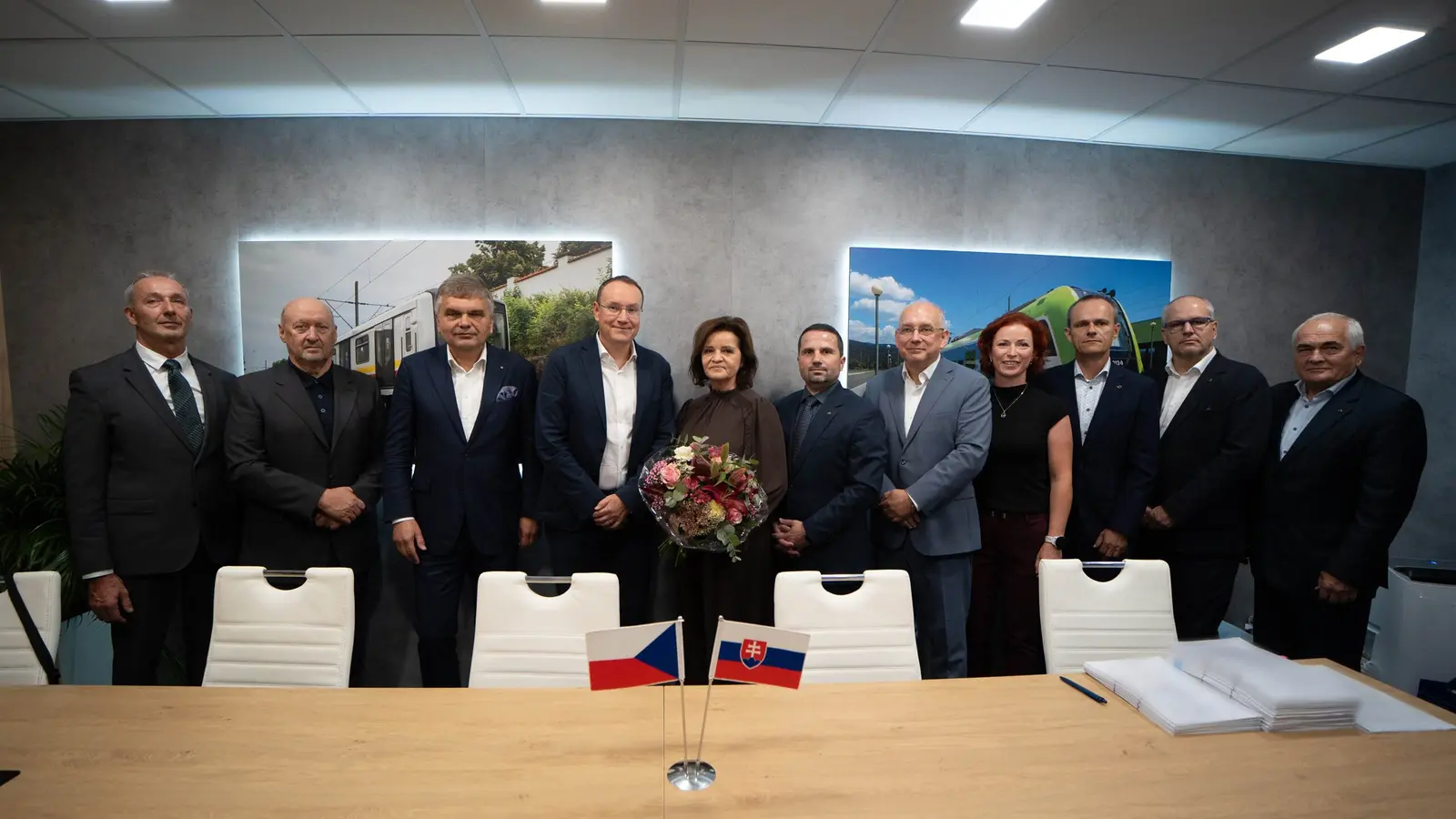
The agreement was signed at InnoTrans 2026 in Berlin. On top of the eight trains in the base order, the Slovak passenger operator holds an option for seven more. ZSSK does not expect the first units before 2032–2033. Besides the trains, the package includes ten years of maintenance, diagnostic tools and spare parts, certain repairs, training for ZSSK staff and technical documentation.
Price and funding for the eight trains
Including 23% VAT, the eight trains in the fixed part cost €327.4 million, according to an updated assessment by Slovakia’s Ministry of Finance dated 9 July 2026. Servicing is paid separately: the ministry puts it at €11.1 million a year for these trains, and ZSSK put the tendered price of the ten-year servicing at €3.27 per train-kilometre. The ministry values the option for seven further trains at €286.5 million including VAT and says its financing is not yet known.
Money for the base order has not been confirmed either. ZSSK is counting mainly on EU funds from the next programming period, and the contract enters into force only after financing for the fixed part is in place. The ministry notes that, without that funding, the project is not yet part of the operator’s prioritised investment plan for 2026–2030, and work is not expected to begin before 2028. Because the agreement had not taken effect by 30 June 2026, the draft contract reviewed by the ministry before the September signing also allowed the supplier to step back from the fixed part.
Ministry view of the tender price
Only one bidder took part in the tender. The ministry’s analysts found that the winning price equals the estimated contract value, but at €40.9 million per train including VAT it sits at the upper end of comparable long-distance projects abroad. In their view, the single bid may have influenced the price, while the smaller size of the Slovak order could also explain part of the difference.
| Operator (country) | Train | Year | Trains in order | Cost per train |
|---|---|---|---|---|
| Westbahn (Austria) | KISS 3 | 2019 | 15 | 34.5 |
| Deutsche Bahn (Germany) | Talgo 230 | 2023 | 56 of 100 | 40.2 |
| PKP Intercity (Poland) | Coradia Max | 2025 | 42 of 72 | 31.4 |
| ZSSK (Slovakia) | EMU550 | 2026 | 8 of 15 | 40.9 |
On the ministry’s figures, each ZSSK train costs more than in the three foreign orders, though the gap to the German Talgo 230 order is €0.7 million. For the foreign trains, the ministry added an estimate of extra costs for Slovak conditions, such as additional traction and signalling systems, radios and crew training: €3.0 million per train for the KISS 3 and Coradia Max, and €0.6 million for the Talgo 230, which is a push-pull train with a locomotive. All values were converted to first-quarter 2026 prices with Slovakia’s 23% VAT. A larger number of trains in an order may indicate savings from scale. Source: Slovakia’s Ministry of Finance, updated assessment of 9 July 2026, Table 1.
ZSSK’s fleet plan since 2024
The contract grew out of a different plan that the ministry reviewed two years earlier. In its June 2024 assessment, ZSSK was preparing to buy 25 electric locomotives and 10 long-distance trainsets for €479.7 million including VAT, with deliveries between 2025 and 2028. Separately, the operator leased 15 Vectron locomotives in 2024, with an option for 15 more. According to the ministry, planned delivery of the new trains has moved back by four years against the original intention. It now falls after the planned liberalisation of the Bratislava – Košice line in 2030. The Ministry of Transport has told the analysts that the trains will be made available to whichever operator wins that competition.
Seven-car trains for the Košice – Bratislava route
Each unit will be a seven-car, tri-system electric multiple unit about 190 metres long, ZSSK said. It will have a top speed of 200 km/h and 566 seats, 75 of them in first class. The trains are intended mainly for the Košice – Žilina – Bratislava route, with a possible extension to Austria. They will be approved for Slovakia on handover, and Austrian approval is expected within 12 months of the first delivery. If ZSSK takes up the option, type approval for Czechia and Hungary is planned as well.
Onboard features listed by Škoda Group include Wi-Fi, USB charging, a quiet zone, a restaurant area and a family section with a children’s cinema. ZSSK specifies 32 restaurant seats and room for two wheelchairs, seven prams and 16 bicycles. Tomáš Ignačák, vice-chairman of the board of Škoda Group, described the EMU550 as the first tri-system variant in the company’s new generation of electric multiple units for international long-distance services.
Once the new units are in service, ZSSK plans to move part of its modernised long-distance coach fleet to other lines, primarily Bratislava – Banská Bystrica. When the ten-year service contract ends, it intends to maintain the trains itself after building the necessary facilities. The same consortium also holds a framework agreement with ZSSK for up to 36 battery trains, signed in December 2025 and worth almost €332 million.