
Trenitalia’s six Hitachi battery trains can run up to 100 km off the wires
The Hitachi Rail BEMU Intercity, six of which Trenitalia has on order, is on show at InnoTrans 2026 as a diesel-free train rated for up to 100 km on batteries.
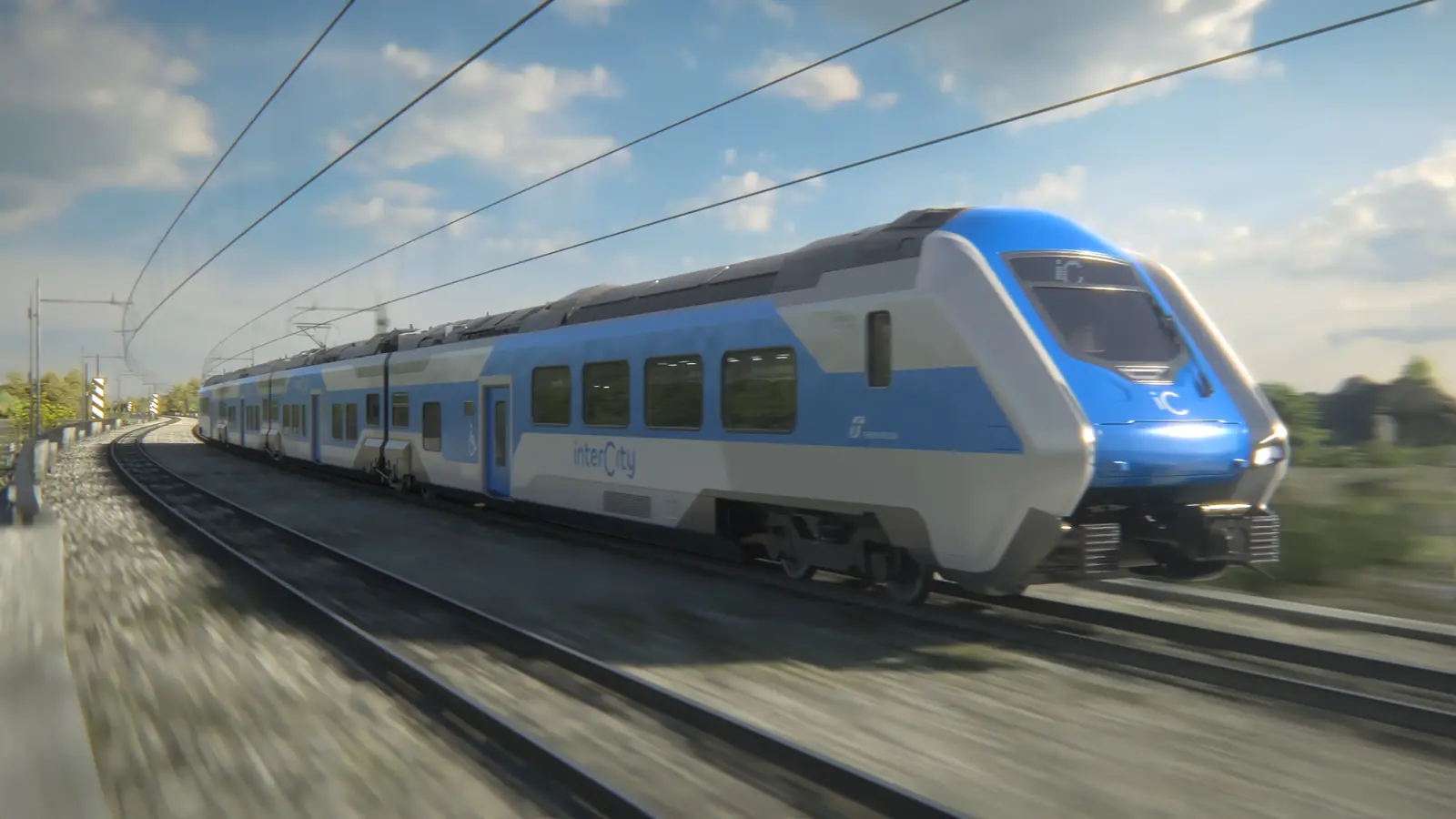
Hitachi Rail presents the BEMU at its stand in Hall 4.2 at Messe Berlin, where the fair runs from 22 to 25 September. The train itself is not part of the company’s outdoor display, which consists of four cars of the latest-generation ETR1000 high-speed train it builds for Trenitalia.
What Trenitalia has ordered
The order predates the fair. FS Italiane Group, Trenitalia’s parent, presented the BEMU Intercity at Expo Ferroviaria 2025 and said on 2 October 2025 that the six-train fleet would enter service from June 2026. The trains are part of a €525 million Trenitalia investment in 38 new Intercity trains, funded through Italy’s National Recovery and Resilience Plan (PNRR).
Hitachi Rail says the six units are ordered under the framework agreement for Blues regional trains and come with 15 years of full-service maintenance. Trenitalia has put its investment in the six-train fleet at €80 million, also funded through the PNRR. Hitachi Rail has not said whether the six units count towards the framework ceiling of 135 trains.
The manufacturer pitches the train at partially electrified routes. It can take power from overhead wires where they exist and run on its batteries where they do not. On such lines, it could take over from diesel trains.
Range, charging and capacity
Hitachi Rail puts the battery capacity above 600 kWh, which gives the train up to 100 km on lines without electrification. Two pantographs let the batteries be fully recharged in about 30 minutes during a stop. The trains have a top speed of 160 km/h and accelerate at 1.10 m/s². Hitachi Rail gives the seating capacity as 200, while FS Italiane Group puts it at up to 192 seats, 30 of them in the Plus area.
The company estimates that the train can cut CO2 emissions by up to 70% compared with current diesel trains. It also lists uses beyond timetabled services. The batteries allow shunting in depots with no overhead power and boarding ferries with passengers on board, and they keep trains moving during long outages of the overhead supply.
The units are built at Hitachi Rail’s plants in Pistoia and Naples. Hitachi Rail calls the BEMU Intercity the first fully battery-electric train planned for passenger service in Italy.
How the BEMU differs from the Blues trains
The framework goes back to September 2022, when Hitachi Rail and Trenitalia unveiled the Blues at InnoTrans. Hitachi Rail then valued the agreement at €1.2 billion for up to 135 trains. The Blues is a tri-mode design: it uses overhead power on electrified lines, a mix of diesel and battery power on other lines, and batteries alone near stations.
The manufacturer’s figures for the two trains differ. It gave the four-car Blues a top speed of 160 km/h, up to 300 seats and a cut of up to 50% in fuel use and CO2 emissions against current diesel trains. The BEMU Intercity has the same top speed, fewer seats and no diesel engine, and the company puts its emissions cut at up to 70%. Both percentages are Hitachi Rail’s own estimates.
The first 20 Blues trains had left the Pistoia factory by June 2023. At that point, Hitachi Rail said the next model of the platform was expected in about two years and would run on batteries only, with a range of more than 100 km. The company has not said whether the BEMU Intercity is that model. The range it now gives for the BEMU Intercity is up to 100 km.
| Date | Milestone | What was stated |
|---|---|---|
| 21 September 2022 | Blues unveiled at InnoTrans in Berlin | Tri-mode train with overhead, diesel and battery power; framework for up to 135 trains worth €1.2 billion |
| 20 December 2022 | Blues enters passenger service in Sicily | 22 of the trains to operate in Sicily |
| 27 June 2023 | First 20 Blues trains leave the Pistoia factory | Framework valued at €1.23 billion; next model expected in about two years, battery-only, with a range above 100 km |
| 2 October 2025 | FS Italiane Group reports the BEMU Intercity presentation at Expo Ferroviaria 2025 | Six-train fleet to enter service from June 2026, within a €525 million PNRR investment in 38 new Intercity trains |
| 22–25 September 2026 | BEMU Intercity shown at InnoTrans 2026 | Hitachi Rail places the six units under the Blues framework; range of up to 100 km without overhead wires |
Within four years, the framework has gained diesel-free battery-electric units alongside the tri-mode trains. Trenitalia separately puts its investment in the six-train fleet at €80 million. Hitachi Rail has not said whether the six BEMU Intercity units count towards the 135-train ceiling. Sources: FS Italiane Group article of 2 October 2025, a Trenitalia post on the six-train investment, Hitachi Rail press releases of 21 September 2022, 20 December 2022 and 27 June 2023, the Hitachi Rail InnoTrans 2026 vehicles page and the company’s InnoTrans 2026 statement placing the order under the framework. The framework value is given as €1.2 billion in 2022 and €1.23 billion in 2023.
What is still unknown
FS Italiane Group’s October 2025 target was service from June 2026. Hitachi Rail’s InnoTrans material describes the BEMU Intercity as intended for passenger service but gives no service date, and neither company’s material names the routes the six trains will serve. The company notes that more than 85,000 km of railway in Europe has no electrification, which it presents as the market for trains of this type.
Battery trains from Siemens Mobility and Stadler are also in Berlin, as part of an outdoor display that lists 113 vehicles.


