Poland nears GSM-R completion on Central Railway Line
21.04.2026
GSM-R on Central Railway Line is nearing completion. PKP Polskie Linie Kolejowe (PKP PLK) is Poland’s railway infrastructure manager. It has entered the final stage of the installation project. This is reported by the railway transport news portal Railway Supply.

The latest step is the erection of the last radio mast in Secemin. The site is in the Świętokrzyskie Voivodeship. This completes the digital radio communications infrastructure. It is on one of the country’s most important railway routes. According to PKP PLK, the final GSM-R base station is being installed. The contractor is a consortium of Nokia Solutions and Networks, Fonon, and SPC-2. It is on the Central Railway Line, also designated Railway Line No. 4. In addition, the work has included the installation of the telecommunications tower. It has also included the construction of 35 radio communication sites. Meanwhile, commissioning is scheduled for August 2026. GSM-R testing on the Central Railway Line is also scheduled for that month.
GSM-R on Central Railway Line and ETCS Level 2
Piotr Malepszak, Undersecretary of State at the Ministry of Infrastructure, said: “The construction of a unified GSM-R network is one of the most important modernization projects for the Polish railways. The installation of the final facility on the CMK demonstrates that we are constantly enhancing the safety and reliability of train operations on Poland’s most important lines,”
Don’t miss…PCC Intermodal advances Ropczyce terminal plan
The final GSM-R elements are being installed in Secemin. The CMK is moving closer to a modern digital communications system. That system enhances the safety and reliability of train operations. At the same time, ETCS Level 2 is essential on the line. Together with GSM-R, it supports operations at 250 km/h on the Central Railway Line. Using GSM-R as the transmission medium, ETCS Level 2 continuously monitors the driver’s actions. It reacts when messages and warnings are ignored. It also stops the train automatically if it exceeds the permitted speed. In addition, data must pass between the control center and the train. GSM-R digital radio communication provides that function.
Krzysztof Drozdowski, Director of Digital Transformation at PKP PLK, said: “The completion of radio infrastructure construction on the CMK represents a major milestone in the creation of the national GSM-R network. It is also a technology that will allow us to raise safety standards and prepare the infrastructure of Line 4 for the implementation of ETCS Level 2, so that we can fully utilize the speed of Pendolino trains,”
National ERTMS/GSM-R infrastructure project
GSM-R provides stable communication between locomotive engineers, traffic control personnel, and safety services. Also, it forms the basis for the implementation of ERTMS. That system must be deployed on the European Union’s main transport corridors. In addition, EU-standardized systems will let trains circulate freely between member states.
The project on the CMK is part of the initiative “Construction of the ERTMS/GSM-R system infrastructure on PKP Polskie Linie Kolejowe railway lines.”
It covers around 14,000 km of track. It is the largest telecommunications project in the history of the PLK network. According to RailwayPro, its value exceeds 3 billion zlotys (710 million EUR). The project also receives European funding under the Infrastructure, Climate, and Environment program.
The role of the CMK in Polish rail traffic
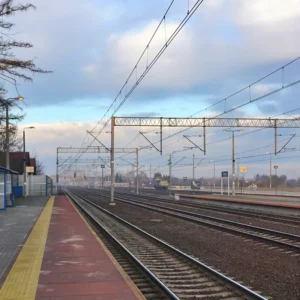
The Central Railway Line is one of Poland’s most important and modern railway lines. According to RailwayPro, it is 224 km long. It was originally designed for high-speed passenger and freight traffic.
The line connects Warsaw with the south of the country. It provides fast links to Katowice and Kraków, and indirectly to Wrocław. Meanwhile, traffic on the CMK is dominated by high-speed trains, including PKP Intercity’s Pendolino services. Still, the line is also used for freight transport because of its high technical specifications.
Following recent modernizations and the implementation of ERTMS/ETCS, the CMK allows speeds of 200–250 km/h. That makes it essential for national mobility. It is also essential for integrating the Polish railway network into European transport corridors.
News on railway transport, industry, and railway technologies from Railway Supply that you might have missed: