Lewes Derailment: the Track Fault Was Already on CCTV
20.08.2026
UK: A track geometry irregularity was visible in rear-facing CCTV from a train that passed the site at about 14:04 on Aug. 13 — nearly two hours before the Southern service derailed at the same spot at 15:54.
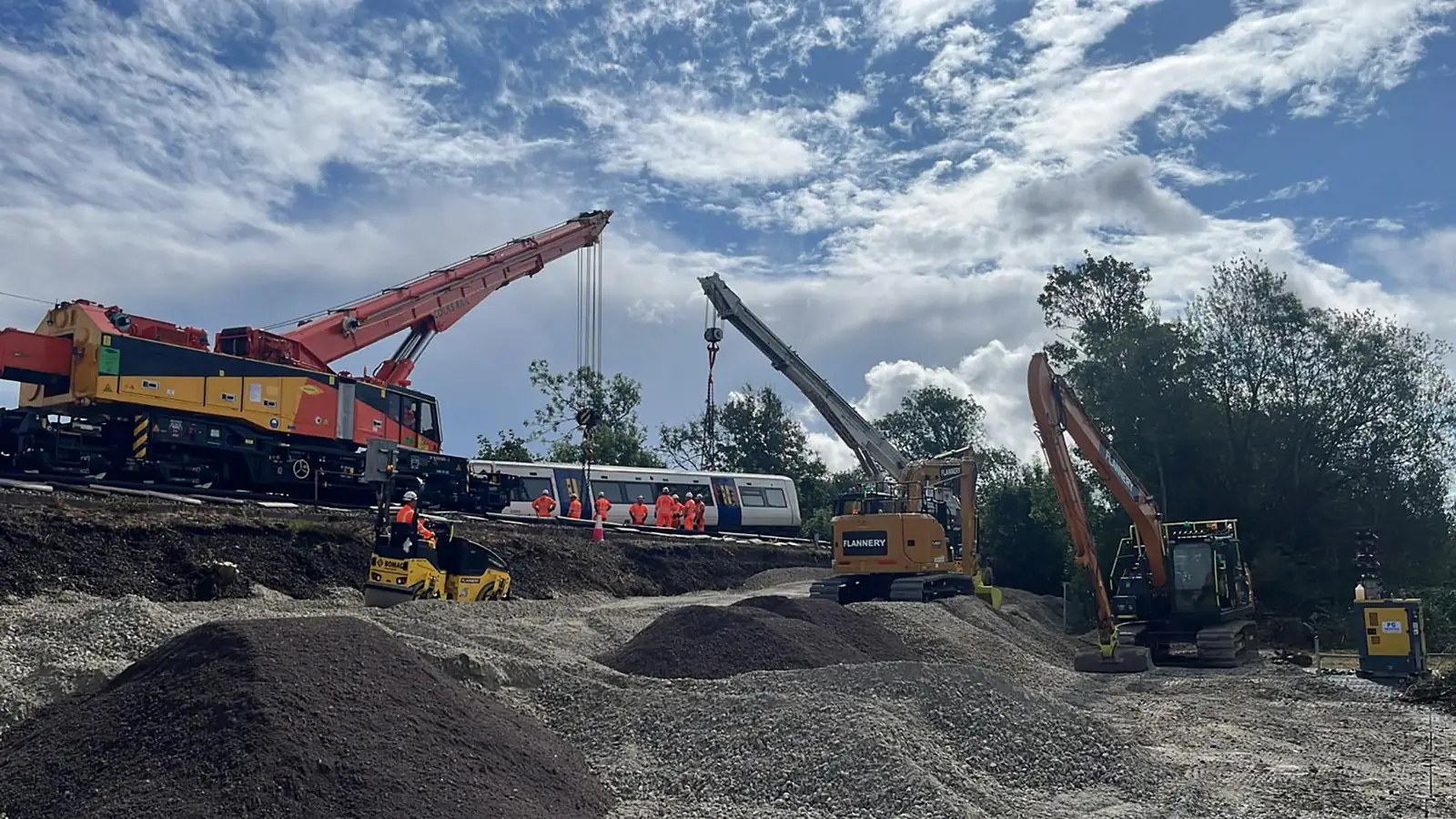
The investigation update published by the Rail Accident Investigation Branch on Aug. 19 sets out what had been established six days after train 1F34, the 14:24 London Victoria to Eastbourne service, left the track about a mile north of Lewes station. The rear three of its eight vehicles derailed and overturned onto the embankment; 30 people were injured and 20 needed hospital treatment.
Don’t miss… Two 125-Tonne Cranes Needed After Lewes Derailment
What the cameras and the recorder established
RAIB obtained forward-facing CCTV from the derailed train and both forward and rearward-facing CCTV from services that used the line earlier the same day. Those images show the irregularity on the immediate approach to the point of derailment, before the accident occurred. The report also notes evidence of previous track maintenance activity in the same area.
Preliminary data from the front vehicle’s on-train recorder puts the train at around 65 mph approaching the point of derailment, below the 70 mph maximum permitted there for this type of train. The driver braked as the train passed that point. Marks on the rails are consistent with the wheels of the rear vehicles having climbed over them.
Since the accident, RAIB says it has received several reports of rough riding at the same location from passengers on other trains.
The report says as much about the ground as the rail
Coverage of the update has centred on heat and buckled rail. The report itself is more restrained: it records that the ambient air temperature at the time was around 27°C at the nearest weather station, at Brighton City Airport, and that the accident took place during a sustained period of hot and dry weather. It does not use the word buckle.
What it does describe in detail is the embankment. The railway runs on an embankment constructed of clay, sitting on alluvial deposits of loose clay, silt, sand and gravel. Both are sensitive to changes in water content and can move as moisture levels change. RAIB says there is no evidence at this stage that a significant embankment slip occurred before the accident — but there is evidence that some movement had previously taken place.
Clay can shrink as it dries and swell as its moisture content increases, potentially affecting the infrastructure above. However, RAIB has not established that this mechanism caused the track irregularity at Lewes.
Previous monitoring advice may provide wider context
The investigation will examine eight areas, including how the track was inspected and maintained, the condition of the embankment and how it was inspected, the weather in the weeks and months beforehand, and the effectiveness of measures intended to manage hot-weather risk. The final item on the list is any actions taken in response to previous relevant safety recommendations.
There is recent safety advice that may provide wider context. In December 2025 RAIB issued Urgent Safety Advice 01/2025, warning Network Rail and other infrastructure managers that some lineside monitoring equipment may fail to detect rapid slope failures or provide the data expected for safety decisions. The advice followed the Shap derailment of November 2025, when a train struck a landslip after sustained heavy rainfall.
RAIB has not said that similar monitoring equipment was installed at Lewes or that the Shap advice is directly relevant to this accident. The Lewes investigation will, however, consider the inspection and maintenance of the embankment and any actions taken in response to previous relevant safety recommendations.
In a joint statement, Network Rail Sussex route director Lucy McAuliffe and GTR chief executive John Whitehurst said they were “very sorry that this happened on our railway” and that the independent investigation should be allowed to reach its conclusions given the complexity of the issues being examined. The line between Lewes and Haywards Heath remains closed while recovery and repairs continue. Network Rail and Southern said on Aug. 20 that passenger services are scheduled to resume on Sept. 1.
News on railway transport, industry, and railway technologies from Railway Supply that you might have missed:
Don’t miss… Lewes Line Closed 10 More Days After Derailment