Utah sought 74% but FTA caps its FrontRunner 2X grant at 40% of cost
The Federal Transit Administration has set a $1.29 billion ceiling on potential FrontRunner 2X federal funding, or 40% of the $3.22 billion project cost, against the 74% share Utah requested.
FTA set the cap in the letter that moved the Utah commuter rail project into Engineering, a later stage of its Capital Investment Grants (CIG) program, on August 7, 2026. The FTA project profile puts the ceiling at $1,286,611,600 if a Full Funding Grant Agreement is awarded. According to the agency’s August 7 announcement, the money also depends on annual appropriations by Congress. Engineering status lets the Utah Department of Transportation (UDOT) and the Utah Transit Authority (UTA) spend on engineering, utility relocation, property acquisition and early procurement.
Utah’s plan counted on a 74% federal share
UDOT, the project sponsor, filed its Engineering request in October and November 2025. Its financial plan sought $2.38 billion in Section 5309 CIG funds, or 74% of the cost. The rest was $762.5 million from the state Transit Transportation Investment Fund (23.7%) and $75 million in UTA sales tax revenue (2.3%). FTA notes that the sponsor drew up this plan and that it is not a federal commitment.
Measured against that plan, the cap would leave about $1.09 billion without an identified source. This is a Railway Supply calculation that assumes the state and UTA amounts stay as submitted. The profile does not say how the difference will be covered. FTA also wrote that UDOT gave no detail on extra debt capacity, cash reserves or other committed money to absorb cost increases or funding shortfalls.
The project received a Medium overall rating, with Medium scores for project justification and for local financial commitment. FTA judged the capital cost estimate reasonable but described the assumed growth in capital revenues as optimistic against recent experience. The profile says all capital funds outside the requested CIG share are committed or budgeted, but that statement refers to the plan built on the 74% request.
| Rating factor | Rating | Main points in the FTA profile |
|---|---|---|
| Overall project | Medium | Overall rating assigned to the Engineering request |
| Project justification | Medium | Profile summary lists a 90% existing seated load and 17,200 daily linked trips |
| Local financial commitment | Medium | Rated on the three weighted factors below |
| Current capital and operating condition (25%) | Medium-High | UTA bond ratings from September 2023 of Aa2 (Moody’s), AA (Fitch) and AA+ (S&P), with an updated AA from Fitch in June 2025; current ratio of 2.47 in FY2024; no recent service cuts or cash shortfalls |
| Commitment of capital and operating funds (25%) | High | All capital funds outside the requested CIG share committed or budgeted; about 99% of first-year operating funds committed or budgeted |
| Reasonableness of estimates and funding capacity (50%) | Medium-Low | Capital cost estimate judged reasonable; capital revenue growth seen as optimistic; UTA reserves equal to 28.0% of annual operating expenses, or 3.4 months |
The weakest score is for the realism of the financial assumptions, which carries half the weight of the local financial commitment rating. Percentages in parentheses show each sub-rating’s weight. Source: FTA project profile for FrontRunner 2X.
UTA had published a different split earlier. Its 2025 FrontRunner 2X fact sheet listed $2.1 billion in federal funds and $1.1 billion in local funds for the same $3.2 billion total.
How FrontRunner 2X reached the Engineering phase
UTA selected the locally preferred alternative in January 2022, and the project entered CIG Project Development in November 2022 with UDOT as primary sponsor. The Wasatch Front Regional Council and the Mountainland Association of Governments added it to their long-range plans in May and June 2023. FTA issued 11 categorical exclusions between July 2023 and August 2025, which completed the environmental review.
Construction and opening dates differ by document
UTA’s 2025 fact sheet showed design in 2025–2026, construction in 2026–2029 and completion in 2030, ahead of the 2034 Winter Olympics in Salt Lake City. UDOT’s August 7 announcement expects construction from 2027 through 2030, provided the federal grant process is finished. The FTA profile records UDOT’s expectation of a Full Funding Grant Agreement in March 2027 and of full project implementation in December 2031.
What double tracking changes for FrontRunner riders
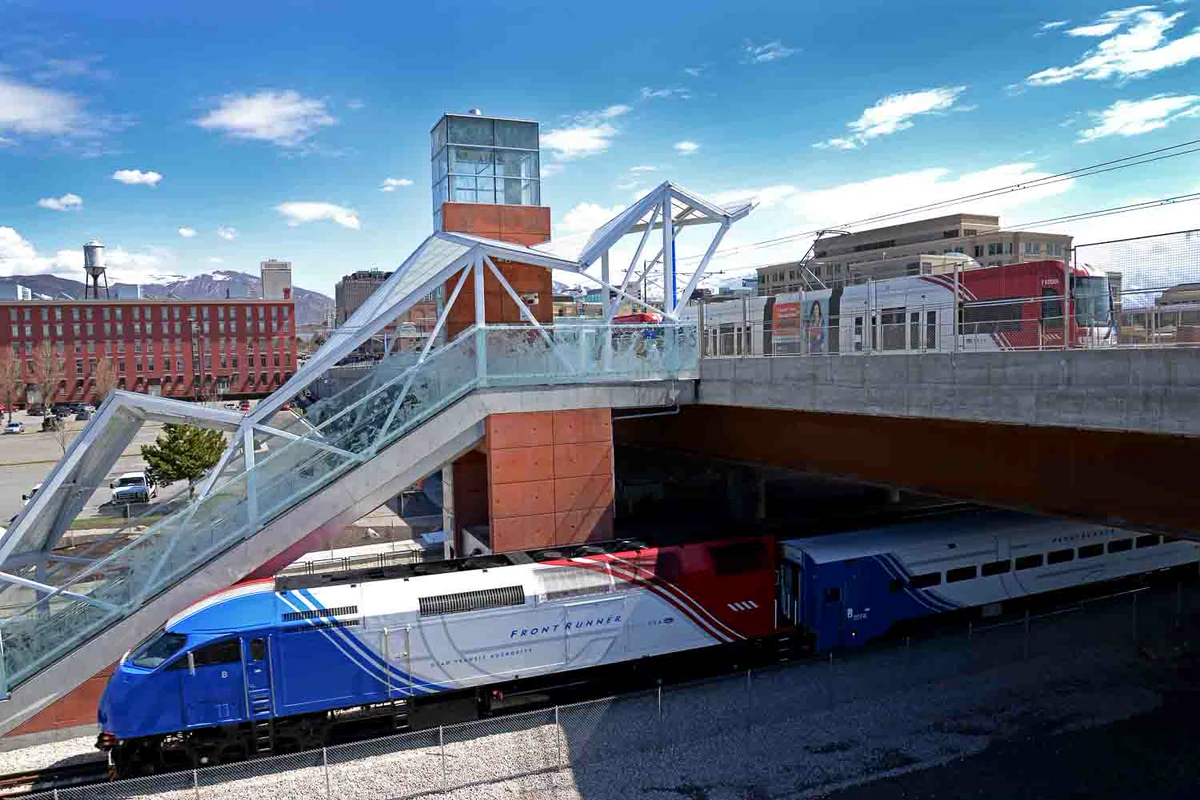
FrontRunner runs 82 miles between Ogden and Provo with 16 stations, mostly on a single track. The project adds 26.1 miles of second track across 11 sections, realigns one section and buys 10 diesel multiple unit trainsets. It also includes signal upgrades, a new vehicle maintenance facility and a new infill station with 325 parking spaces.
Trains now run every 30 minutes at peak times and every 60 minutes otherwise, and the project targets 15 and 30 minutes. FTA expects capacity to rise by at least 60%. The corridor carries 17,200 daily linked trips, and the existing seated load is 90%. UTA projects a 53% ridership increase. FTA puts annual operating cost in the 2031 opening year at $16.74 million. Railway Supply earlier reported on the double-track sections and 10 new trainsets planned for the line.