India’s Second Vande Bharat Sleeper Was Announced — but a Different Train Entered Service
12.08.2026
INDIA: A July service widely billed before launch as India’s second Vande Bharat Sleeper entered operation as a mixed-class express, while official records still listed only Howrah–Kamakhya as the sleeper network.

On 14 July, Railway Supply reported that train numbers 14624/14623 between Chheharta and Varanasi would become India’s second Vande Bharat Sleeper under the Sant Ravidas Express name. Three days later, however, the Prime Minister’s official programme described the launch simply as the Amritsar (Chheharta)–Varanasi train service, without identifying it as Vande Bharat.
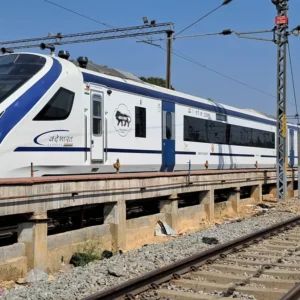
The distinction became clearer after operations began. The Tribune reported a 14-coach formation with second-class AC, third-class AC, non-AC sleeper and general coaches. By contrast, Indian Railways describes the current Vande Bharat Sleeper as a 16-coach, fully air-conditioned trainset with only AC First Class, AC Two-Tier and AC Three-Tier accommodation.
Most importantly, the Ministry of Railways published a nationwide Vande Bharat status update on 23 July — six days after the Chheharta–Varanasi flag-off — and still identified Howrah–Kamakhya as the first Vande Bharat Sleeper service. The same update said two sleeper trainsets had been manufactured. Its headline counted two sleeper “services,” while the body listed the two directions, 27575/27576, as one Howrah–Kamakhya pair.
The identity changed between the announcement and the operating train
The July record does not support treating 14623/14624 as an operating Vande Bharat Sleeper. It does show that the service was publicly identified that way before launch and then entered the timetable with a different rolling-stock profile.
| Date | Public record | How Chheharta–Varanasi was identified | What the record establishes |
|---|---|---|---|
| 14 Jul 2026 | Railway Supply pre-launch report | Identified as India’s second Sleeper Vande Bharat Express; train nos. 14624/14623 | The Vande Bharat Sleeper identity was in public circulation before launch |
| 17 Jul 2026 | Prime Minister’s official programme | Amritsar (Chheharta)–Varanasi train service | The official launch notice did not identify the service as Vande Bharat |
| 19–20 Jul 2026 | Post-launch Tribune report | 14-coach express with AC, non-AC sleeper and general accommodation | The operating formation was materially different from the current 16-coach all-AC Vande Bharat Sleeper configuration |
| 23 Jul 2026 | Ministry of Railways national status update | Howrah–Kamakhya remained the Vande Bharat Sleeper pair; two sleeper trainsets reported manufactured | The ministry’s post-launch network status did not add Chheharta–Varanasi as a Vande Bharat Sleeper service |
The contrast is not merely about branding. The current Vande Bharat Sleeper is a specific trainset platform. Indian Railways says the first production configuration has 16 coaches, 823 berths, automatic plug doors, semi-permanent couplers, Kavach and a design/operating speed of 180/160 km/h. A mixed formation containing general and non-AC sleeper coaches is a different operating product.
Railway Supply’s earlier Vande Bharat Sleeper overview focused on the platform’s speed, comfort and proposed role in overnight travel before commercial operations began. The July discrepancy shows why the next phase needs to be measured by operating trainsets rather than route labels alone.
Route announcements and fleet induction are different milestones
Indian Railways itself draws that distinction. In parliamentary material on Vande Bharat services, the ministry says introduction of new services depends on section capacity, train-path availability, required rolling stock, matching infrastructure, maintenance needs, occupancy and traffic demand.
The sleeper programme therefore has at least three separate layers: a planned route, an available and accepted trainset, and an operating service using that trainset. Combining those layers can make expansion look faster than the rolling-stock evidence supports.
This matters because the national manufacturing ambition is much larger than the operating network. In February, Railway Minister Ashwini Vaishnaw said 260 Vande Bharat Sleeper rakes were planned for manufacture and that induction would take place in phases according to demand and operational readiness. On 23 July, the ministry’s own status update still reported two manufactured sleeper trainsets.
Don’t miss…LLC “Kyivguma”: Leading Manufacturer of Rubber Technical Products for Industry and Railway Sector
Those two facts do not show that the 260-rake programme is stalled or failing. The second manufactured trainset and the planned Bengaluru–Mumbai service are important counterevidence to any claim that expansion has stopped. On 17 May, the Ministry of Railways said a Bengaluru–Mumbai Vande Bharat Sleeper service was expected to start soon.
They do show why a procurement, manufactured-trainset or route figure should not be converted into an operating-fleet figure. Production, trials, acceptance, maintenance preparation and path allocation all sit between a plan and a passenger service.
What the July record does not explain
The public sources reviewed do not establish why Chheharta–Varanasi was described before launch as a Vande Bharat Sleeper but entered service with a mixed-class formation. It could reflect a change in deployment plan, an earlier identification that was not carried through, or another operational decision that has not been publicly documented.
There is no competent evidence in the reviewed record to attribute the change to a particular manufacturer, certification issue, political decision or shortage. Nor does the discrepancy by itself establish deception or an attempt to mislead passengers.
That uncertainty matters. The evidence supports a correction of the operating status; it does not support a causal accusation.
The same caution should apply to other proposed sleeper routes. An announcement that a corridor is expected to receive Vande Bharat Sleeper service is evidence of a plan. Confirmation should come from the trainset assigned to the service, its official classification and the ministry’s operating-fleet record.
The next sleeper should be counted by the trainset
For the rollout to move beyond Howrah–Kamakhya, the strongest evidence will be straightforward: another accepted Vande Bharat Sleeper trainset must enter regular passenger service on another route and appear in official operating records.
That is a higher bar than a flag-off announcement, but it is also a more useful measure of industrial and operational scale. It connects manufacturing with certification, maintenance and deployment rather than treating each as interchangeable.
The July Chheharta–Varanasi launch is therefore less a story about one disputed pre-launch identification than a warning about how to read the next phase of the programme. India has a real Vande Bharat Sleeper in commercial service, a second manufactured trainset and a large manufacturing plan behind it. What the Ministry of Railways’ 23 July network status did not show was a second operating Vande Bharat Sleeper corridor.
The next genuine expansion milestone will be visible when those two records — route announcement and Vande Bharat Sleeper trainset induction — finally describe the same service.
News on railway transport, industry, and railway technologies from Railway Supply that you might have missed: