China-Kyrgyzstan-Uzbekistan railway digs through first tunnel in Kyrgyzstan
The China-Kyrgyzstan-Uzbekistan railway has its first tunnel holed through in Kyrgyzstan, the 209.6-metre Kosh Dobo North No. 2, one of 27 tunnels on which work has started there.
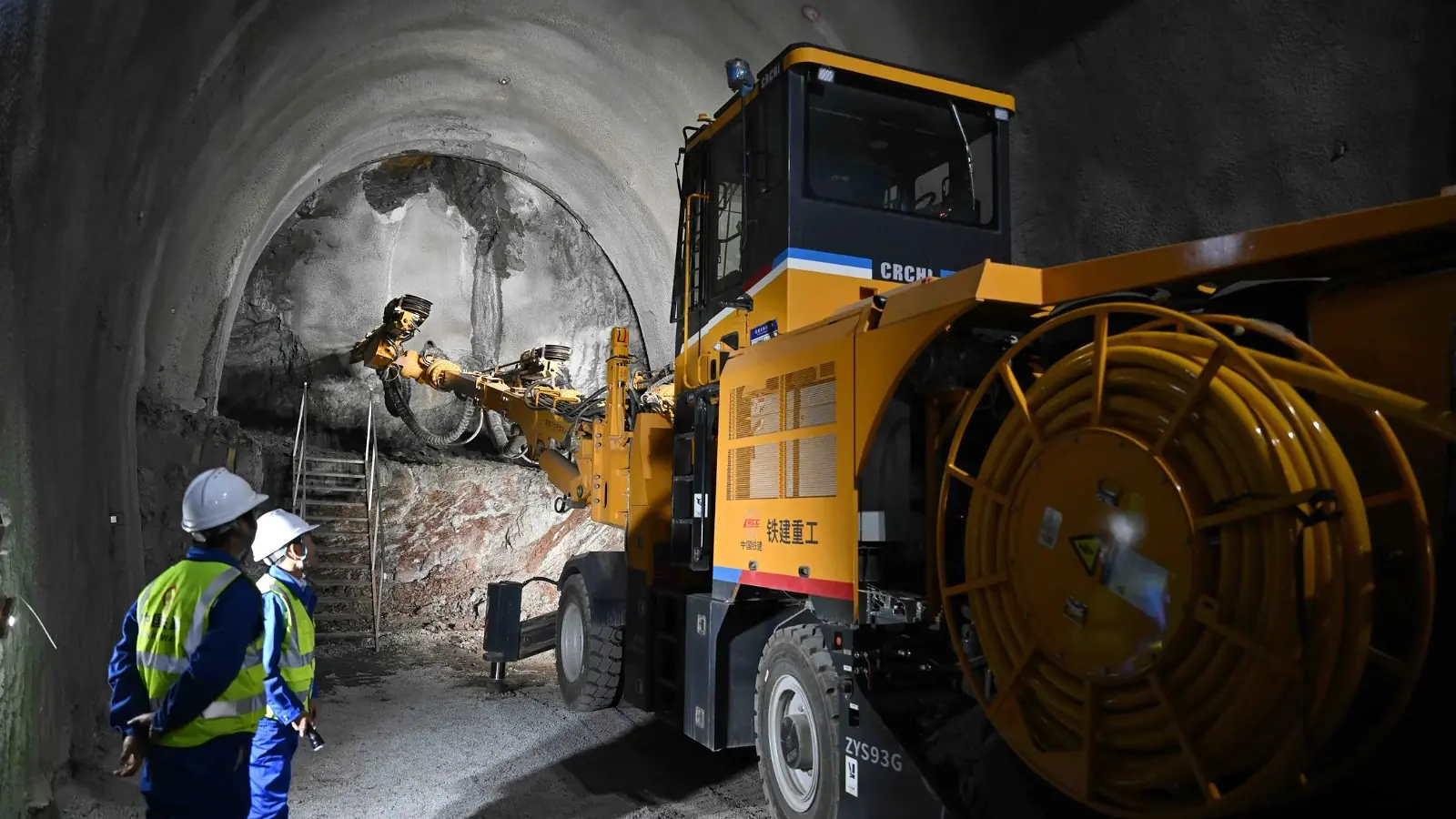
China-Kyrgyzstan-Uzbekistan Railway Company, set up by companies mandated by China, Kyrgyzstan and Uzbekistan to finance, build and operate the line on Kyrgyz territory, announced the breakthrough on 5 September. The announcement said the breakthrough had come recently and on schedule, without giving a date. China Railway International put it at 5 August, after 87 days of excavation that began on 10 May, Kyrgyzstan’s state news agency Kabar reported on 26 August. The tunnel is a single bore carrying one track, with a maximum depth of cover of 41 metres.
Construction on the Kyrgyz section
Civil works along the whole Kyrgyz section started in June 2025. Since then, work has begun on 27 tunnels and 43 bridges, along with 88 roadbed sections, and building work has started at 20 stations. Of those 27 tunnels, Kosh Dobo North No. 2 is the only one holed through so far. The company said all large temporary roads and temporary power supply facilities along the Kyrgyz route are finished and in use, and that control structures including the Naryn No. 1 tunnel have reached intermediate milestones.
In Kyrgyzstan the line will run for 304.84 km. Starting in Kashgar in China’s Xinjiang, it will enter the country at the Torugart Pass and head west via Jalal-Abad to Andijan in eastern Uzbekistan, a route of more than 500 km in total. The company’s announcement set no opening date. It said it would keep construction moving so that the railway is completed and opened on schedule.
| Date | Milestone |
|---|---|
| 6 June 2024 | The three governments sign their agreement on the railway in Beijing |
| 28 September 2024 | China-Kyrgyzstan-Uzbekistan Railway Company is opened in Bishkek |
| 20 December 2024 | Investment agreement for building the line is signed in Bishkek |
| 27 December 2024 | Ceremony in Kyrgyzstan marks the start of construction |
| 29 April 2025 | Work formally begins on key structures |
| June 2025 | Civil works start along the whole Kyrgyz section |
| 5 September 2026 | The company announces that Kosh Dobo North No. 2, its first tunnel in Kyrgyzstan, is holed through |
Civil works on the Kyrgyz section started a year after the three governments signed their agreement. The first tunnel breakthrough there was announced 15 months later. Sources: Kyrgyzstan’s Ministry of Transport and Communications, June 2025 (dates to April 2025); China-Kyrgyzstan-Uzbekistan Railway Company statements carried on 5 September 2026 by China.com.cn and Xinhua (June 2025 start of civil works, September 2026 announcement). Month counts are Railway Supply calculations.
Gauge change at Makmal
A June 2025 presentation by Kyrgyzstan’s Ministry of Transport and Communications divides the Kyrgyz route between two gauges. Standard 1,435 mm track is to run 165.5 km from the Torugart border station to Makmal, and 1,520 mm track the 146.26 km from Makmal to the Jalal-Abad border station. Makmal will host a transshipment station where freight and transfer trains are split up and re-formed, containers and cargo are reloaded and sorted, wagons and loads are weighed, and wagons are moved from one gauge to the other.
The ministry put the combined Torugart-Makmal-Jalal-Abad alignment at 311.76 km, against the 304.84 km the company now gives for the section. It expects the corridor to cut 700 km off journeys from East Asia towards the Middle East and southern Europe.
Local purchasing and jobs
The company said it has bought bulk materials and hired machinery in Kyrgyzstan worth more than 10 billion som. All fuel for the project is sourced locally, local suppliers provide over 60% of cement and other main building materials, and more than 1,700 units of Kyrgyz machinery and equipment are on hire.
It counts more than 2,000 engagements of Kyrgyz workers on the railway and related work. Three training bases at project sites in the Jalal-Abad region have recorded more than 1,800 trainee attendances by Kyrgyz workers in civil engineering, machinery and steel structures. The company has also put about 156 million som into village roads, drinking water, power supply and mobile coverage, medical check-ups and school donations along the route.