California Cut $1B by Building Less, Watchdog Finds
20.08.2026
USA: California high-speed rail cut about $2 billion from the ends of its first operating segment, but cost increases elsewhere left its cost estimate only about $1 billion lower.
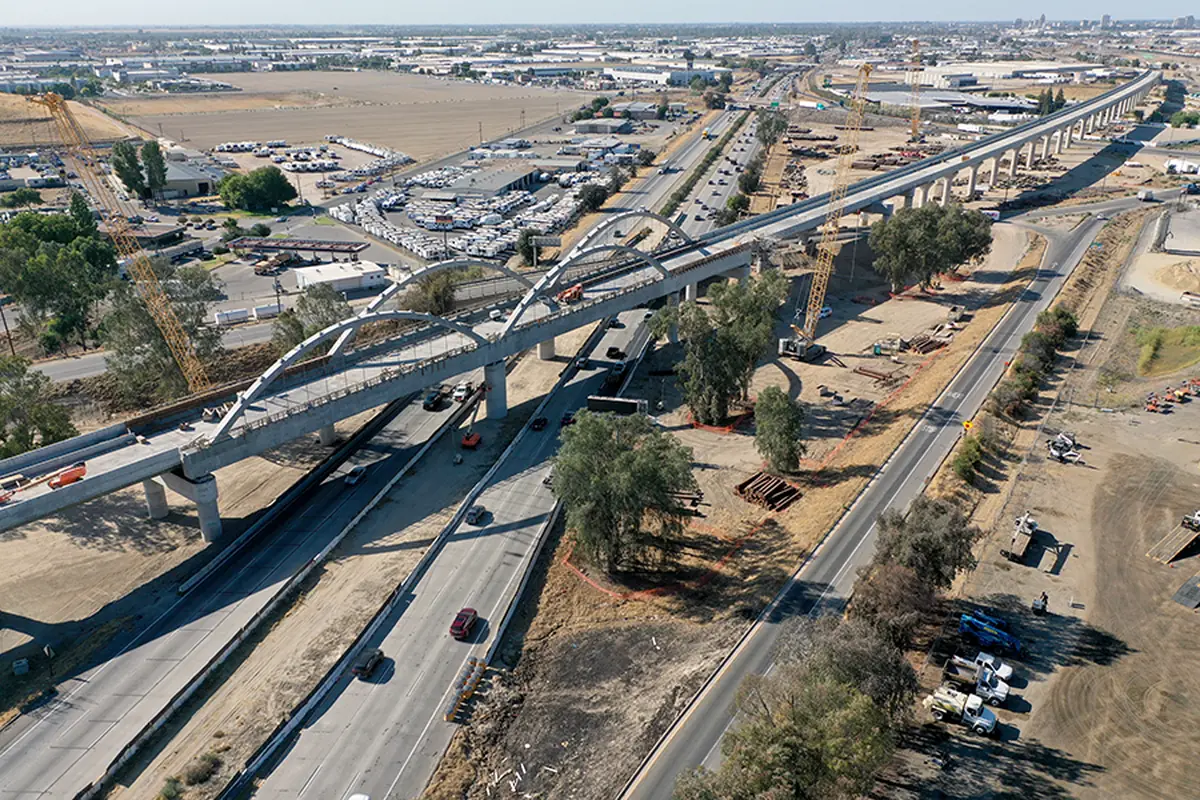
The July 31 review of the Authority’s final 2026 Business Plan by the Office of the Inspector General, High-Speed Rail puts the reduced-scope Merced–Bakersfield estimate at $35.662 billion against $36.750 billion in the 2025 Supplemental Project Update Report. The inspector general says the reduction came from scope changes rather than efficiency, which the office defines as “delivering equivalent scope for less cost.”
Don’t miss… California HSR Narrows Depot Site to Fresno or Hanford
The $2 billion cut was offset by rising costs elsewhere
Base costs before escalation and contingency fell from $29.802 billion to $28.855 billion — a net $947 million. That net figure hides movement in both directions.
| Section | Change in base cost | What drove it |
|---|---|---|
| Merced extension | −$757 million | Station moved south of downtown; shorter guideway |
| Bakersfield extension | −$1,278 million | Temporary north station defers all work south of it |
| 119-mile Central Valley | +$885 million | Design advanced; change orders; power, stations, maintenance facility |
| Program-wide | +$203 million | Longer contracts; escalation on delayed trainsets |
| Net change | −$947 million |
The two extensions gave up about $2.0 billion between them. The increases came from two places. The 119-mile core, where civil construction is well advanced and no scope was removed, added $885 million — track and train control alone accounting for $404 million as the project moved from generic design assumptions to a specific system design, with $166 million in civil change orders and $157 million for power supply. Program-wide costs added a further $203 million, largely for extended consultant contracts and escalation on the delayed trainset procurement.
Bakersfield is deferred, Merced is moved
The two cuts are not the same kind of decision, and the inspector general treats them differently.
At Bakersfield, ending the segment at a temporary station north of the city shortens it by about six miles and defers roughly $1.3 billion in civil construction, including the downtown station, to a future phase. The report warns that building it later will likely cost more than the SPUR estimated, because delay compounds inflation.
At Merced, the reduced-scope plan moves the station south of downtown and, unlike Bakersfield, does not describe the relocation as temporary. State law defines the segment as 171 electrified dual-track miles with a new station in downtown Merced. Together with the Bakersfield deferral, the preferred configuration shortens the line to 162 miles. The business plan acknowledges that changing the Merced location would require amending the statute. As of July 2026, the Authority was negotiating with the City of Merced and had not put a proposal to the Legislature.
The Authority disputes the framing, saying the concerns reflect “differences in interpretation rather than gaps in information” and that it has never implied it is abandoning either the statutory configuration or a two-track system. The inspector general points to Exhibit 2.0 of the business plan, which shows no ACE connection at Merced and instead depicts Amtrak San Joaquins services terminating at Madera.
What the $35.7 billion leaves out
The estimate already includes $5.567 billion in contingency, but the inspector general says another $1.2 billion would be required if Federal Transit Administration default risk levels were applied. It also excludes $3.6 billion to $6.6 billion in financing costs and $816 million the Authority assumes partner agencies will pay without formal agreements in place.
The estimate further excludes $1.7 billion for structures covered by a 2018 settlement with the City of Shafter. The city rejected the Authority’s proposed design changes in October 2025, and negotiations were continuing as of July 2026.
The inspector general reports that these adjustments would raise the estimate to between $42.278 billion and $45.278 billion. However, the figures listed in the report’s Table 4 appear to add up to $42.978 billion to $45.978 billion — $700 million more than the stated total. The report does not explain the discrepancy.
A separate estimate the Authority says complies with state law — 171 miles, dual track, downtown stations — comes to $47.654 billion. The inspector general cautions, however, that the $47.654 billion estimate includes assumptions not strictly necessary to comply with state law and may therefore overstate the additional cost of statutory compliance.
Using the inspector general’s stated total, the reduced-scope option faces a funding gap of about $3 billion to $6 billion against the $39.3 billion in capital funding forecast through 2045. The unexplained $700 million discrepancy in Table 4 could make that gap larger. For the statutory configuration, the reported gap is about $8.4 billion.
News on railway transport, industry, and railway technologies from Railway Supply that you might have missed:
Don’t miss… California High-Speed Rail Funding Risk in 2027