Amtrak Rejected the Transcontinental Chief. What Do the Public Numbers Say About Its Business Case?
13.08.2026
USA: Amtrak rejected AmeriStarRail’s Transcontinental Chief over its business case, but FRA data show the decisive question is whether new truck, vehicle and passenger revenues could cover a new layer of operating and infrastructure costs.
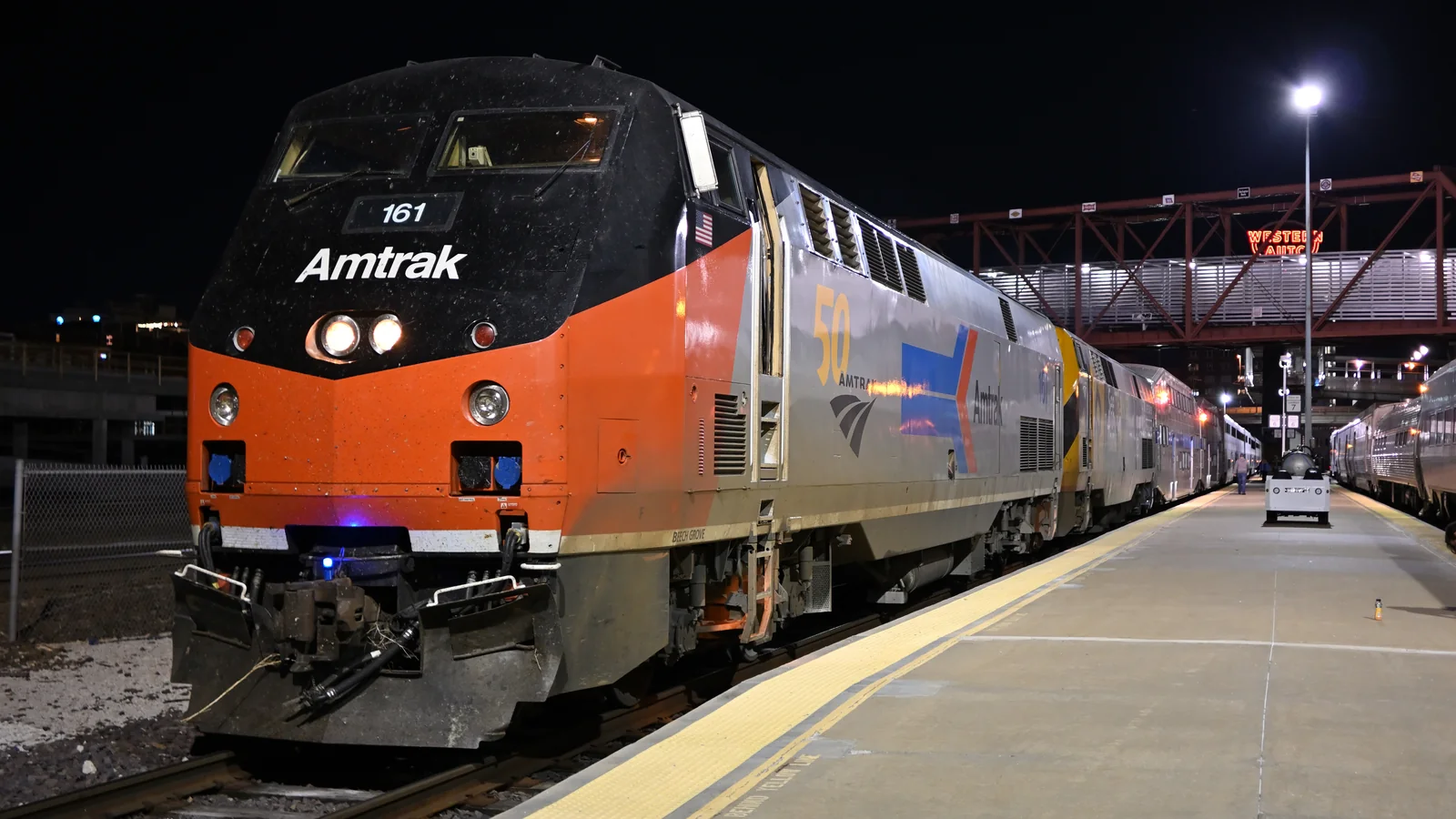
AmeriStarRail’s June 30, 2025 proposal was not simply a direct New York–Los Angeles passenger train. The company proposed replacing the Southwest Chief and Pennsylvanian with a service carrying passengers, personal vehicles and entire tractor-trailers, using roll-on/roll-off RailPorts and targeting a sub-72-hour coast-to-coast trip. Its proposed May 10, 2026 start was explicitly subject to approval by BNSF, Norfolk Southern and New Jersey Transit.
Amtrak said it reviewed the proposal and concluded that it lacked the fundamental business case needed to support the concept; it also said it was not considering the combined freight-and-passenger model. AmeriStarRail later said it would provide detailed business-case information under a mutual nondisclosure agreement. Railway Supply has already covered the rejection and its immediate next steps. The narrower question here is what the public economics can actually verify.
The existing routes show why the business case mattered
The latest FRA financial metrics explain why the economics became the center of the dispute. In FY2026 Q2, covering January 1 through March 31, Amtrak reported adjusted operating revenue equal to 38.9% of fully allocated adjusted operating expense for the Southwest Chief. The Pennsylvanian was at 76.9%, while Auto Train was at 124.4%.
Those figures do not describe the same commercial product. FRA classifies the Pennsylvanian as State Supported, and its passenger revenue covered 94.2% of avoidable operating expense when state operating payments were included, compared with 67.8% when they were excluded. Auto Train has its own vehicle-carrying revenue model, while Southwest Chief is reported as a conventional Long Distance service.
| Existing service | FY2026 Q2 cost recovery | Passenger revenue coverage of avoidable operating expense | Customer OTP |
|---|---|---|---|
| Southwest Chief | 38.9% | 45.6% | 39% |
| Pennsylvanian | 76.9% | 94.2% incl. state operating payments; 67.8% excl. | 80% |
| Auto Train | 124.4% | 145.1% | 64% |
Source: FRA FY2026 Q2 Financial Metrics and Performance and Service Quality Report. Cost recovery compares adjusted operating revenue with fully allocated adjusted operating expense. These are existing-service baselines, not a Transcontinental Chief forecast.
The comparison therefore gives three baselines, not a forecast. It shows both the size of Southwest Chief’s existing route-level financial gap and the fact that a passenger service carrying customers’ vehicles can produce materially different economics. It does not show what a coast-to-coast train carrying full tractor-trailers would earn or cost.
The proposal’s new revenue is also where the public evidence stops
AmeriStarRail’s proposal tried to change the revenue mix, not merely extend the Southwest Chief. The letter described Intermodal Express traffic for entire tractor-trailers, Auto Train-style vehicle transport, passenger revenue and a privately financed operation.
But the public materials reviewed for this analysis do not provide the quantitative assumptions needed to translate those ideas into a reproducible business case:
- passenger, vehicle and truck volumes by segment and departure;
- ticket prices, freight rates, yields and load factors;
- RailPort construction and operating costs, including financing terms;
- host-railroad access, compensation, capacity and timetable assumptions;
- equipment rehabilitation, maintenance, crew and terminal-handling costs;
- insurance, liability, working-capital requirements and risk allocation.
Without those inputs, the proposition that new logistics revenue would make the train profitable remains an attributed company claim rather than a result that can be independently reproduced from public data.
Auto Train is evidence of a viable product type, not proof of this proposal
Auto Train is the strongest public counterpoint to a blanket argument that carrying vehicles cannot improve passenger-rail economics. In FY2026 Q2, its route-level cost recovery was 124.4%, and passenger revenue covered 145.1% of avoidable operating expense in FRA’s metrics.
But Auto Train is not a proxy for the proposed Transcontinental Chief. FRA’s numbers describe one existing service; AmeriStarRail proposed a much longer operation across several host railroads while adding full tractor-trailers, new RailPorts and through passenger service. The key question is incremental economics: would added truck and vehicle revenue exceed the associated terminal, equipment, crew, maintenance, access and operating costs? The current public record does not answer that.
Southwest Chief punctuality proves the operating problem, not the solution
The operating case is similarly mixed. FRA’s FY2026 Q2 performance report recorded Customer OTP of 39% for Southwest Chief. Its three largest delay causes were freight-train interference at 17,435 minutes, slow-order delays at 7,762 minutes and locomotive failure at 4,959 minutes.
That evidence supports the premise that the existing service has a material reliability problem. It does not verify AmeriStarRail’s claim that proprietary operating techniques could solve it. A combined passenger, auto and tractor-trailer train would need a demonstrable timetable and terminal plan, plus host-railroad agreements and capacity assumptions that account for loading, train length, meets and recovery margins.
Amtrak’s statutory position can help with one part of that operating equation. Federal law gives intercity and commuter passenger transportation provided by or for Amtrak preference over freight transportation on rail lines, subject to the statute’s exceptions and Surface Transportation Board processes. Preference rights are an operating tool, not evidence that a particular schedule or financial model is viable.
What would make the Transcontinental Chief business case testable
A testable Transcontinental Chief business case would have to start from incremental economics, not simply add the current route results. Southwest Chief and Pennsylvanian sit in different FRA service categories, and the latter has state-support mechanics. The proposed service also created revenue streams and costs that neither current route contains.
The minimum useful disclosure would connect traffic volumes and yields to a timetable, host agreements, terminal and equipment costs, financing and downside cases. It would also separate a financial-return claim from the broader public-service value of long-distance rail. FRA’s long-distance planning framework evaluates connectivity, rural economic and social well-being, and regional support alongside the case for service.
That distinction matters because public value and route-level profitability are different questions. AmeriStarRail made the stronger financial claim that its model could make long-distance operations profitable. Testing that claim requires a reproducible financial model, not just evidence that the existing services have weaknesses or that vehicle-carrying rail can generate revenue.
The public numbers do not settle the argument
The public numbers do not prove that Amtrak was economically right in every unstated assumption, because the sources reviewed do not contain a detailed Amtrak rejection model. They also do not prove that AmeriStarRail could deliver the profits it described, because the public proposal does not disclose the variables needed to calculate them.
What the data do show is the size and shape of the problem. Southwest Chief recorded weak route-level cost recovery and 39% Customer OTP in FY2026 Q2, while Auto Train demonstrates that a materially different passenger-and-vehicle product can produce stronger financial metrics. The Transcontinental Chief hypothesis sits between those facts.
The next meaningful evidence would therefore be a transparent incremental model—or enough disclosed assumptions to reconstruct one—not another launch target. Until then, “profitable” and “unworkable” are both stronger conclusions than the public evidence supports.
News on railway transport, industry, and railway technologies from Railway Supply that you might have missed: