How China’s “Deep-Sea Space Station” Cracked an Undersea Rail Problem
19.08.2026
CHINA: Crews completed 21 days of cutter maintenance beneath the seabed in the world’s longest undersea high-speed rail tunnel, remaining under pressure between shifts to avoid repeated decompression.
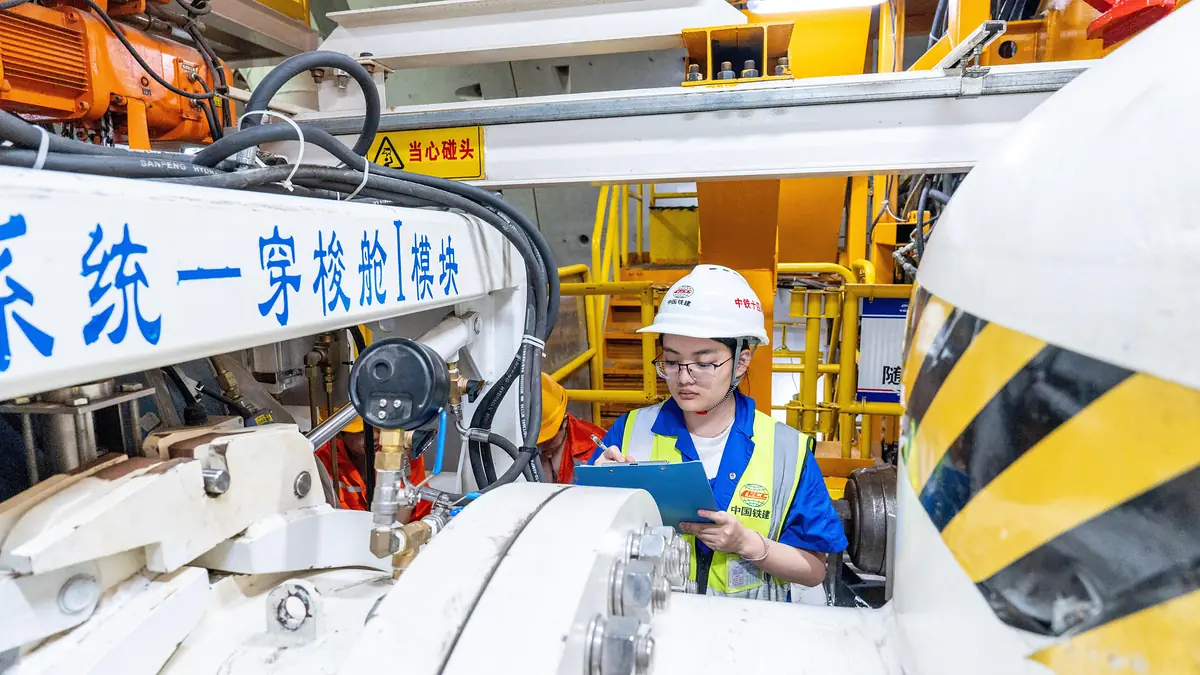
The inspection and replacement work involving 104 cutters was carried out at a depth of 80 metres under 7.8 bar of water pressure on the “Yongzhou” shield machine, setting a new Chinese record for maximum pressure in shield-tunnelling chamber entry, according to Science and Technology Daily. The machine is boring towards Zhoushan from Ningbo as part of the 16.18-kilometre Jintang tunnel, a critical section of the Ningbo-Zhoushan railway. Facing rock strength of up to 191 megapascals along its route, the machine has advanced 3,936 of its planned 4,940 metres — nearly 80% of its task.
Why cutter replacement above 6 bar is a global challenge
The tunnel reaches a maximum depth of 92 metres below sea level, where combined water and soil pressure can reach 8.5 bar; around 2,000 metres of the alignment is exposed to pressures above 6 bar. Pressurised cutter replacement in such high-water-pressure sections is widely recognised in the tunnelling field as a world-class technical challenge. Extreme geological conditions along the route wear down cutting tools quickly, forcing repeated stoppages for replacement work.
To address this, China Railway 14th Bureau Group worked with the Ministry of Transport’s Shanghai Salvage Bureau over three years to adapt deep-sea saturation diving technology into China’s first domestically built saturation hyperbaric system for shield tunnelling, nicknamed the “Deep-Sea Space Station.” The system comprises three modules — Ninghai (living), Tanhai (transfer) and Zhenhai (control) — with a maximum designed operating depth of 100 metres.
“Compared with other pressurised working methods that require repeated cycles of pressurisation and decompression, saturation technology uses precise gas ratios to pressurise workers once to match the tunnel face, after which dissolved inert gas in the body reaches saturation, allowing long-term stays in the Ninghai module,” said Hu Hao, project manager for China Railway 14th Bureau Group.
The system previously completed its first real-world application at 75 metres, where nine workers stayed for 22 days and replaced 46 cutters. The latest operation, conducted at 80 metres, represented a significant increase in difficulty. After the work was completed, the crew began a three-day staged decompression process.
What to watch
According to regional government sources, the Jintang Undersea Tunnel is expected to be fully completed by the end of 2026, with the “Yongzhou” and “Dinghai” shield machines reaching their meeting point beneath the seabed. The wider Ningbo-Zhoushan railway is planned to be ready for operation in 2028, cutting Ningbo–Zhoushan journeys to as little as 26 minutes and Hangzhou–Zhoushan trips to 77 minutes.
News on railway transport, industry, and railway technologies from Railway Supply that you might have missed:
Don’t miss… Undersea Railway Tunnel to Revolutionize Travel Between Ningbo and Zhoushan



