India’s LNG-diesel train gets a formal launch months after entering service
Home Minister Amit Shah formally flagged off what the government calls India’s first LNG-powered train at Sabarmati on 27 September, but the dual-fuel DEMU was already carrying passengers in January.
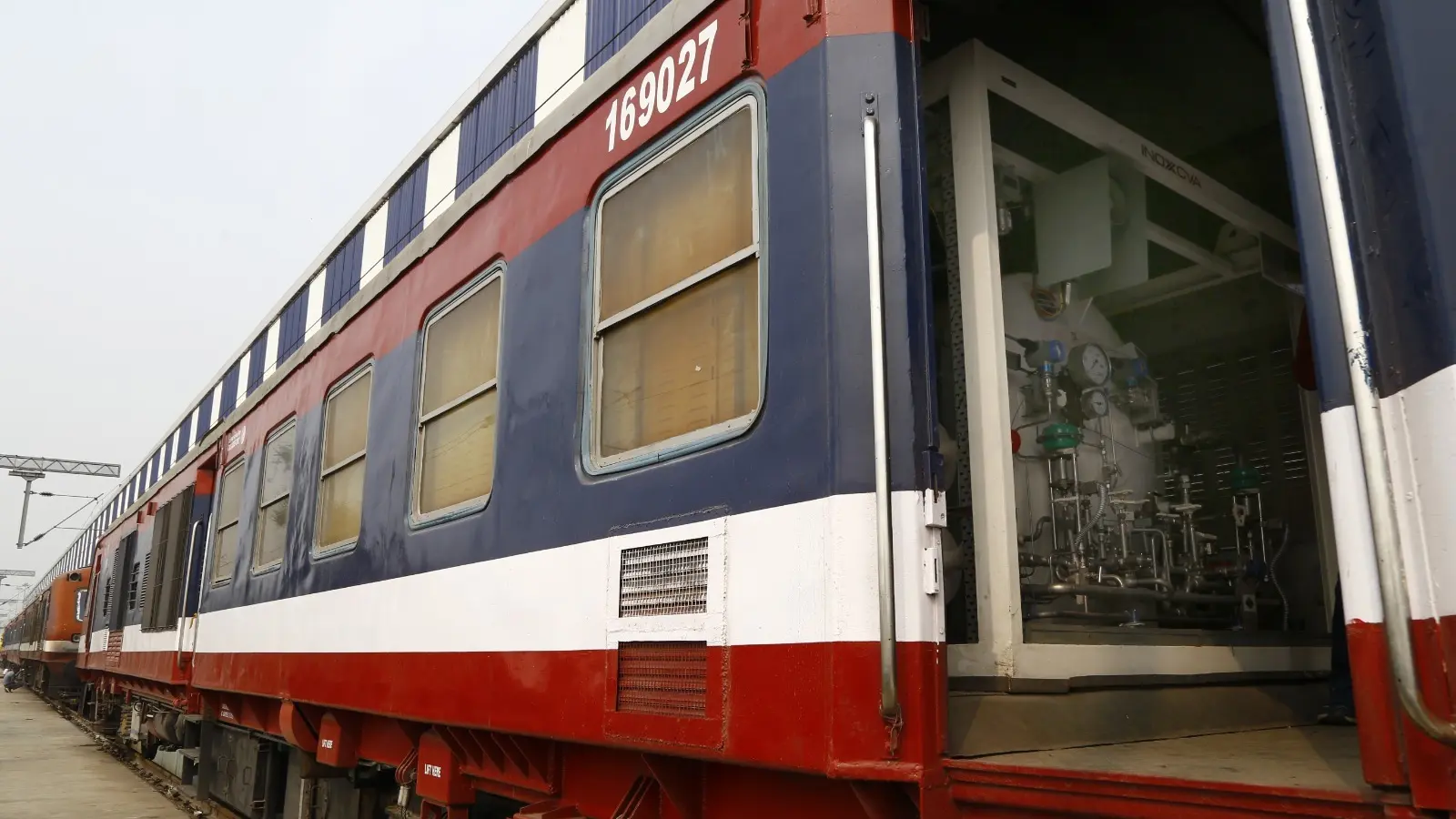
The train is a Diesel Electric Multiple Unit (DEMU) whose driving power cars run on a mix of diesel and liquefied natural gas (LNG). Shah dedicated it to the nation at Sabarmati Railway Station in Ahmedabad, Gujarat, at an event where he inaugurated and laid foundation stones for development projects worth ₹1,472 crore (about ₹14.7 billion). Gujarat Chief Minister Bhupendra Patel attended. Shah said the train would help protect the environment in the coming years.
How the dual-fuel DEMU uses LNG
The conversion covers the train’s 1,400 HP driving power cars, which now burn LNG alongside diesel instead of diesel alone. With the dual-fuel system, LNG replaces approximately 40 per cent of the diesel the power cars previously consumed.
At the end of January, Ahmedabad Divisional Railway Manager Ved Prakash said the converted power cars had completed more than 2,000 km of field trials and were already in regular passenger service without operational problems. He cited lower carbon dioxide and nitrogen oxide emissions and better air quality along rail routes as benefits of the system.
The September ceremony was the train’s formal launch, not its first run with passengers. The home ministry’s release on the event does not describe the train’s technology, route or fuel savings.
Compressed natural gas came first on Indian DEMUs
Natural gas is not new to the DEMU fleet of Indian Railways. In a written answer to the Lok Sabha on 9 March 2015, the Ministry of Railways said dual-fuel engines using compressed natural gas (CNG) and diesel were already running on DEMU train sets. By contrast, the Sabarmati train carries its gas in liquefied form.
The rest of the Sabarmati package
The LNG train was one item in a wider package of works around Sabarmati. Shah opened a ₹700 crore maintenance shed for WAG-12 locomotives and commissioned a 12,000 HP twin-section WAG-12. He said a single such engine can haul roughly as much freight as 600 trucks, a task that earlier needed two locomotives.
The Kavach train protection system is now in use on the Sabarmati–Kalol–Sabarmati section, installed for ₹48 crore. Work has started on Kavach for the Ahmedabad–Palanpur and Ahmedabad–Samakhiali sections and on doubling the Sabarmati–Sarkhej line.
| Item | Status | Cost given in the release |
|---|---|---|
| LNG-powered train (dual-fuel DEMU) | Flagged off | Not stated |
| WAG-12 locomotive maintenance shed | Inaugurated | ₹700 crore |
| 12,000 HP twin-section WAG-12 locomotive | Commissioned | Not stated |
| Kavach, Sabarmati–Kalol–Sabarmati section | In use | ₹48 crore |
| Kavach, Ahmedabad–Palanpur and Ahmedabad–Samakhiali sections | Work started | Not stated |
| Doubling of the Sabarmati–Sarkhej line | Work started | Not stated |
The home ministry release gives separate costs for only two of the six items. It puts the combined value of the works inaugurated and started at the event at ₹1,472 crore. Source: home ministry release, 27 September 2026.
Diesel use and electrification figures cited by Shah
Shah said the railways’ diesel consumption fell from 293 crore litres (2.93 billion litres) in 2015–16 to 108 crore litres (1.08 billion litres) in 2024–25. He added that 99.6 per cent of the network is now electrified and that the remaining 0.4 per cent will be completed soon. He also referred to the hydrogen-powered train that Prime Minister Narendra Modi recently inaugurated.


