Mumbai-Ahmedabad Bullet Train Project Cost Doubles
31.08.2026
The Mumbai-Ahmedabad bullet train project is now estimated to cost around Rs 2.1 lakh crore, compared with the original projection of about Rs 1.1 lakh crore. The revision comes nearly nine years after Prime Minister Narendra Modi laid the foundation stone for India’s first high-speed rail project in September 2017.
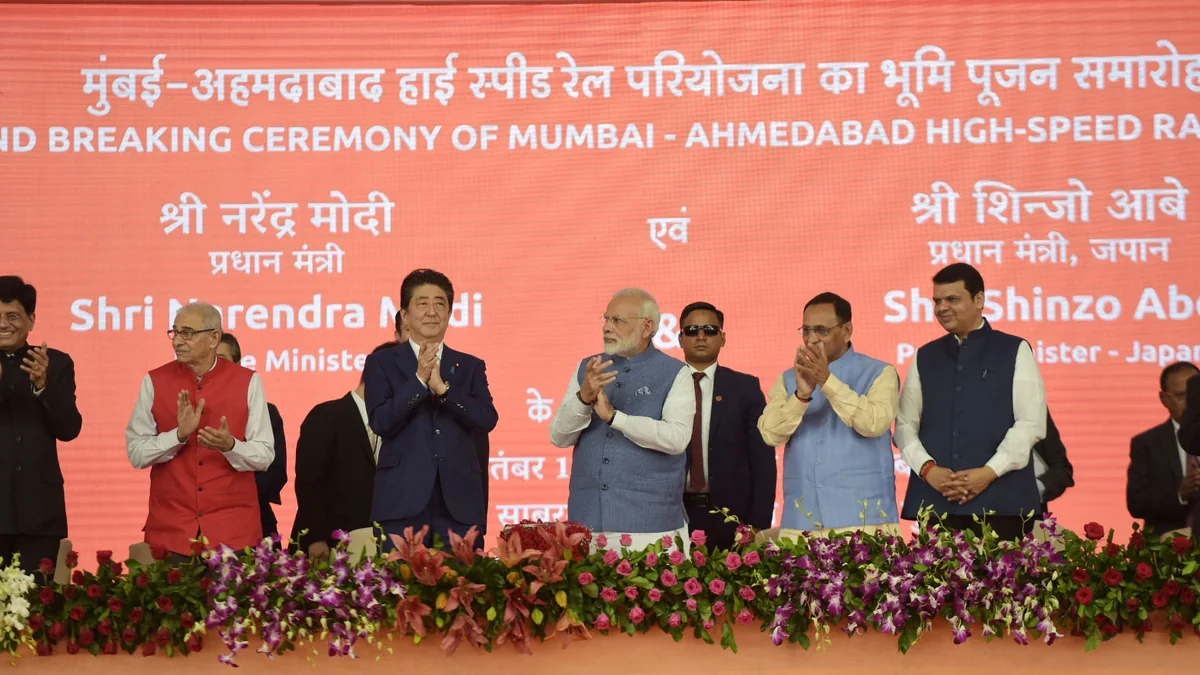
The 508-km Mumbai-Ahmedabad High Speed Rail corridor has faced delays linked to the pandemic and other project issues. The Ministry of Railways is now looking at approvals for the revised cost, while the first operational section is expected to open in August 2027.
Mumbai-Ahmedabad bullet train project cost and timeline
A proposal covering the revised Rs 2.1 lakh crore estimate was placed before the Cabinet on Tuesday. Sources quoted in the original report attributed the increase mainly to the prolonged land acquisition process in Maharashtra and delays in receiving trainsets from Japan.
The entire Mumbai-Ahmedabad corridor is now expected to be completed in 2030. Its initial section is scheduled to enter operation in August 2027, most likely between Surat and Bilimora. According to the same sources, most of the additional funding is expected to come through budgetary support.
Funding under the original Rs 1.1 lakh crore estimate has come from the Japan International Cooperation Agency and government budget allocations. Sources said the Railways has also indicated that high-speed trains will be manufactured in India, with each train expected to cost around Rs 390 crore to Rs 400 crore.
No official briefing was issued on decisions taken during the Cabinet meeting chaired by Prime Minister Narendra Modi. Earlier, in January, Railway Board chairperson Satish Kumar said the project’s estimated cost had increased by about 83% to Rs 1.98 lakh crore.
The project has experienced both schedule and cost overruns, with delays in land acquisition, statutory clearances and finalisation of the trains among the factors involved.
Don’t miss…Newport Freight Train Derailment Disrupts Freight Traffic
High-speed rail construction progresses
Construction is continuing across the corridor, with viaducts taking shape in Gujarat and Maharashtra, stations being built and tunnel construction progressing near Mumbai.
National High Speed Rail Corporation Limited is developing the line with Japanese financial and technical assistance. The project will use Shinkansen technology and include 12 stations, with trains capable of speeds up to 320 kmph.
One of the main engineering challenges is a 7-km undersea tunnel near Thane Creek. The project also includes seven mountain tunnels and 17 river bridges.
The corridor uses Japan’s J-Slab ballastless track system, which is being deployed in India for the first time. Specialised machinery is being used for track laying, alongside training for Indian engineers and technicians.
India develops indigenous high-speed trainsets
Alongside construction of the corridor, India is developing its first indigenous high-speed trainsets. Integral Coach Factory in Chennai has awarded BEML Limited a Rs 866.87 crore contract to design and manufacture two prototype bullet train sets capable of 280 kmph.
BEML is responsible for designing, manufacturing and commissioning two eight-coach high-speed trainsets. They are being developed for operating speeds of around 250 kmph and a design speed of 280 kmph. The trains are scheduled to roll out in 2027, while their designs are currently being finalised, according to sources quoted in the original report.
The trains will have fully air-conditioned chair cars, advanced onboard infotainment systems, reclining and rotatable seats, and dedicated facilities for divyangjans.
BEML has established the Aditya High-Speed Rail Complex in Bengaluru to produce the trains. The indigenous trainsets carry the B-28 codename and will be manufactured using precision-driven technologies.
Indian operating conditions are also being taken into account. While bullet trains in Japan and across Europe are generally designed to operate in cold climates, the B-28 trainsets are being developed with India’s heat and dust conditions in mind.
For the time being, Indian Railways plans to manufacture the trains using stainless steel. Railway Minister Ashwini Vaishnaw has also announced that the next generation of bullet trains will be designed to operate at speeds of 350 kmph.
Context
NHSRCL reported in July 2026 that both tunnel boring machines had begun work on the 21-km underground section in Maharashtra. The second TBM started from Sawli towards Vikhroli on July 18, after the first began its 6-km drive from Vikhroli towards BKC on July 5; the remaining 5-km section built using NATM had already been completed.
BEML documentation also provides a clearer link between the indigenous B-28 programme and the Mumbai-Ahmedabad corridor. A May 2026 tender specifies that the complete eight-car B-28, with an operating speed of 249 kmph and test speed of 280 kmph, is to undergo testing on track designated for the NHSRCL MAHSR section.
Seven more high-speed rail routes considered
The Mumbai-Ahmedabad project is also becoming a platform for India’s wider high-speed rail ambitions. Seven additional routes are under consideration, including Bengaluru-Chennai, Bengaluru-Hyderabad and Bengaluru-Pune-Mumbai.
News on railway transport, industry, and railway technologies from Railway Supply that you might have missed:
Don’t miss…LA 2028 Transit Funding Seeks $2 Billion in Support



