Driverless battery-powered shuttle EcoTrain unveiled
04.12.2025
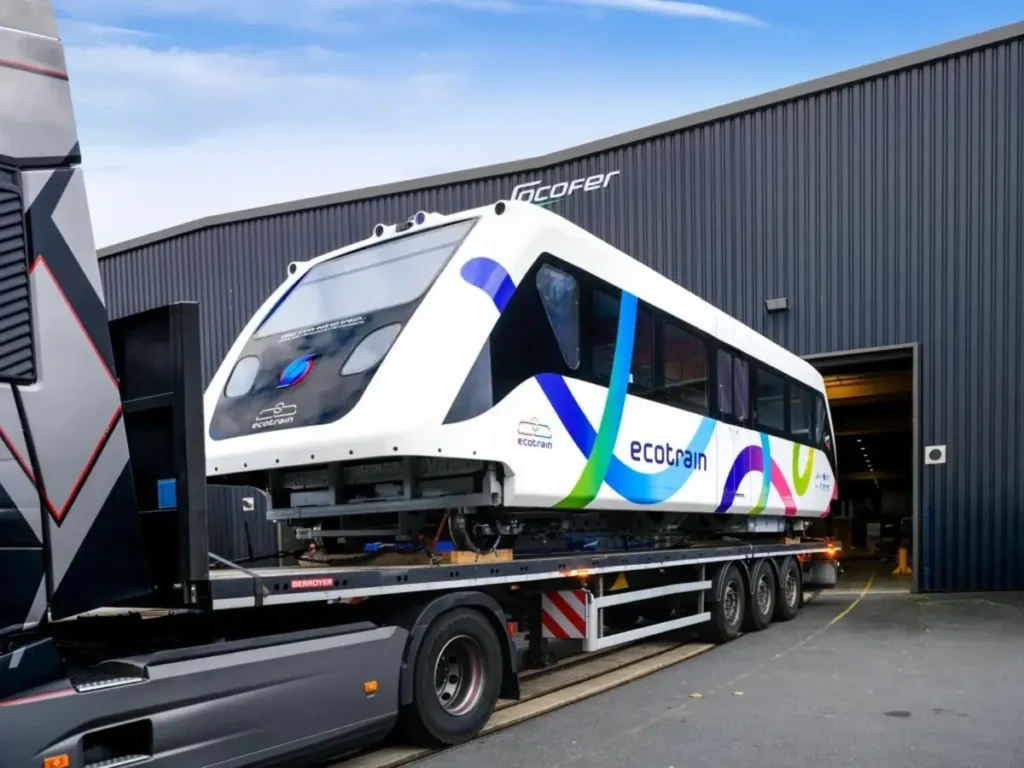
The driverless battery-powered shuttle EcoTrain has been presented in France as a new solution for low-traffic railway lines. The launch of the mixed-traffic trainset took place in Paris; it is designed to operate on sections with infrequent train movements and on loss-making routes.
This is reported by the railway transport news portal Railway Supply.
Technical parameters of the driverless battery-powered shuttle EcoTrain
The two-axle mixed-traffic shuttle EcoTrain is 12.5 m long and 2.8 m wide and is designed for an axle load of 8 t. In its passenger configuration it can carry up to 50 standing passengers, or a mix of 32 seated and 16 standing places. When needed, the trainset can also be used to move palletised freight with a total mass of up to 2.5 t, making it suitable for serving low-traffic railway lines in France.
Don’t miss…UP NS merger application delayed amid rising opposition
A lithium-ion battery system is expected to provide a range of 500 km. The maximum operating speed is stated at 70 km/h, while the permissible gradient of the line is up to 25‰. Several individual shuttles can be coupled into a train to match the needs of a specific route while retaining the driverless operating concept. A detailed description of the light autonomous train concept for small lines is also available on the Institut Mines-Télécom website.
EcoTrain trials began in September and are expected to continue throughout 2026. Entry into regular service is planned for 2029. These timelines and the key parameters of the project were outlined at the presentation by EcoTrain CEO, engineer and project initiator Philippe Bourguignon.
Project financing and partners in France
The next stage — launching a test line — will require additional funding. In the near future EcoTrain intends to announce an investment round worth between €2 million and €3 million. The project already receives financial support from the French government, which underlines its importance for the national railway network.
The initiative is being implemented by four local companies together with a consortium of universities and engineering schools under the Institut Mines-Télécom umbrella. This cooperation model is expected to support the rollout of the driverless battery-powered shuttle EcoTrain on low-traffic lines and to strengthen regional rail services.
A solution for loss-making railway lines in France and Europe
The company hopes that the new shuttle will help address the long-standing issue of loss-making railway lines. According to various estimates, such routes account for between 40% and 80% of the total length of the French network, and EcoTrain’s focus on secondary lines is discussed in detail in a Railway Gazette article. EcoTrain estimates the aggregate length of similar lines in Europe at 50,000 km, highlighting the potential for the concept far beyond France.
According to Philippe Bourguignon, passenger services using EcoTrain on low-traffic railway lines could be organised at intervals from 15 to 60 minutes. The operation of the shuttles is expected to be fully self-financing, although capital expenditure on infrastructure renewal is not included in these calculations: track modernisation is estimated at €1.5 million per kilometre.
The possibility of introducing this new operating model is currently being studied by authorities in six regions of France, where the use of EcoTrain is being considered on five railway lines. According to the head of the company, the project has also attracted interest in Poland, Argentina, Canada and countries in West Africa.
The broader development of driverless trains in France is explored in a Railway Supply article, which further underlines the relevance of the driverless battery-powered shuttle EcoTrain format for loss-making and low-traffic routes in different parts of the world.
News on railway transport, industry, and railway technologies from Railway Supply that you might have missed: