UP NS merger application delayed amid rising opposition
03.12.2025
UP NS merger application is now slated to reach federal regulators around Dec. 16, roughly two weeks later than Union Pacific and Norfolk Southern had hoped to file it this week, according to Trains.
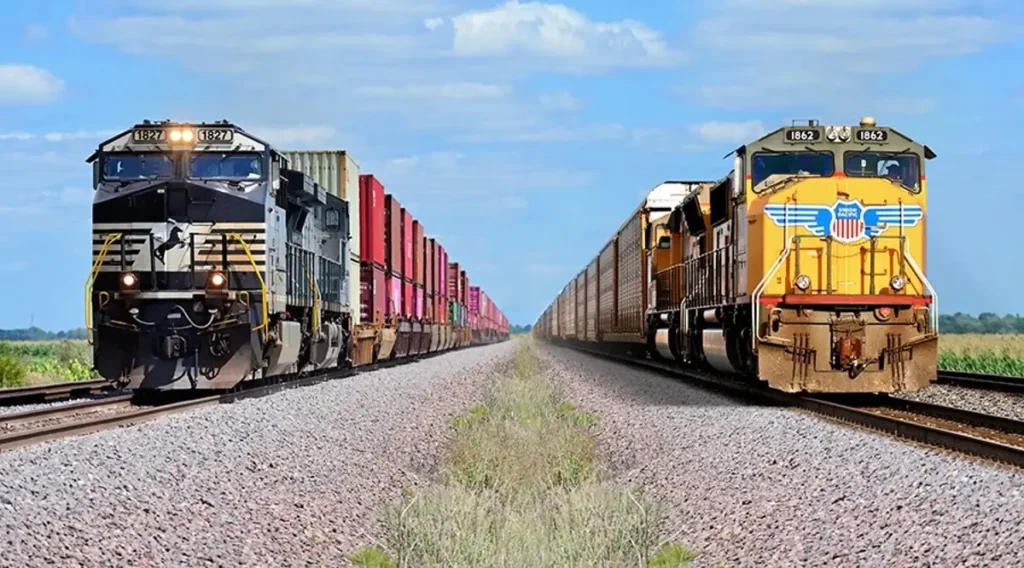
UP NS merger application delayed to mid-December
At an investor appearance on Tuesday, UP Chief Executive Jim Vena said the schedule slipped because one of the outside firms responsible for a portion of the filing needed extra time to finish its work before the massive package could go in for Surface Transportation Board (STB) merger review.
This is reported by the railway transport news portal Railway Supply.
Vena stressed that the carriers want the final product to be “exceptional” so that, when they hand it to the STB, regulators are comfortable that the railroads have answered all questions and provided the information the board is looking for.
Scope of the $85 billion Union Pacific and Norfolk Southern merger filing
The filing itself is expected to run to more than 4,000 pages, setting out the railroad’s growth projections along with its operating plan for the proposed $85 billion Union Pacific and Norfolk Southern merger.
Don’t miss…New Czech Railways night train from Prague to Ukraine border
Once the UP NS merger application is formally submitted, the STB will have 30 days to decide whether to accept it as complete or send it back as incomplete.
BNSF opposition to UP NS merger and competition concerns
While UP and NS work to finalize the documentation, other Class I railroads have intensified their criticism of the $85 billion UP–NS merger. They argue that combining the two systems would weaken competition, trigger integration-related service problems and ultimately hurt the wider economy — concerns that have also been highlighted in broader coverage of the deal, as previously covered by Railway Supply.
BNSF Railway has gone a step further by asking federal regulators to re-examine Union Pacific’s compliance with the competitive safeguards that were attached to UP’s 1996 acquisition of Southern Pacific, filing a petition with the STB that echoes issues described by Railway Age. BNSF contends that UP has repeatedly tried to restrict its access to shippers that once had both UP and SP as options and that UP has favored its own trains when dispatching on lines where BNSF holds trackage rights.
Interline partnerships vs railroad mergers
Vena, however, frames the growing opposition as a sign that rivals understand what a transcontinental UP system could offer — faster, more efficient single-line service from coast to coast. In his words, competing railroads “understand what we’re going to be able to offer” and are left asking, “How do we compete against that?”
BNSF, Canadian National and CPKC, for their part, maintain that railroads can grow by using interline partnerships instead of pursuing large railroad mergers. Union Pacific counters that such alliances are inherently temporary and cannot measure up against a merged railroad that controls shipments from origin to destination on a single network. Vena delivered these remarks at the UBS Global Industrials and Transportation Conference.
News on railway transport, industry, and railway technologies from Railway Supply that you might have missed: