Death Railway station reappears in Thailand reservoir
07.07.2026
A Death Railway station in western Thailand has reappeared after falling reservoir levels exposed remains at the Vajiralongkorn Dam.
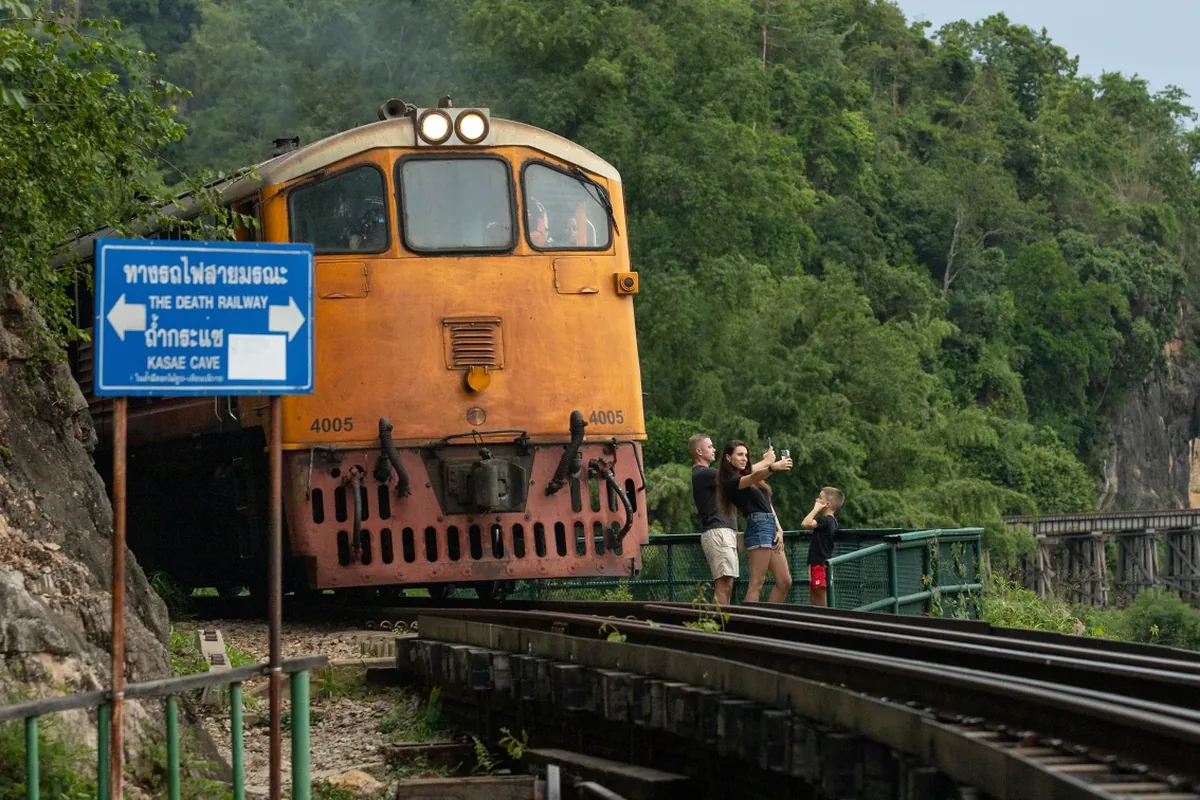
The remains are those of Nithe Station in Kanchanaburi province. For decades, the site lay beneath the reservoir of the Vajiralongkorn Dam, which is managed by the Electricity Generating Authority of Thailand.
Part of the reservoir was drained for maintenance, making the station accessible again. Researchers and historians now have only a limited period to examine the area, because dam work is due to finish in August and seasonal rains in Southeast Asia may soon raise the water level again.
Nithe Station on the Thailand–Burma Railway
Nithe Station belongs to the history of the Thailand–Burma Railway, a 415 km line built during World War II between Thailand, then known as Siam, and Burma, now Myanmar. Japanese occupation forces constructed the route as a military supply line across mainland Southeast Asia.
The railway was built with forced labour. Around 60,000 Allied prisoners of war, mainly from Australia, the United Kingdom, the United States and the Dutch East Indies, now Indonesia, were made to work on the project. They worked alongside hundreds of thousands of Asian labourers known to the Japanese as rōmusha.
The line’s later name came from that human cost. More than 12,500 prisoners of war and about 75,000 Asian labourers died during construction because of disease, starvation, exhaustion, abuse and severe working conditions.
Don’t miss…BuildersFirst Source rail-served facility opens in Colorado
Researchers document the Death Railway station
The reappearance of Nithe Station has drawn researchers seeking to document the site while it remains exposed. One of them is Martyn Fryer, an Australian independent researcher whose grandfather died as a prisoner of war on the railway after being captured in Singapore in 1942.
Fryer travelled from Perth and searched the muddy site in heat close to 38 degrees Celsius. Using a metal detector, he located spikes, fasteners and other objects connected with the old railway infrastructure.
Researchers also compared wartime aerial photographs held by the National Archives in London with hand-drawn maps brought by Andrew Snow of the Thailand–Burma Railway Centre. Their aim was to identify the locations of former prisoner-of-war camps near the station.
According to researchers, parts of the old station can sometimes be seen during dry periods. This time, however, the water dropped unusually low and quickly, before vegetation had time to cover the remains, making the site easier to examine.
A wartime site seen before the water returns
The station’s temporary return has also brought many visitors from Thailand. Photos shared on social media made the location widely known, and some people travelled long distances to see it before it disappears beneath the reservoir again.
For visitors, the site is more than an unusual historical find. It is also connected with the memory of prisoners of war and Asian labourers who died during the construction of the railway.
One Thai visitor, Channarong Noimala, rode about 350 km by motorcycle from Bangkok to reach the station. He said the site should help people remember those who died there, whether they were labourers or prisoners of war.
Hellfire Pass and the wider railway history
About 100 km southwest of Nithe is Hellfire Pass, one of the most difficult and deadly sections of the railway. Prisoners were forced to cut through the mountain under extreme conditions, and hundreds died there.
Hellfire Pass is now the location of the Hellfire Pass Interpretive Center, funded by the Australian government. Last year, the center received a record 169,000 visitors, during a year that also marked the 80th anniversary of the end of World War II.
The railway has particular significance for Australia. About 22,000 Australians became prisoners of war during the conflict, and around 13,000 of them worked on the Thailand–Burma Railway. Approximately 2,800 Australians died during its construction.
The line is also known internationally through film and literature. Its history helped inspire the 1957 film “The Bridge on the River Kwai” and the 2013 film “The Railway Man”.
The same subject was later explored in the novel “The Narrow Road to the Deep North”, which won major awards and was adapted into a miniseries released in 2025.
The renewed visibility of Nithe Station brings attention back from cultural depictions to the physical railway and the suffering behind its construction. The exposed tracks, objects and possible camp locations give researchers a chance to record details that are normally hidden under water.
Context
The reappearance of Nithe Station is significant for documentation because the Burma–Thailand Railway was more than a single track. The DVA Anzac Portal notes that, by its completion in October 1943, the line included 63 named stations, depots and trains, while smaller stations and passing loops were placed at most 10 km apart. This helps explain why an exposed station site such as Nithe can give researchers evidence about how the railway operated locally and how nearby prisoner-of-war camps fitted into the wider route.
That opportunity may soon close. If maintenance at the dam ends in August and the rainy season restores normal reservoir levels, the remains of Nithe Station will once again be covered.
For historians, documenting the site now is important because it may help reconstruct the local history of the “Death Railway” more accurately. As fewer eyewitnesses to World War II remain, places such as Nithe Station and Hellfire Pass continue to preserve the memory of individual lives and of a railway built through forced labour, suffering and the deaths of tens of thousands of people.
News on railway transport, industry, and railway technologies from Railway Supply that you might have missed: