Amsterdam Centraal bridge replacement reaches second bridge
29.06.2026
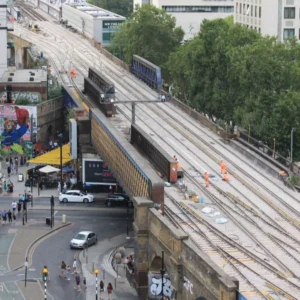
Amsterdam Centraal bridge replacement work has continued with the installation of a second railway bridge, part of a multi-year infrastructure programme to upgrade the busiest rail hub in the Dutch capital.
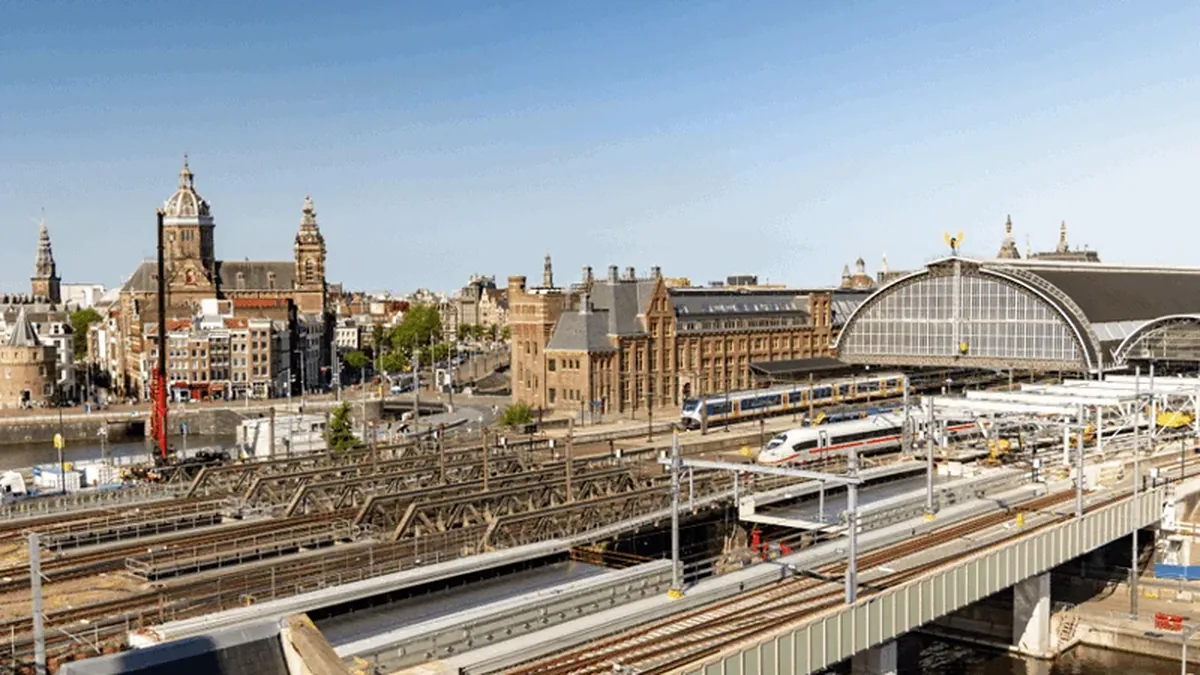
The work follows the first bridge installation completed in 2025 and is being delivered under the High-Frequency Rail Transport Programme, known as PHS and led by ProRail. The wider programme includes track works, civil engineering activities and other infrastructure changes intended to expand rail capacity at the station.
Second railway bridge installed at Amsterdam Centraal
Working with construction company Dura Vermeer, Mammoet completed the transport and installation work. Three steel bridge deck sections produced by Hollandia Infra were moved into place. The structure consists of two outer deck sections, each 28.5 metres long and weighing 275 tonnes, and one central section measuring 21 metres and weighing 175 tonnes.
Because Amsterdam Centraal Station is located in the city centre, the bridge components were brought in by water instead of road. This approach was used to reduce disruption and allow station operations to continue while the works were carried out.
The sections arrived on flat-top barges at the Oostertoegang side of the station. To pass under a low pedestrian bridge, the barges were partly submerged. The bridge sections were then turned through 90 degrees with self-propelled modular transporters and positioned for lifting.
Mammoet adapts lifting method for restricted site
The second bridge required a different installation method from the first replacement. In 2025, Mammoet used its Mega Jack 300 system for the final lift, but the latest operation had to be adapted because working space was limited between the existing bridges and the newly installed structure.
Mammoet Project Manager Leo de Vette said:
“Previously, we used our Mega Jack 300 system and SPMTs to lift and rotate all deck sections on the deck of the barge and then drive them off and into position.”
“This time, however, we are working between two bridges, so we had to consider the decks and columns of the old bridges, as well as those of the new bridge we installed last year.”
“For this reason, we had to first maneuver and rotate the new sections underneath these bridges and then jack them up using a four-point lifting system, which was assembled on the quayside.”
For the lifting stage, Mammoet used four synchronised hydraulic cylinders mounted within tracks. This four-point lifting system allowed the bridge sections to be raised and placed with precision despite the restricted working area.
PHS Programme includes further bridge replacements
The central span was installed in a separate sequence. It was first set temporarily on support consoles fixed to the two outer spans. The central bridge column was then built before the span was lowered into its final position. Each bridge section required about one week for installation.
The bridge replacement is part of wider works at Amsterdam Centraal, a station dating from 1889 and used by about 200,000 passengers per day. ProRail expects that number to rise to around 275,000 by 2030, so the programme includes changes intended to create more space for both passengers and trains.
The current works at the Oostertoegang cover the replacement of five railway bridges on the east side of the station: four steel bridges and one concrete bridge. According to Dura Vermeer, one bridge is being replaced each year from 2024, while ProRail lists the broader Amsterdam Centraal programme as running from 2021 to around 2030.
Further bridge replacements at Amsterdam Centraal Station are still planned under the continuing PHS Programme. The works are part of preparations for higher rail service levels at the station in the years ahead.