Sunnyside Yard’s 12,000-Home Revival Still Has No Federal Commitment for Its $21 Billion Deck
14.08.2026
USA: New York City is seeking more than $21 billion in federal grants to deck over Sunnyside Yard for 12,000 affordable homes, but months after the proposal was pitched to President Donald Trump, the project remains in talks with no confirmed federal funding commitment.
The intended source of the money is clearer than the recent stalled-project coverage suggests. In its February announcement, the Mayor’s Office said the discussion centered on securing more than $21 billion in federal grants to construct the deck above the rail yard. The announcement did not identify a specific grant award or committed federal program.
That distinction matters. The city has named the type of funding it wants, but it has not announced that the money has been secured. In a July update, Mayor Zohran Mamdani described Sunnyside Yard as the subject of continuing, long-term conversations because of the scale of investment and commitment required.
The $21 billion figure is a federal request, not committed money
The current figure is tied to the deck itself: the structure that would create development space above the operating rail facility. The February city release links the request for more than $21 billion in federal grants directly to construction of that deck and to the goal of building 12,000 affordable homes above it.
What the release does not provide is a line-item cost breakdown, a stated cost base year, or a named grant program that would supply the full amount. That limits how far the figure can be compared with earlier Sunnyside Yard estimates.
Don’t miss…Binghamton Selects GPI for Passenger Rail Grant Bid
Public funding was already part of the feasibility problem
The funding challenge predates the 2026 revival. The 2017 Sunnyside Yard Feasibility Study tested several overbuild scenarios and concluded that public investment would be required.
For the full-yard test cases, the study estimated total development costs of about $16 billion to $19 billion in 2017 dollars. Those figures covered both horizontal and vertical development costs and therefore are not the same thing as the current federal request for a deck. The study also calculated negative residual land values across its test cases, which it said indicated a need for public investment.
Crucially, the 2017 work did not solve the financing question. It explicitly left the specific financing, contractual and governing structures outside the study’s scope.
How the documented numbers differ by stage
| Stage | Documented housing scale | Cost or funding signal | What it establishes |
|---|---|---|---|
| 2017 feasibility study | 14,000–24,000 homes across three test cases | $16–19 billion total development cost in 2017 dollars; public investment indicated as necessary | Scenario-level feasibility, not a current deck budget |
| 2020 master plan | 12,000 affordable homes across a 140-acre planning area | The current NYCEDC project summary does not state a funding figure | The 12,000-home target predates the 2026 revival |
| 2026 revival | 12,000 affordable homes, including 6,000 Mitchell-Lama-style homes | More than $21 billion in federal grants requested for deck construction | A proposed funding path, not a confirmed award |
The comparison shows why the numbers should not be treated as a simple cost-escalation series. The 2017 figure covers complete test-case development, while the 2026 number is the amount the administration says it wants in federal grants for the deck. The scopes and price bases are different.
The 12,000-home target comes from an earlier master plan
The current housing scale is also not new. NYCEDC’s Sunnyside Yard Master Plan, released in 2020 after 18 months of public engagement and analysis, identifies 12,000 affordable homes across a 140-acre planning area, along with 60 acres of new public open space. The same NYCEDC page currently lists the master plan’s project status as “Ongoing.”
The wider rail yard is about 180 acres. Earlier planning therefore did not assume that every part of the facility would be decked. The 2017 feasibility study suggested an overall deck-coverage target of roughly 80% to 85%, leaving the most difficult areas uncovered.
The rail yard is being modernized at the same time
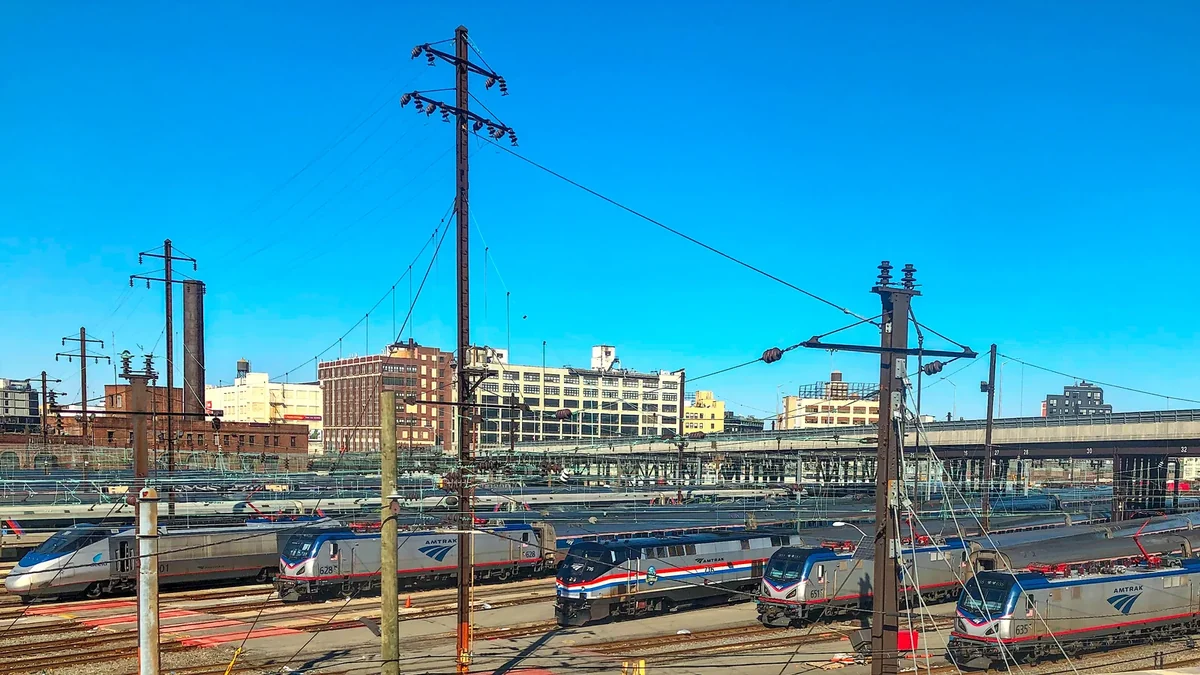
Sunnyside Yard is not vacant land awaiting redevelopment. It remains a major operating facility serving Amtrak, Long Island Rail Road and NJ Transit, and Amtrak is carrying out a separate modernization program there.
In 2025, Amtrak awarded a design-build contract for Sunnyside Yard upgrades that include a new two-track maintenance and inspection facility, six new service and cleaning tracks, work on 11 existing service platforms and changes to interlockings and track connections to the Northeast Corridor. Amtrak said the work would be phased through 2030.
That operating context was already central to the 2017 feasibility study, which said overbuild construction should be phased in close coordination with Amtrak’s yard plans so track outages could be synchronized and rail disruption minimized. The public sources reviewed do not establish how the revived housing proposal would be sequenced with Amtrak’s current modernization program.
What remains unresolved
The project is therefore more accurately described as an active planning concept with a defined federal funding request, not as a financed construction program. NYCEDC still lists the master plan as ongoing, and Mamdani says discussions continue. But the public record reviewed does not yet provide a confirmed federal commitment, a detailed current cost breakdown explaining the more-than-$21-billion deck request, or an updated implementation plan integrating the overbuild with the yard’s ongoing rail works.
That is the central feasibility gap. New York City has identified where it wants the largest tranche of enabling money to come from — federal grants — while the older technical work shows that substantial public investment was always expected. What remains missing is evidence that the funding request has become committed capital.
News on railway transport, industry, and railway technologies from Railway Supply that you might have missed: