ÖBB Railjet M faces its toughest Alpine test
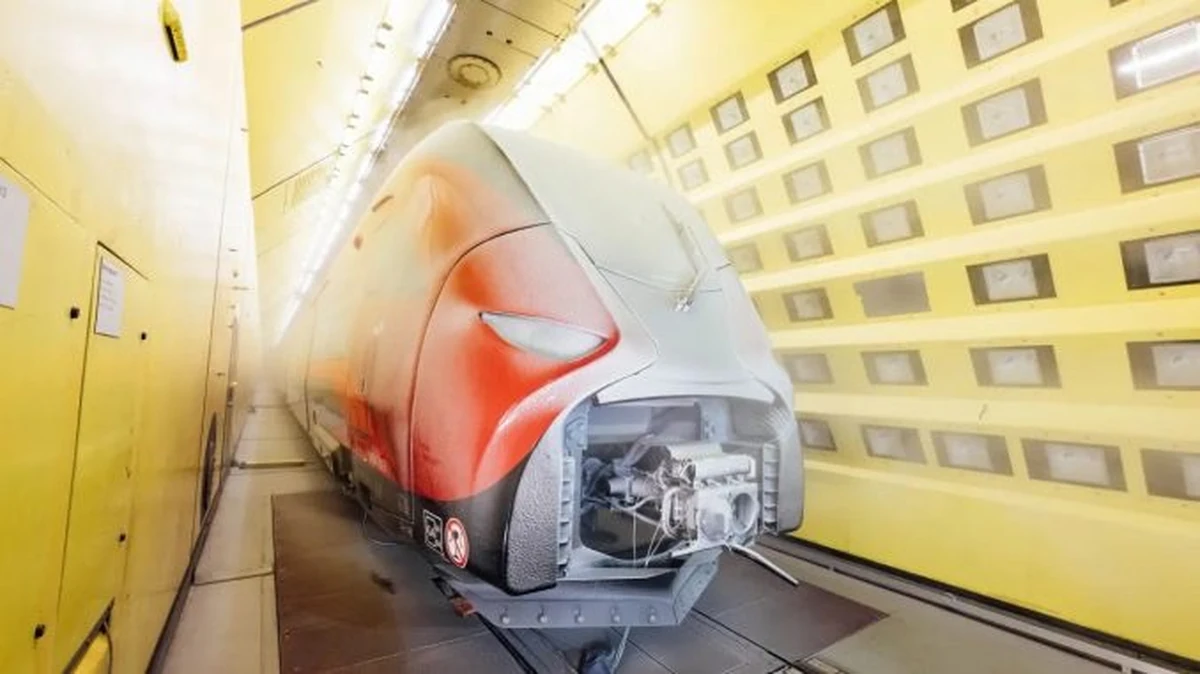
ÖBB Railjet M is now being tested in Vienna’s climate and wind tunnel, where the train is exposed to conditions close to those found on Alpine routes. Built for interregional services in Austria, it is expected to enter Interregio service from 2028, offering more capacity, modern comfort, and dependable operation in demanding environments.
Railjet M climate tunnel Vienna tests
The Railjet M climate tunnel Vienna programme puts the train through a broad set of extreme-weather scenarios. Temperatures in the tests range from -25°C to +45°C. The simulations also include intense solar radiation, strong winds, snow, high humidity, and freezing rain, as described in the official ÖBB announcement on the Railjet M climate and wind tunnel tests.
The purpose is to check how the train responds to severe conditions that can occur in the Alpine region. After each phase, specialists inspect the vehicle’s windows, doors, and technical systems to confirm their stability. The review also covers restrooms and water systems, thermal insulation, air quality, and energy efficiency under extreme operating conditions.
A train built for intra-Alpine rail transport
The Railjet M has been developed for intra-Alpine rail transport, where rolling stock faces steep gradients, winding tracks, and severe weather. These conditions require robust equipment and technical systems that can operate reliably throughout the year.
ÖBB has ordered 31 trains from Siemens Mobility. Each unit will be approximately 106 meters long, accessible to people with reduced mobility, and fitted with 257 seats, according to ÖBB’s own passenger train fleet overview.
Inside, passengers will find wider cars and a redesigned interior concept, giving the train a more spacious feel. The onboard equipment includes air conditioning, comfortable seating in second and first class, ski and snowboard racks, and bicycle storage.
ÖBB Interregio Railjet M and new rolling stock investment
Austria’s Minister of Mobility, Peter Hanke, said rail transport is a key part of the transition toward more sustainable mobility.
“Rail is a key lever on our path toward the mobility transition. That is why ÖBB is investing over 6.1 billion EUR by 2030 in the purchase of more than 300 new trains. Thus, the Railjet M will enable greater capacity and comfort on intra-Alpine routes in the future,” said Peter Hanke.
Klaus Garstenauer, a member of the ÖBB Personenverkehr management team, said the Railjet M is the selected vehicle for the new organization of intra-Alpine long-distance rail transport.
“Through the Interregio lines, we have reorganized intra-Alpine long-distance rail transport. The Railjet M is the vehicle chosen for this purpose. Tests in the climate and wind tunnels ensure that our trains will withstand even extreme weather conditions in the Alpine region and offer passengers modern comfort for long-distance travel,” said Klaus Garstenauer.
Siemens Mobility Railjet M from the Mireo family
The Railjet M belongs to the Mireo family developed by Siemens Mobility. Railway Supply has also previously covered the wider Siemens Mobility Mireo framework for ÖBB, while Tanja Kienegger, CEO of Siemens Mobility Austria, described the new trains as flexible vehicles for urban areas, Alpine regions, and cross-border routes.
“With the Mireo trains, we are bringing the latest generation of trains to Austria. As flexible vehicles, they are ready for both urban environments and alpine areas—including cross-border operations. At the same time, they are computers on wheels: thanks to their diagnostic capabilities, they will have high availability and be particularly economical to operate,” said Tanja Kienegger.
The Railjet M is planned for introduction on Interregio routes in 2028. ÖBB expects the trains to support the modernization of intra-Alpine rail transport in Austria by combining technical reliability, energy-efficient operation, and improved passenger comfort.


