Mumbai–Ahmedabad Bullet Train: 2027 First Service Expected, but Final Completion Date and Cost Remain Open
INDIA: The Mumbai–Ahmedabad High-Speed Rail project has completed civil works on the 97 km Surat–Vapi section and expanded track and electrification work, while official statements still separate an expected first service in 2027 from a final completion date and final project cost for the entire 508 km corridor.
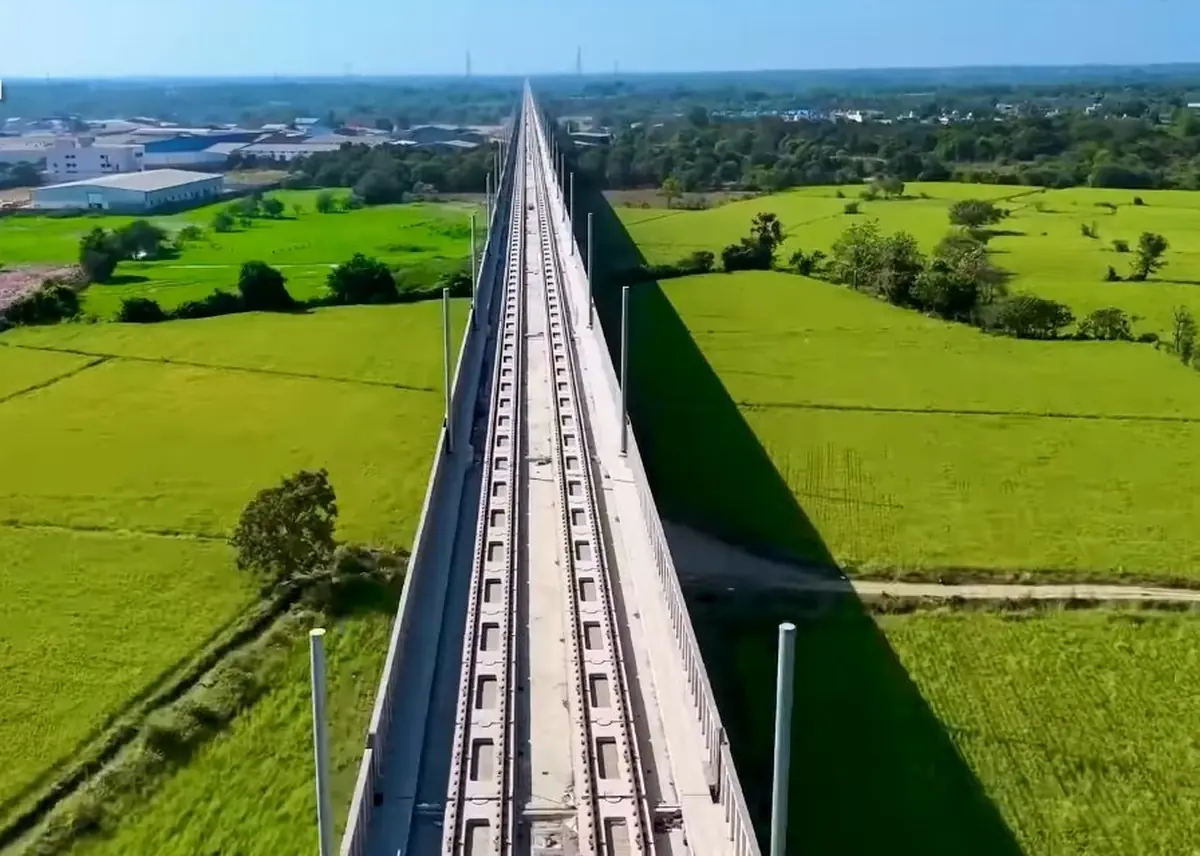
The latest construction data show why the distinction matters. Comparing official parliamentary updates from 27 March 2026 and 29 July 2026, reported track-bed progress increased by 35 km and OHE-mast progress by 37 km in just over four months. Pier construction increased by 22 km and girder work by 15 km over the same period.
| Workstream | 27 Mar 2026 | 29 Jul 2026 | Change |
|---|---|---|---|
| Piers | 430 km | 452 km | +22 km |
| Girders | 341 km | 356 km | +15 km |
| Track bed | 174 km | 209 km | +35 km |
| OHE masts | 153 km | 190 km | +37 km |
The July update also records all civil works complete on the 97 km Surat–Vapi section, including river bridges, with track bed at 86%. Across Gujarat, structural work is complete at several stations and track work has started at Surat, Bilimora and Bharuch. The project is therefore no longer a civil-construction story alone: civil structures, track and electrical work are proceeding at the same time, but they are not at the same stage of completion.
A 2027 first-service expectation is not a final corridor completion date
Official schedule statements now describe several different milestones. An August 2025 Lok Sabha reply said the Vapi–Sabarmati portion was planned for completion by December 2027 and the entire BKC–Sabarmati project was expected to be completed by December 2029. NHSRCL’s June 2026 project overview separately says the first high-speed rail service on the corridor is expected to commence in August 2027.
Those statements should not be treated as the same milestone. A first-service expectation, a planned completion date for the Gujarat portion and an expected completion date for the entire corridor describe different scopes. When Parliament asked in March 2026 whether the line and the Surat–Vapi section would be operational by August 2027, the ministry did not fix that date as the exact completion point. It said the exact timeline for the project could be reasonably ascertained only after the associated civil, track, electrical, signalling, telecommunications and trainset work is completed.
That qualification remains central to the latest progress picture. It supports reporting the 2027 service expectation, but not converting it into a firm final completion date for the whole project or describing the current position as a new delay without further evidence.
Don’t miss…LTG Cargo EuroDual Takes Shape for 5,700-Tonne Trains
₹86,939 crore has been spent, but the final outturn cost is still open
The cost picture has a similar distinction between what is known and what is not. A February 2026 parliamentary answer said ₹86,939 crore had been spent on MAHSR through 31 December 2025. The same answer said the final cost can only be reasonably ascertained after the remaining civil, track, electrical, signalling, telecommunications and trainset work is completed.
There is also a historical project estimate, but it is not a current final-cost figure. JICA’s 2023 ex-ante evaluation for the fifth Japanese ODA loan tranche retained an estimated project cost of ¥1.806282 trillion on a feasibility-study basis and explicitly said that estimate was under review by the governments of India and Japan because of subsequent changes in the economic environment and other factors.
The figures therefore answer different questions. Expenditure to date is not the final project cost, and a feasibility-study estimate that is under review is not evidence by itself of a current cost overrun. The verified position is narrower: spending is documented, an earlier estimate exists, and the final outturn cost has not yet been fixed.
Track, power and signalling now form a second layer of delivery
The remaining work is more concrete than a generic list of “systems”. MAHSR is using a Japanese Shinkansen-based J-Slab ballastless track system; an April 2026 Ministry of Railways update described track installation and the approval process required before rail welding and high-speed operation.
Electrification is also an active construction stream. The Ministry of Railways said in July that the corridor is being equipped with a 2×25 kV overhead traction system, with 14 traction substations and 16 distribution substations planned across the route and depots.
Signalling and train control still have to move through installation, integration, testing and commissioning. NHSRCL’s awarded-tenders register lists the MAHSR-S-1 package for the signalling and train-control system, telecommunications and the operations control centre, with that scope extending through testing, commissioning and comprehensive maintenance.
Rolling stock is another remaining dependency. The Government of Japan has agreed to introduce next-generation E10 Shinkansen trains on MAHSR, according to a Ministry of Railways release. The official sources reviewed for this article did not provide a trainset delivery date, so the rolling-stock schedule should not be inferred from the construction programme.
Maharashtra tunnelling remains a major unfinished civil front
Civil construction is also still active outside the completed Surat–Vapi works. The approximately 21 km underground section between BKC and Shilphata includes about 5 km built by the New Austrian Tunnelling Method and 16 km to be excavated by tunnel boring machines. The latest parliamentary construction figures record 4.8 km completed between Ghansoli and Shilphata.
The TBM phase accelerated in July. The first TBM began a 6 km drive from Vikhroli toward BKC on 5 July, while a second TBM started from Ghansoli toward Vikhroli on 18 July. That work is part of the unfinished Maharashtra scope that sits alongside track, power, signalling and rolling-stock delivery.
The result is a more precise picture than a single project-completion percentage can provide. MAHSR has crossed important civil milestones in Gujarat and has added measurable track and electrification progress since March. It also has an official expectation for first high-speed service in 2027. But the entire corridor still has major civil and railway-system work in progress, while the ministry continues to leave the exact final completion date and final cost conditional on those works and the supply of trainsets.
News on railway transport, industry, and railway technologies from Railway Supply that you might have missed: