Liquefied hydrogen supply system could double train range
10.06.2026
Liquefied hydrogen supply system technology has been developed for hydrogen trains, and KRRI expects it to more than double the current single-charge range of about 600 km.

The Korea Railroad Research Institute said on the 10th that it had completed development of liquefied hydrogen supply system technology for rail transport. On the 9th, the institute demonstrated a liquefied hydrogen-based hybrid propulsion system at its test site in Dangjin, South Chungcheong Province.
KRRI develops onboard liquefied hydrogen storage
The work is part of KRRI’s broader development of technologies for hydrogen-electric locomotives powered by liquefied hydrogen. Liquefied hydrogen is produced by cooling hydrogen to an extremely low temperature until it becomes a liquid. Because it takes up less space than gaseous hydrogen and allows a larger quantity to be stored, it is considered suitable for longer-distance rail operation.
The new system brings onboard liquefied hydrogen storage and supply together in one unit that can be installed directly on rolling stock. KRRI reduced the overall volume and weight by integrating the storage vessel and vaporizer into a single structure.
Its main components include a highly insulated storage vessel that keeps liquefied hydrogen at minus 253 degrees Celsius and a vaporization system that turns the liquid hydrogen back into gas before sending it to fuel cells. The system vaporizes the hydrogen quickly at ambient temperature and then regulates pressure so the fuel cells receive a stable supply.
Hydrogen train propulsion system uses four fuel cells
According to KRRI, the developed system is the world’s first designed to run four 100 kW-class fuel cells at the same time. The institute built a hydrogen train propulsion system by combining the fuel cells with a voltage stabilization device, battery pack, and liquefied hydrogen storage and supply system. KRRI plans further tests to verify performance under load changes and fault-response conditions.
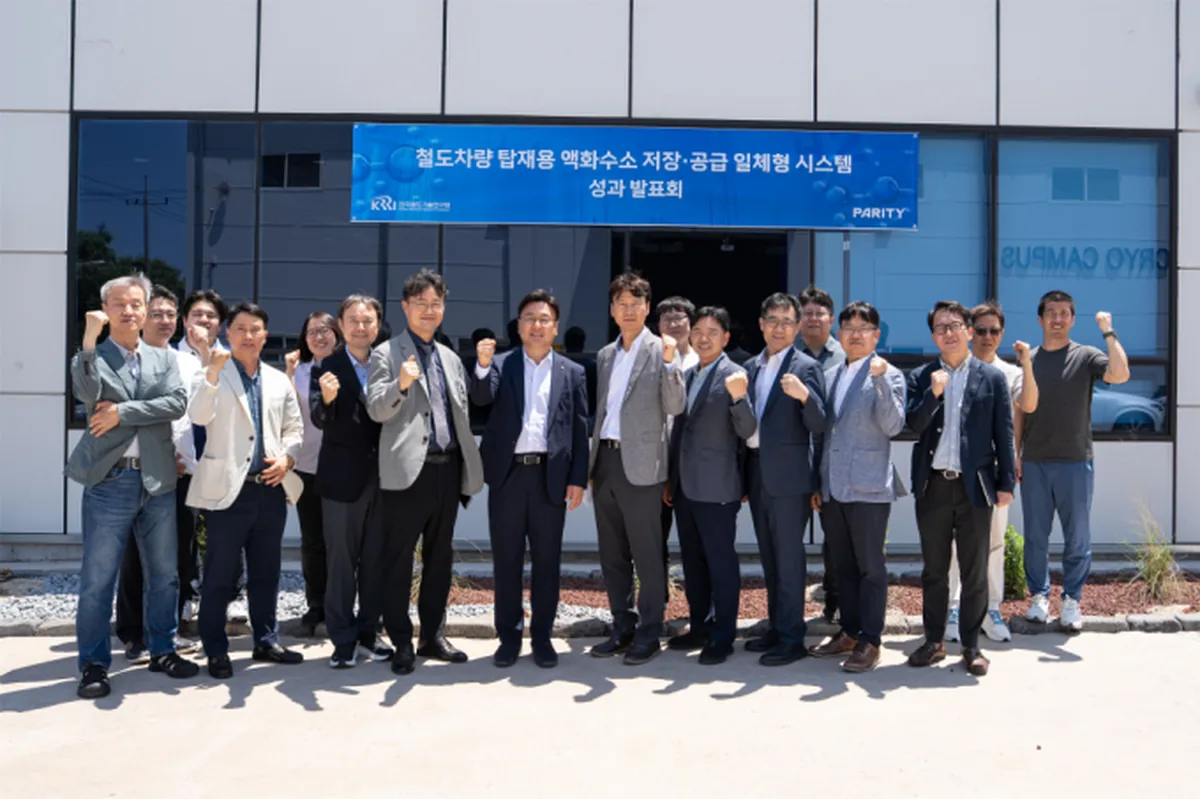
Because detailed domestic rules for the use of liquefied hydrogen are not yet in place, KRRI is carrying out the demonstration under a regulatory sandbox. The institute said it received government sandbox approval in 2023 and completed approval of its safety management plan from the Ministry of Trade, Industry and Energy and the Korea Gas Safety Corporation.
Range gains and hydrogen rail applications
KRRI expects the technology to support hydrogen trams and the conversion of aging diesel trains into hydrogen-powered rolling stock. It projects that liquefied hydrogen systems could increase the present single-charge driving range of hydrogen trains, estimated at about 600 km, by more than two times.
Principal Researcher Kim Gil-dong said, “Liquefied hydrogen technology offers higher storage and transport efficiency than conventional gaseous hydrogen and enables fast refueling and long-distance operation,” adding, “We plan to apply it first to hydrogen-electric trams to verify operational efficiency and then expand practical research.”
President Sagong Myeong said, “This technology can greatly expand the potential for using liquefied hydrogen in mobility fields that require large-capacity fuel, such as rail and ships,” and added, “We will continue to develop hydrogen rail technologies to help achieve carbon neutrality.”