KiwiRail edges past FY26 surplus target but misses injury-rate goal
KiwiRail FY26 results show a NZ$161.7m operating surplus, just above the $160m target in its Statement of Corporate Intent, alongside a $1.41bn net deficit after $1.75bn of impairments.
KiwiRail’s FY26 results release shows the operating surplus for the year to 30 June 2026 up 45.4% from $111.2m in FY25. Operating revenue grew 5.1% to $1,120.9m, while operating expenses rose 0.4% to $959.2m. The net deficit after tax widened to $1,411.9m from $422.2m a year earlier, and, in line with its Statement of Corporate Intent, no dividend will be paid for FY26.
Where the $1.41bn deficit came from
Impairments totalled $1,748.1m. The largest item was a $1,191.9m write-down of City Rail Link assets transferred to KiwiRail during the year, and a further $556.2m impairment followed the yearly review of what its rail, ferry and associated assets are worth. Separately, the fair value of investment properties fell by $197.8m, mainly on land linked to the Drury Station development.
KiwiRail says the charges are non-cash. Accounting standards require it to value assets on the commercial returns it expects to earn itself, and for City Rail Link those returns are below the construction cost. The company says the valuation movements do not affect its cash position, liquidity or funding arrangements. City Rail Link opened to passengers on 13 September 2026, after the balance date.
Shareholders’ equity still rose by $489.7m to $2,350.1m at 30 June 2026. The Vote Transport section of the FY26 Integrated Report records $1,193.6m of Crown equity injections in 2025/26 for the transfer of City Rail Link assets.
KiwiRail’s FY26 scorecard against plan
The report measures FY26 against targets in the FY26–FY28 Statement of Corporate Intent. KiwiRail met or beat its plan on operating surplus, on freight volume at 3,473m net tonne kilometres against 3,451m, on rail freight revenue of $504m against $468m and on employee engagement of 76% against 65%. Interislander reliability of 99.1% and metro punctuality in Auckland (96.4%) and Wellington (97.3%) were also above plan, and on-time, in-full freight delivery matched the 90% target.
Several measures fell short. The total recordable injury frequency rate was 21 against a plan of 15, and the freight customer Net Promoter Score improved by 2.8 points against a targeted 10. Rail freight carbon intensity was 26.3g of CO2 equivalent per net tonne kilometre against 23.9g, and the freight and property operating ratio was 73% against 71%. KiwiRail achieved five of six planned major capital milestones on the national network, five of six on the Auckland metro network and one of two in Wellington. Return on equity was minus 67% against a planned 5%, which the report attributes to the impairment charges.
| Measure | FY26 plan | FY26 actual | Target met |
|---|---|---|---|
| Operating surplus (NZ$m) | 160 | 162 | Yes |
| Services business revenue (NZ$m) | 758 | 811 | Yes |
| Rail freight revenue (NZ$m) | 468 | 504 | Yes |
| Interislander freight and passenger revenue (NZ$m) | 127 | 135 | Yes |
| Great Journeys New Zealand and commuter revenue (NZ$m) | 60 | 59 | No |
| Property revenue (NZ$m) | 75 | 73 | No |
| Rail freight net tonne kilometres (million) | 3,451 | 3,473 | Yes |
| On-time, in-full freight delivery (%) | 90 | 90 | Yes |
| Freight customer Net Promoter Score (change in points) | +10 | +2.8 | No |
| Total recordable injury frequency rate, 12-month moving average* | 15 | 21 | No |
| High-potential incident and near-miss frequency rate, 12-month moving average* | 3.1 | 2.7 | Yes |
| Employee engagement (%) | 65 | 76 | Yes |
| Interislander reliability (%) | 98 | 99.1 | Yes |
| Auckland metro punctuality (%) | 93.0 | 96.4 | Yes |
| Wellington metro punctuality (%) | 95.0 | 97.3 | Yes |
| Rail freight carbon intensity (g CO2e per net tonne km)* | 23.9 | 26.3 | No |
| Freight and property operating ratio (%)* | 71 | 73 | No |
| Major capital milestones, national network | 6 | 5 | No |
| Major capital milestones, Auckland metro network | 6 | 5 | No |
| Major capital milestones, Wellington metro network | 2 | 1 | No |
KiwiRail met 11 of the 20 plan measures listed here. The misses cover injury rate, customer score, carbon intensity, operating ratio, tourism and property revenue, and capital milestones. *For these measures a lower figure is better. Revenue is shown on the Statement of Corporate Intent reporting basis, which can differ from the financial statements. Source: KiwiRail FY26 Integrated Report, key performance measures, page 47.
Freight, Interislander and safety results
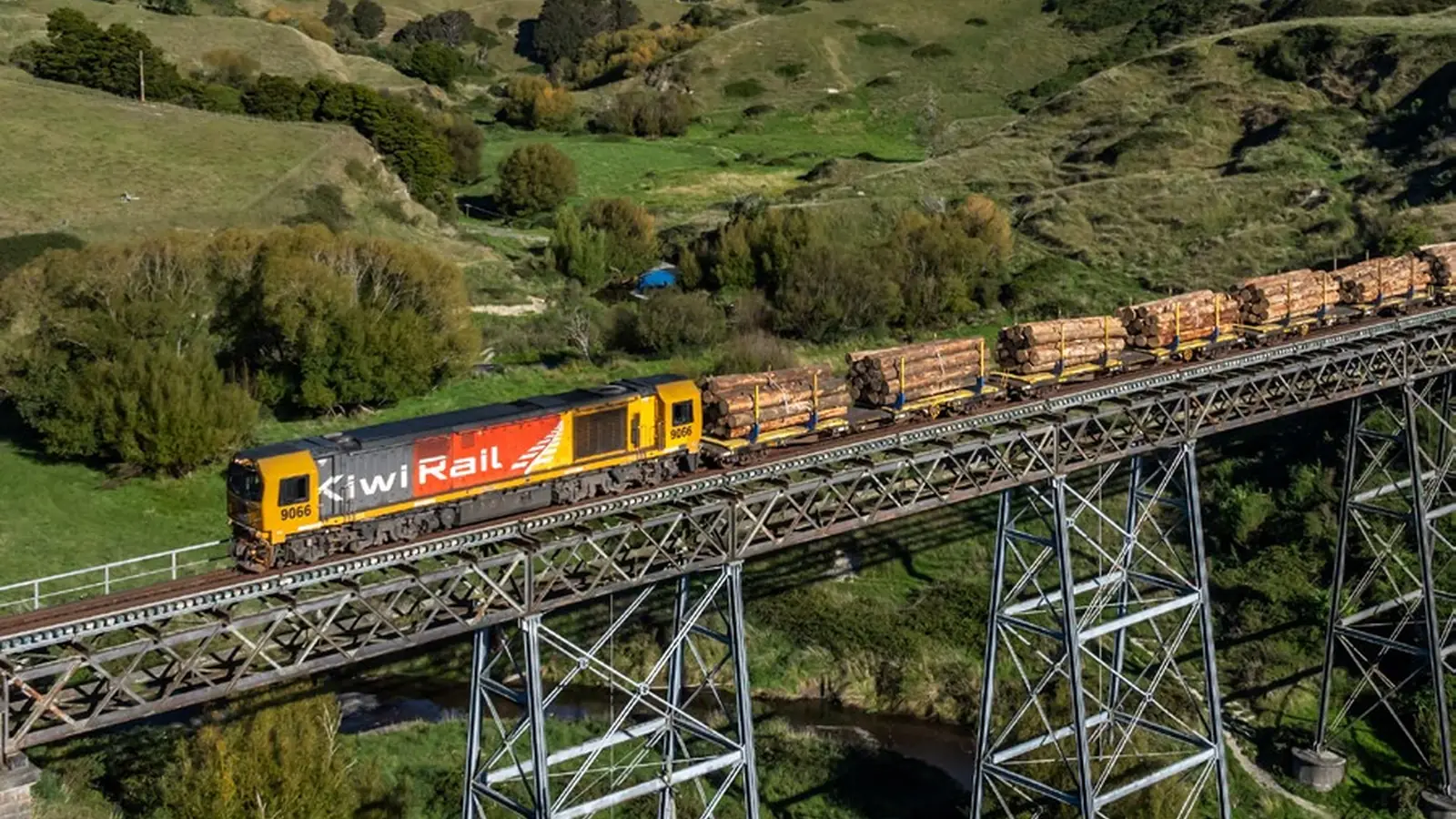
Freight revenue rose 11% to $504.4m. Net tonne kilometres increased by about 3% and tonnes carried by 1%, with gains in import and export traffic while forestry declined structurally. Export coal volumes grew 8.5% with a full year of Midland line operation after the Tawhai Tunnel reopened. On-time, in-full delivery across freight sectors reached 90%, up from 87% in FY25.
Interislander, which ran two ships for most of FY26 after the retirement of Aratere, turned an operating deficit of $11m in FY25 into a $16m surplus. Its reliability excluding weather was 99%.
High-potential safety events fell to 43 from 89, and recordable injuries fell to 214 from 242. KiwiRail was prosecuted over three safety incidents during the year. Chief Executive Peter Reidy said:
“Getting our people home safe is not a target we balance against others.”
Four years of surpluses and write-downs
The gap between the operating line and the bottom line is not new. KiwiRail’s FY24 results release reported a $105.6m operating surplus, above a $104m forecast in the Statement of Corporate Intent, and a $646.9m net deficit after $1,022.2m of impairments. The same release shows an FY23 operating surplus of $157.6m and a net deficit of $770.6m after $1,425.4m of impairments. FY25 impairments were $946.8m, so the FY26 surplus is the highest of the four years and the FY26 impairment charge the largest.
Fleet renewal and the ferry timeline
Seven Stadler DM locomotives are in service in the South Island, with six more in commissioning, and the Hillside plant in Dunedin has now assembled 1,000 new wagons. KiwiRail has been confirmed as the operator of two new rail-enabled ferries for Cook Strait, which are expected in 2029 under a programme led by Ferry Holdings.
For FY27, KiwiRail expects mixed freight demand, with forestry under pressure from softer Chinese demand and fuel-driven increases in shipping costs. The 2027–2029 Statement of Corporate Intent changes several performance measures for future reporting periods. The company’s longer-term strategy goals include 4.0bn net tonne kilometres of freight and 95% on-time, in-full delivery.


