Copenhagen M5 metro tenders valued at EUR 1.35 billion
11.07.2026
The Copenhagen M5 metro line has entered first-phase procurement, with the project intended to expand transport capacity and support development in existing and planned urban districts.
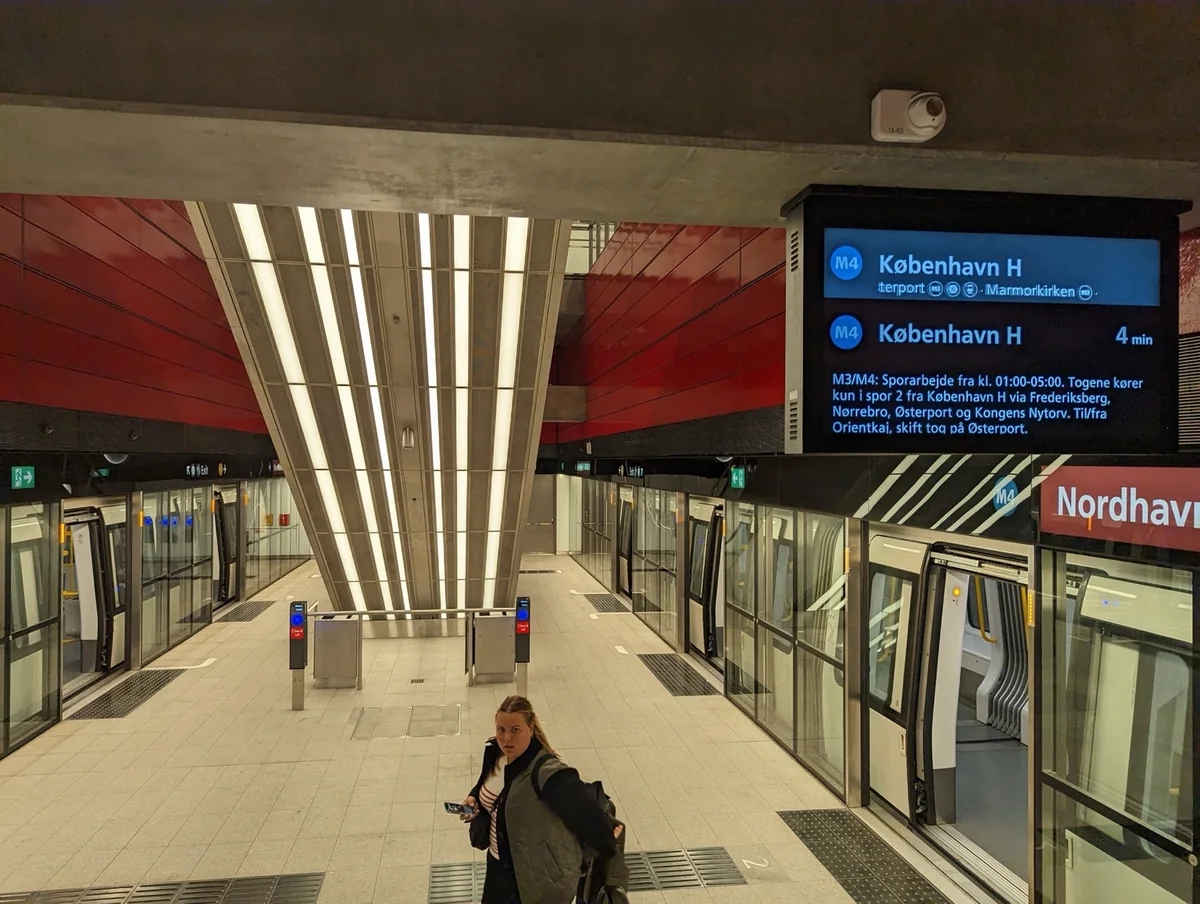
Over nearly 25 years of operation, the Copenhagen Metro has evolved beyond its original transport role. The network is now part of the Danish capital’s approach to urban planning, with metro extensions developed alongside new neighborhoods and used to improve connections across the city.
This model has encouraged Copenhagen to continue investing in public transport. The M5 Phase 1 tenders have a combined estimated value of EUR 1.35 billion and cover civil construction and the systems required to operate the automated line.
Few European capitals have seen public transport use grow as quickly as Copenhagen. Metroselskabet, which develops and manages the network, reported that the metro carried 135 million passengers in 2025. This was approximately 8% more than in the previous year and the highest annual ridership recorded by the system. The trend indicates that investment in recent years has substantially changed how residents move around the city.
Results from the M4 extension also illustrate the relationship between metro investment and urban growth. The southern extension to Sydhavn and Valby opened in June 2024 with five new stations, where passenger volumes were 50% above initial forecasts.
Havneholmen Station recorded a 22% year-on-year increase in passenger numbers in 2026 as residential and office development continued in the surrounding area. Metro stations in Copenhagen have also helped attract property investment, corporate headquarters, commercial premises, and services to developing neighborhoods.
Don’t miss…ONRSR partly lifts Southern Shorthaul Railroad suspension
The same planning approach will shape M5. Planned as a main line, it will serve established, densely populated parts of Amager in southeastern Copenhagen, along with future districts in Østhavnen to the east and Lynetteholm to the northeast. Lynetteholm is described as one of Europe’s most ambitious urban expansion projects.
Copenhagen M5 metro line Phase 1 tenders
M5 will operate independently from the existing lines and is planned with nine stations. Construction will be divided into two phases.
Phase 1 comprises six stations: five below ground and one above-ground station. Its infrastructure will include two bored tunnels extending for a combined 7 km, a 2-km viaduct, and a control and maintenance center. The first stage will also put 14 automated trains into service and install all technological equipment needed for automated operation.
Metroselskabet has opened separate procurement procedures for the two principal packages. The civil works contract is valued at an estimated EUR 800 million, while the transport systems package is worth EUR 550 million. The latter also includes the purchase of more than five automated metro trains.
The tender documentation was prepared following three years of engagement with industry participants. Through that dialogue, the contracting authority revised technical specifications and contract templates to align them more closely with conditions in the European market.
The current Phase 1 procurement applies to the southern part of the planned route, running from Copenhagen Central Station, København H, to an area north of Prags Boulevard.
Prequalification applications must be submitted by August 25, 2026. The contract award process is scheduled to run between September 16 and December 27, 2026.
Automated trains, infrastructure, and maintenance
The transport systems contract brings together the design, delivery, and integration of the principal components needed to operate M5. Its scope includes rolling stock and railway infrastructure, including a GoA4 CBTC signaling system, together with the control and maintenance center, or CMC.
Long-term maintenance after commissioning is included in the same package. The selected contractor will be responsible for maintenance activities, preparing maintenance plans, and training staff.
The transport system and related maintenance services will be procured as a single integrated contract, with one bidder chosen to deliver both elements.
Three optional extensions of scope are also included. They cover the acquisition of up to five additional trains, an extension from Prags Boulevard to Refshaleøen, and another section linking Refshaleøen with Lynetteholm.
The contract covers planning, design, manufacturing, testing, commissioning, and final handover. The trains will be developed for the particular requirements of the Copenhagen project and supplied in relatively small batches. This refers to initial deliveries of 10–30 vehicles through one contract, without any guaranteed follow-on orders.
The first section of M5 is scheduled to begin carrying passengers in 2036.
Design-and-build contracts and shared risks
Both major contracts will follow a design-and-build model, although Metroselskabet will apply different award procedures. Competitive dialogue will govern procurement of the transport systems, while the civil works package will use a negotiated procedure.
The contracting structure also introduces mechanisms for distributing project risks. One is a geotechnical baseline under which the beneficiary accepts part of the risk associated with geological conditions.
Another is a “pain/gain” arrangement. Under this model, Metroselskabet and the contractor share both cost overruns, described as “pain,” and achieved savings, or “gain,” according to a distribution formula agreed by the parties.
The approach reflects a broader trend in major European infrastructure projects, where cooperation between the beneficiary and industry begins during the earliest design stages rather than focusing solely on the submitted price.
M5 opening plans and network connections
M5 is designed to add capacity across the metro system as well as extend its geographic coverage. The existing harbor crossing is currently among the busiest parts of the network, and the authorities expect Copenhagen’s continued development to place additional demands on the infrastructure.
As an automated line, M5 will support the planned increase in capacity. The longer-term program also provides for a northern section, whose final part is expected to enter service in 2045. These later works appear in the transport systems procurement as contractual options.
A further extension is also under consideration and would turn the route into a circular line. This remains part of Copenhagen’s long-range approach to urban mobility.
Interchange connections are planned with all four existing metro routes: M1, M2, M3, and M4. Passengers will also be able to transfer to regional and long-distance rail services and the S-train network. These links are intended to reinforce Copenhagen Central Station’s function as an intermodal hub.
Station design and carbon targets
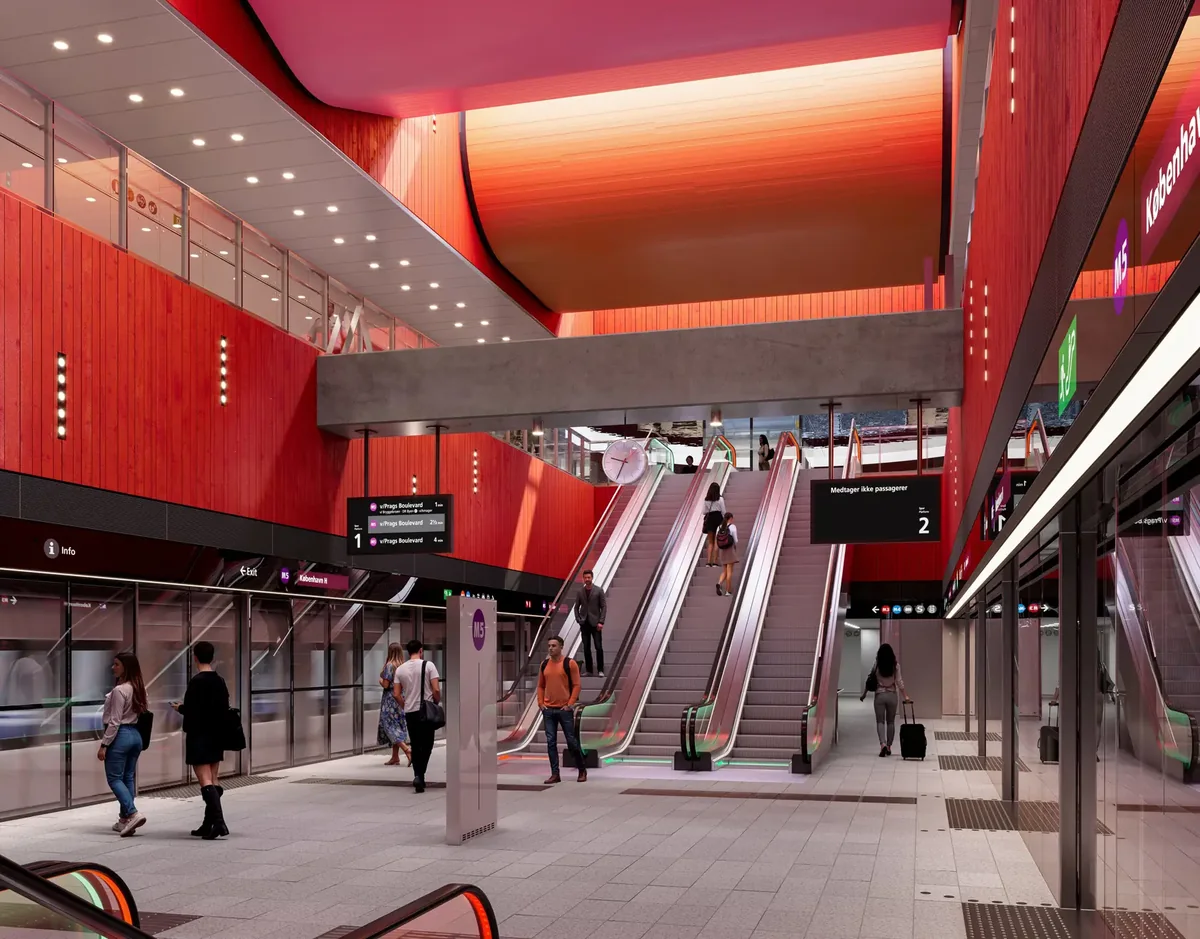
Passenger experience is also part of the project scope. Plans call for more daylight inside stations, clearer spaces for passenger orientation, and, at selected locations, direct routes between street level and platforms.
Each station’s architecture is intended to reflect the character of its surrounding district. More compact structures and a restricted range of construction materials will also support Metroselskabet’s target of cutting the line’s carbon footprint by 50% compared with metro routes built previously.
Within this model, M5 is treated not only as transport infrastructure but also as part of Copenhagen’s climate and urban development strategy.
Metroselskabet CEO Mikkel Kjær Jensen said:
“The new line will further strengthen the links between different areas of the city and create stronger connections both between existing neighborhoods and to new urban development areas,”
Reducing carbon dioxide emissions is a stated priority for the M5 project. The civil infrastructure contract sets mandatory carbon-footprint reduction targets. Equivalent principles apply to the transport systems package, including the design of the new control and maintenance center, which must comply with high energy-efficiency and sustainability standards.
The EUR 1.35 billion entering procurement covers the two principal contracts for M5 Phase 1, not the full cost of the line. Metroselskabet’s 2025 annual report places the total M5 construction budget at DKK 23.4 billion in 2025 prices, including contingency reserves. The estimate is based on the project economics agreed in March 2025 and covers the wider two-phase program, while the current tenders concern civil works and transport systems for the first section scheduled to open in 2036.
News on railway transport, industry, and railway technologies from Railway Supply that you might have missed: