Canada’s TSB seeks better wheel detector analysis after flagged wheel broke
Canada’s safety board wants Transport Canada to improve analysis of wheel impact load detector data after a CN wheel flagged for removal failed, derailing 18 cars in Alberta in 2023.
The Transportation Safety Board of Canada (TSB) set out recommendation R26-02 on 24 September 2026, together with its investigation report R23E0029. It asks Transport Canada to develop better analytical methods for that data with rail industry stakeholders and to test how well they work. The goal is to spot, in real time, wheels that deteriorate progressively and could suffer a sudden rim failure in service, and to use the results to get those wheels off the network in time.
How the Uncas derailment unfolded
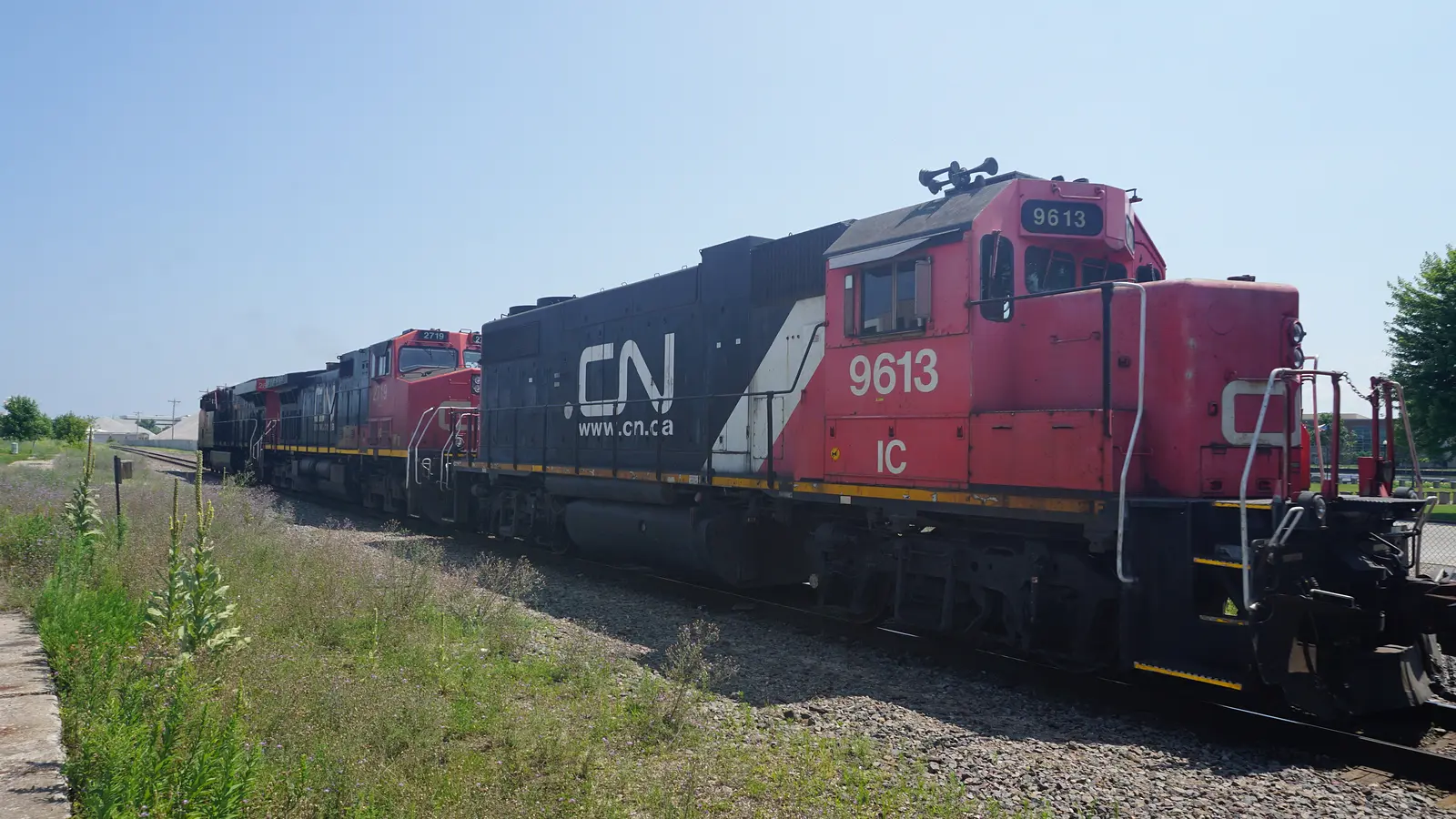
On 5 April 2023, a westbound CN freight train on the Wainwright Subdivision near Uncas, Alberta, went into an emergency brake application initiated by the train itself. The conductor then walked the train and found 18 cars off the north main track. Grain poured out of cars that had overturned or split open. Nobody was injured.
Investigators traced the derailment to a shattered rim on one wheel. Each time the damaged wheel struck the rail, it wore further and cracked the rail at several points, and those rail breaks brought the cars down. Crews had checked the train visually several times in the days before, as the rules require. None of those checks found a problem with the wheel.
Broken CN wheels by failure mode, 2013–2018
| Failure mode | Wheels | Share of total |
|---|---|---|
| Vertical split rim | 183 | 63% |
| Broken or chipped flange | 71 | 24% |
| Shattered rim | 19 | 7% |
| Cracked wheel plate | 16 | 6% |
| Total | 289 | 100% |
Shattered rims, the failure found at Uncas, accounted for 19 of the 289 broken wheels CN removed in Canada over those six years.
In 14 of the 289 cases, or 5%, the broken wheel was discovered only after a derailment. Figures and shares as published by the TSB in report R18W0007 in 2019.
A wheel already marked for removal
Some wheel defects can escape an inspector’s eye and still hammer the rail with extra force. Railways therefore install wheel impact load detectors (WILDs) beside the track to measure those forces and flag damaged treads.
In this case the detectors did flag the wheel. One reading had reached the removal threshold set by industry rules and CN’s WILD policy. CN planned to take the wheel out of service in Edmonton, but it broke before the train got there. Its record showed that peak impact forces had grown at each detector site the train passed.
According to the TSB, railways judge each WILD reading separately instead of following how a wheel’s readings change over time or how quickly it is deteriorating. A wheel that is failing fast can then look like any other source of high impact.
To test the alternative, investigators ran an exploratory analysis of detector data from Uncas and from three other recent derailments that involved broken-rim wheel failures. The TSB found that trend-based analysis of data the railways already hold can identify high-risk wheels earlier and cut the chance of such derailments.
“Advanced analysis of data that is already collected can help identify wheel condition issues early,” said TSB Chair Yoan Marier.
Older wheels without a replacement plan
The failed wheel dates from 1991, twelve years before the Association of American Railroads (AAR) introduced steel cleanliness standards in 2003. According to the TSB, wheels of that age may carry larger or more frequent flaws below the surface, which make sudden failure more likely. No proactive plan exists to replace them, the board added.
The board recorded this as a safety concern rather than a formal recommendation. In its view, reprofiling pre-2003 wheels and putting them back into service keeps the risk of a sudden rim failure and a derailment on the network.
The TSB flagged wheel detector limits in 2019
The issue is not new for the board. In findings released in November 2019 on a January 2018 derailment of 23 CN cars near Rennie, Manitoba, the TSB described a comparable case. That wheel topped the AAR Rule 41 condemning limit of 90 kips five times in two days. CN’s own guidelines let the car run on to the next inspection point, and the wheel broke roughly 4.5 hours after a 109-kip reading.
The full report listed wheel impact trending among the detection methods the industry was still researching. It also recalled that Transport Canada had promised a joint review with industry after a TSB advisory letter on broken wheels in December 2011. By 2019, the TSB saw no significant progress on WILD guidelines, standards or rules.
Single-reading wheel impact thresholds in 2018
| Measured peak impact | AAR Rule 41 | CN guidelines |
|---|---|---|
| 80 to under 90 kips | Wheel may be condemned whenever the car is in the shop or on a repair track | Wheel set is changed during a shop or repair-track visit |
| 90 to 139 kips | Wheel may be condemned at any time, but immediate removal is not required | Treated as an opportunistic repair: the wheel set is replaced at the next certified car inspection location, loaded or empty |
| 140 to 149 kips | No separate level | Train slowed to 5 mph below its speed at the detector (10 mph at −25 °C or colder), car set out, wheel replaced before release |
| 150 to 159 kips | No separate level | Train slowed to 10 mph below its speed at the detector, car set out, wheel replaced before release |
| 160 kips or more measured, or 200 kips or more calculated | No separate level | Train held to 25 mph, car set out at the terminal or first designated siding, wheel replaced before release |
In 2018 both sets of rules acted on a single peak reading, without looking at how a wheel’s readings changed from one detector to the next.
One kip equals 1,000 pounds of force. Thresholds as the TSB described them in report R18W0007, published in 2019. Current AAR and CN thresholds may differ.
Transport Canada has 90 days to respond
Recommendation R26-02 is addressed to Transport Canada. Under the Canadian Transportation Accident Investigation and Safety Board Act, the minister must answer the board within 90 days of receiving a recommendation.


