Australind trains return to Perth–Bunbury line
06.07.2026
The first of four Australind trains built by Alstom has entered passenger service in Western Australia, restoring travel on the Perth to Bunbury line after its closure in 2023.
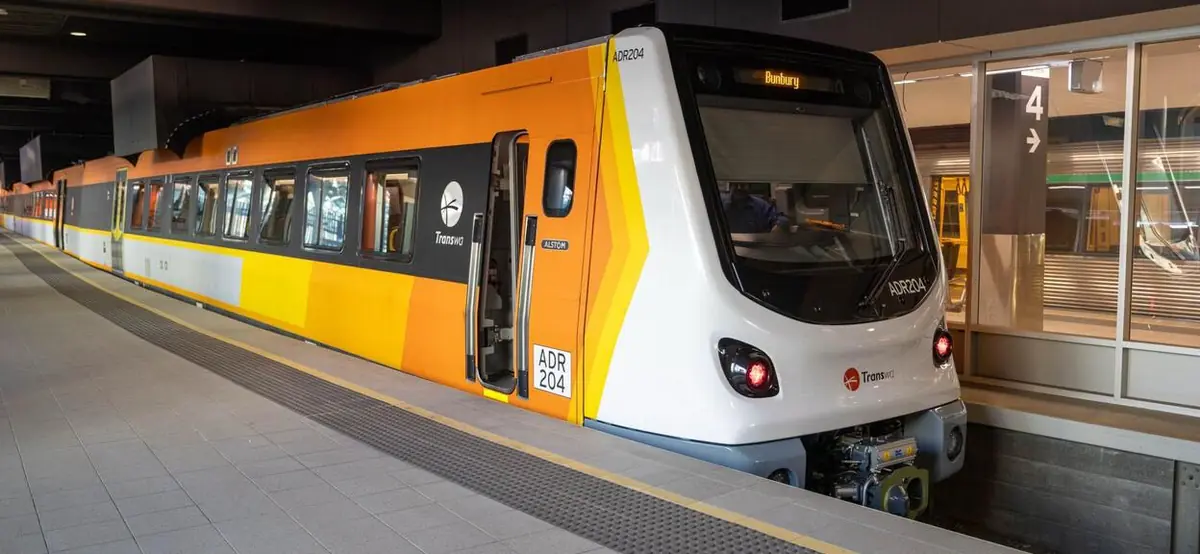
Australind trains return to the Perth to Bunbury line
The first train, named Marley, carried its first passengers on 29 June and completed the Perth to Bunbury journey in two and a half hours. The trip concluded with a major community event in Bunbury. Alstom said on 2 July 2026 that the first train had entered passenger service.
The new Australind fleet is being produced locally at Alstom’s Bellevue site in Western Australia. The trains replace railcars that began operating in 1987 and bring a more modern passenger environment, with improved accessibility, additional space for wheelchairs and bicycles, and an onboard buffet.
Passenger features include contemporary interiors, LED lighting, in-seat USB-C charging and Aboriginal artwork designed to reflect the identity of South West Western Australia.
Guillaume Tritter, Managing Director Alstom Australia and New Zealand, said:
“The ongoing investment and partnership of the West Australian Government has been critical to restoring not just the Perth to Bunbury service, but the continuity of local rail manufacturing, the local supply chain and high skilled jobs in the State. The first Australind trip is a milestone only made possible because of our incredible local workforce and the deep partnership we have with the West Australian Government”.
Don’t miss…Cambridge South station opens for passenger services
WA Railcar program supports local manufacturing
The trains are part of the WA Railcar program, which was awarded to Alstom in 2019 and is valued at around 800 million euros, or 1.3 billion Australian dollars. Under the program, Alstom is supplying 252 railcars for 41 electric multiple units and 12 railcars for four diesel multiple units from its facility in Bellevue.
The program has also brought train manufacturing back to Western Australia. It includes 50% local content on the C-series trains, local suppliers, hundreds of jobs, apprenticeships, and an Aboriginal pre-employment program delivered with Northern Metropolitan TAFE.
The four Australind trains have been named Marley, Kwilena, Koombana and Linda following public suggestions. They will be introduced into passenger service progressively while Alstom continues building, testing, commissioning and maintaining the DMU and EMU fleets.
Passenger features and fleet capacity
Each Australind train can accommodate 158 seated passengers, six wheelchairs and 14 bicycles. The trains also include fully accessible toilets, wifi, luggage storage and USB-C charging points.
Tritter added:
“This is a locally built train, combining our global technological excellence in rail manufacturing with local Australian knowhow to deliver a great outcome for the people and communities of South West WA, ”
What changes for passengers?
The restored Australind service is returning in stages rather than immediately as a full train-only operation. In the first stage, Transwa says the new train is running one return service between Perth and Bunbury four days a week, on Sunday, Monday, Wednesday and Friday. Road coach services will continue to operate alongside the train while the remaining railcars complete testing, with full services expected to resume after testing is completed in late 2026.
The Australind and C-series trains for Perth’s expanding rail network are X’trapolis trains from Alstom’s Adessia commuter rail portfolio. The portfolio is designed for city and suburban networks, with the aim of supporting rising commuter demand and helping reduce road congestion. Alstom says more than 60 commuter systems worldwide carry over 20 million passengers each day on its commuter trains.
News on railway transport, industry, and railway technologies from Railway Supply that you might have missed: