ARTC digital train authorities pass 1,500 km, Nullarbor rollout due 2027
ARTC Electronic Authorities now deliver train movement permissions digitally to locomotive cabs on more than 1,500 km of track between Broken Hill and Stockinbingal in regional New South Wales.
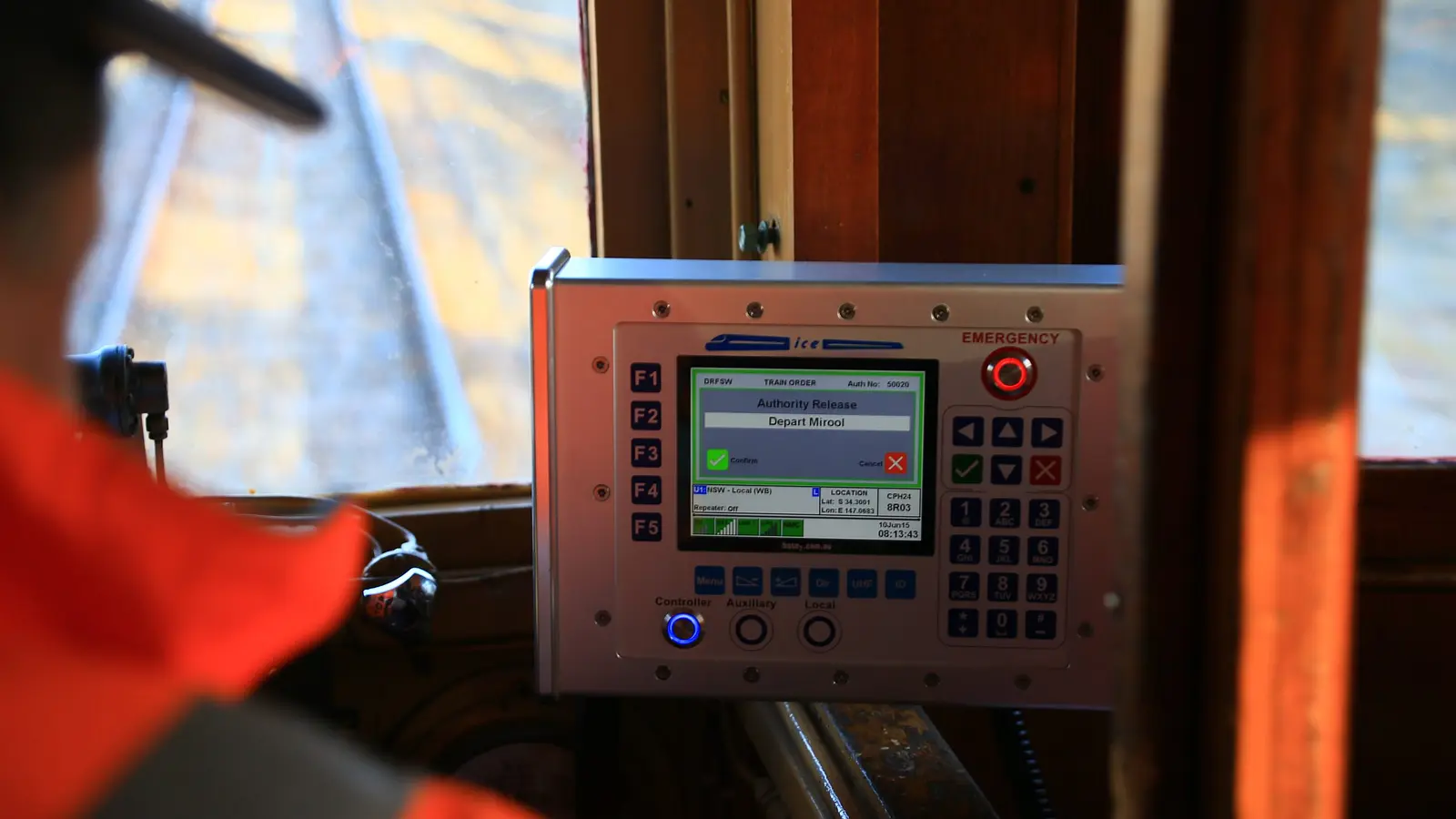
The Australian Rail Track Corporation now sends these permissions digitally, straight to equipment that locomotives already carry, so trained crews no longer have to write them down by hand. The change took effect on 21 September 2026, and the voice and paper method remains in use for crews not yet qualified for Electronic Authorities and whenever electronic transmission is unavailable.
An authority is the permission a driver needs before entering a given stretch of line. It sets how far the train may go and lists any conditions attached to that move. Under the voice and paper method, network controllers read these instructions out over the radio, and drivers wrote them down before repeating them back to confirm.
How TMACS delivers the authorities
Controllers at ARTC’s Junee and Broadmeadow centres issue the same permissions via the Train Management and Control System, known as TMACS. When an Electronic Authority is used, the data appears on the cab equipment instead of being dictated. ARTC says this cuts routine radio traffic and manual handling, lowers the chance of mistakes and gives crews a clearer view of where they are cleared to run.
There is an added safety layer as well. The system alerts the driver as the train nears the limit of its authority, and an alarm goes off if the train runs beyond it.
Existing cab equipment and the trains covered
ARTC chose to work with the cab hardware operators already have instead of requiring a new onboard system across their fleets, which the company says avoids extra cost and complexity.
Both freight and passenger trains use the digital authorities. On the freight side, they cover grain trains heading to Newcastle and Port Kembla as well as intermodal and mineral sands traffic. Passenger users include the Indian Pacific and the Broken Hill Explorer.
Colin Hughes, Chief Technology and Transformation Officer at freight operator Pacific National, said:
“The result is a safer operating environment for our people and greater operational efficiency for our business, helping us move freight more reliably across regional and interstate networks.”
Tarcoola–Kalgoorlie and Benalla–Oaklands rollouts
ARTC also presents the change as a step towards interoperability. Long-distance freight trains cross several networks that may run different systems and procedures, and the company says digital authorities help trains and crews work across those boundaries. It places the work within the federal government’s National Rail Action Plan.
Work is also under way across the Nullarbor. ARTC plans to bring TMACS to the 1,276 km stretch between Tarcoola and Kalgoorlie on the East–West corridor, with completion scheduled for the second quarter of 2027. It is also advancing digital authorities on the Benalla–Oaklands line, which links Victoria and New South Wales.
TMACS supplier 4Tel won the contract to extend the system to Tarcoola–Kalgoorlie in June 2025. Under that contract, the system’s servers for the corridor will be located at ARTC’s Network Control Centre West in Adelaide, and TMACS will be integrated with eTAP, ARTC’s mobile app for track workers and track vehicles.
| Section | Length | Technology | Status |
|---|---|---|---|
| Broken Hill–Stockinbingal, New South Wales | More than 1,500 km | Electronic Authorities via TMACS | In operation since 21 September 2026, alongside the voice and paper method |
| Tarcoola–Kalgoorlie, East–West corridor | 1,276 km | TMACS | Completion scheduled for Q2 2027; contract awarded to 4Tel in June 2025 |
| Benalla–Oaklands, Victoria–New South Wales | Not stated by ARTC | Electronic Authorities | In progress |
| Country Regional Network, New South Wales (not ARTC) | 2,200 km | Electronic Authorities via TMACS | In service since June 2015 |
ARTC uses Electronic Authorities on more than 1,500 km in New South Wales today, while work continues on the Nullarbor and on a line crossing into Victoria. Sources: ARTC, ARTC network notice, ARTC project page, 4Tel, 2025, 4Tel, 2015.
Country Regional Network, ATMS and the ETCS decision
ARTC’s lines are not the first in New South Wales to receive train authorities this way. On the separate Country Regional Network, then managed by John Holland Rail, electronic authorities went into service in June 2015 across 2,200 km of track, according to supplier 4Tel, again using communications equipment already fitted in locomotive cabs.
A different system was once lined up for the Nullarbor. A federal ministerial release said ARTC’s Advanced Train Management System (ATMS) was operating between Port Augusta and Whyalla and that planning for its deployment between Tarcoola and Kalgoorlie was under way. Separately, in August 2025 federal and state transport ministers agreed that new digital train control and signalling systems on the National Network for Interoperability must meet European Train Control System (ETCS) standards.