Oslo S Station expansion to reshape Norway rail hub
26.06.2026
Oslo S Station expansion is set to reshape Norway’s main rail hub and the urban area around the country’s busiest railway station. The project is planned as more than a station refurbishment, since Norwegian authorities and rail infrastructure stakeholders see the future capacity of Oslo’s transport system as closely tied to how Oslo S handles rising passenger demand.

Oslo S is Norway’s main railway hub. It brings together regional, long-distance, airport and commuter services, with around 150,000 passengers using the station each day. Planning estimates point to a substantial rise in traffic between 2040 and 2050. Oslo’s climate strategy also seeks to make public transport, walking and cycling the main forms of mobility in the city, adding further pressure on rail infrastructure.
The “Nye Oslo S” project, or “New Oslo Central Station,” is therefore being developed as a long-term investment in both the rail system and the surrounding city space. Its purpose is to prepare the station for the coming decades by improving capacity, accessibility and connections, while reshaping the area into a more integrated urban centre built around sustainable mobility.
The redevelopment is estimated at more than EUR 520 million. The regulatory plans are now moving through formal political consideration, and construction is expected to start after the Oslo City Council gives official approval to the master plan.
Bane NOR tender covers platform modernization
In June, Bane NOR, Norway’s railway infrastructure manager, opened a tender for platform modernization at Oslo S. The aim is to secure universal access at the country’s busiest station. The work will be delivered through a design-and-build contract with integrated collaboration, with the start of works scheduled for 2028.
The first stage covers the rebuilding of at least four of the station’s ten platforms so that they comply with universal accessibility requirements. Those platforms currently handle about 70% of all traffic at Oslo S.
The contract also includes options for the modernization of six further platforms. It also covers related work on tracks, power supply and signaling. Another planned element is a rail loop designed to improve operational flexibility for trains in the area of two other platforms.
Oslo S Station expansion plans capacity for decades
A central part of the Oslo S Station expansion is preparing the hub for future growth in rail capacity in the Norwegian capital. The planning documents set aside space for a new underground rail tunnel and for through lines across the station. These elements are regarded as necessary for increasing the number of trains that can pass through Oslo in the future. According to Bane NOR, the proposal is intended to keep the station optimal for the next 150 years, and the project is due to be presented to the public in April 2026.
More specifically, the redevelopment would create the conditions needed for a new underground railway structure. This could allow Lines 14 and 15 to be converted into through lines, removing operational constraints associated with the current terminus-style layout. For rail specialists, this is likely to be the most important element of the plan, because it would allow capacity to be expanded without a full reconstruction of the entire rail hub.
The project also provides for improved access to platforms and a reorganization of passenger movement inside and around the station. The plans include new entrances, more efficient links between different transport modes, and a clearer distribution of pedestrian flows to support higher passenger volumes.
Active mobility is also part of the investment package. At least 1,000 bicycle parking spaces are planned, in line with Oslo’s climate objectives. The municipal climate strategy aims to cut direct emissions by 95% compared with 2009 and to strengthen the position of public transport within the city’s mobility system.
Nye Oslo S to become a new urban hub
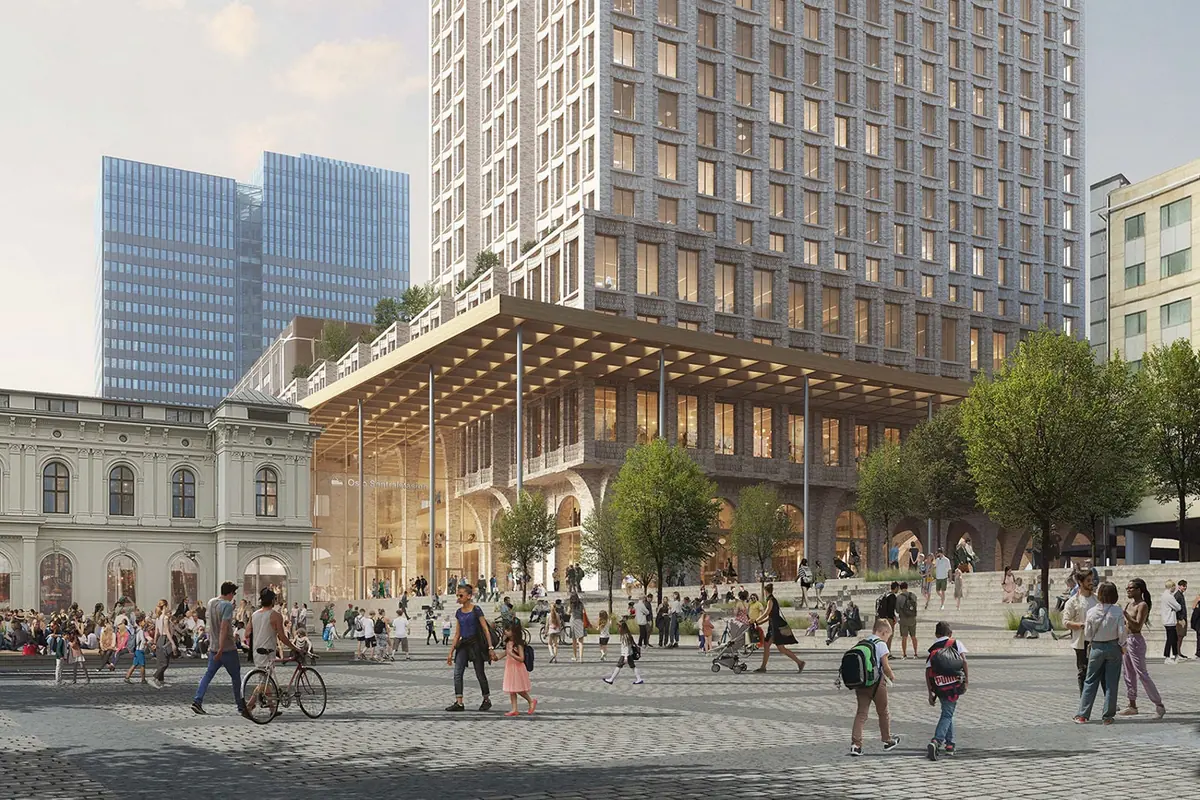
The redevelopment of Oslo S extends beyond railway infrastructure. It also includes a broad redesign of public areas around the station and a large urban development component intended to create a new activity hub in the centre of the Norwegian capital.
Under the plan, the current Flytoget terminal will be replaced by a new building with a height of either 82 or 100 meters. The structure will contain offices and hotel facilities and may reach a gross floor area of up to 42,200 square meters. A further building is planned between the historic Østbanen building and the existing central station. It will take over current functions and provide additional space for culture, hotel use and offices.
Altogether, the project includes about 48,620 square meters of new construction. The documentation also provides for at least 1,000 square meters dedicated to cultural activities and no less than 7,500 square meters of accessible public space.
The public realm around Oslo S will also be reworked. Christian Frederiks plass is to be modernized, while the historic Paléhagen park will be rebuilt and adjusted more closely to pedestrian and recreational use. Areas including Øvre Trafikktorg and Trelastgata are also to be reorganized to improve access and movement around the station.
The platform works at Oslo S are part of a wider accessibility issue on Norway’s rail network. Bane NOR says universal station design covers access to public areas and platforms, step-free access between platform and train, customer information, lighting and guidance lines. Fewer than 50 of Norway’s 335 stations are currently universally designed, and around 18% of boardings and alightings take place at such stations. In the National Transport Plan 2025–2036, the ambition is for around 45% of train journeys to be to or from universally designed stations in the first six-year period and 68% over the full plan period. (banenor.no)
Because of its scale, the Oslo S project follows a pattern seen at major European rail hubs, where station development is combined with urban renewal and sustainability objectives. In Oslo, the planned transformation is intended not only to modernize Norway’s most important railway station, but also to create a mobility hub that can support rail growth, economic activity in the capital and the city’s climate goals over the coming decades.



