Nearly six years on, a software-defined interlocking enters an urban trial
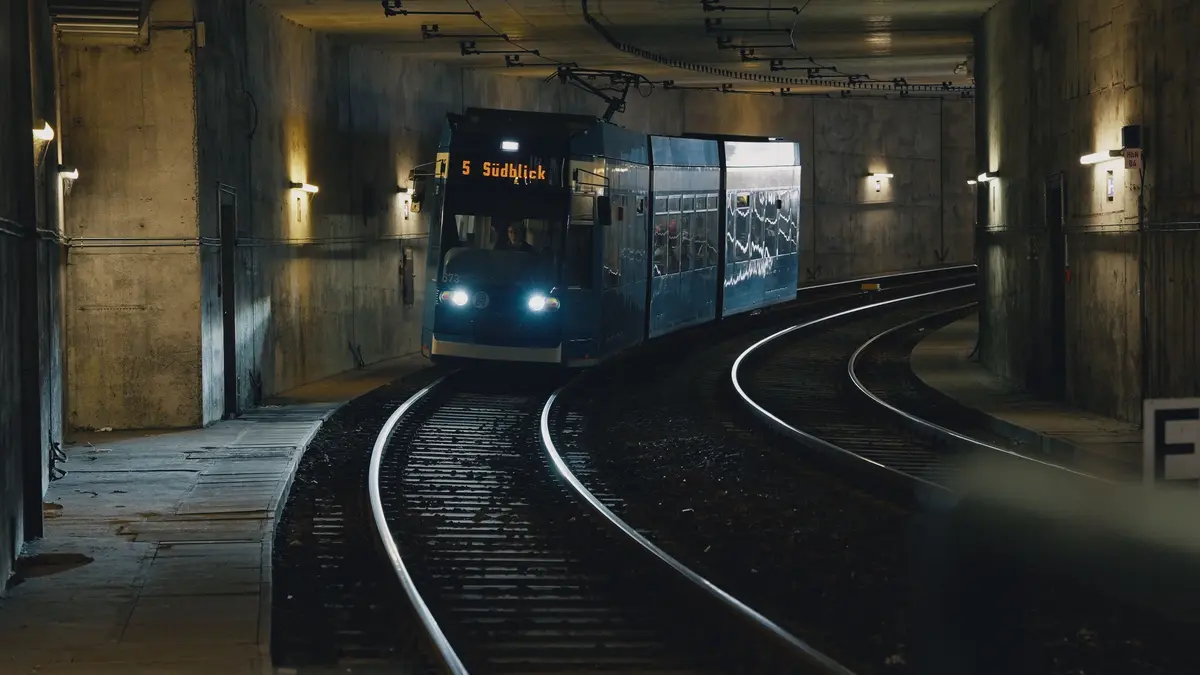
Siemens Mobility has begun trial operation of a software-defined interlocking in the tram tunnel beneath Rostock Central Station, the first use of its Signaling X platform in German urban transport. The pilot is being conducted with Rostocker Straßenbahn AG (RSAG). It covers the section carrying tram lines 2, 3, 5 and 6.
Conventional interlockings have relied on proprietary specialized components. In Rostock, Siemens says the safety-critical interlocking logic runs on standard IT hardware instead, using the DS3 safety platform introduced in 2020.
What runs under Rostock Central Station
DS3, short for Distributed Smart Safe System, creates a redundant environment for safety-critical applications. Those applications reach CENELEC SIL 4 on commercial off-the-shelf servers. Siemens Mobility calls the Rostock installation the first practical use of that architecture in a complex urban setting. Cybersecurity for critical infrastructure forms part of the same package.
According to Siemens, separating the interlocking logic from specific hardware lifecycles allows operators to modernize and scale infrastructure more flexibly. The supplier also says maintenance and spare-parts management can draw on globally available IT standards.
Marc Ludwig, CEO Rail Infrastructure at Siemens Mobility, placed the pilot inside that wider roadmap.
“For the first time, we are deploying our new generation of software-defined signaling technology in a real-world urban operational environment.”
For the operator, the reasoning sits closer to daily practice. Dirk Glauner, Team Lead Railway Power Systems at RSAG, set out the conditions a tram network deals with:
“For mass transit operators, operational safety is the greatest challenge. In addition to the inherent risks of rail operations, the proximity to road traffic creates additional stress for both people and technology.”
Nearly six years from an Austrian station to a German tram tunnel
Rostock is not where this architecture started. ÖBB-Infrastruktur AG and Siemens Mobility put DS3 into live service at Achau, south of Vienna, on 18 November 2020. Joint field trials began in December 2018. The project received the first-ever approval of a SIL 4 interlocking based on commercial off-the-shelf hardware.
Signaling X itself arrived four years later. Siemens Mobility launched the platform at InnoTrans 2024 as a cloud architecture built around a centralized Signaling Data Center for mainline and mass-transit applications.
Urban rail came next, initially at a test site. In November 2025, Siemens Mobility demonstrated live CBTC operation at the Singapore Rail Test Center, with safety-critical CBTC and interlocking functions running on commercial off-the-shelf hardware through DS3. Rostock is therefore the supplier’s first stated implementation of this architecture in a real-world urban operational environment.
| Location | Setting and role | Stated date |
|---|---|---|
| Achau, Austria | Mainline station of ÖBB-Infrastruktur AG; DS3 interlocking in live service, described as the first approval of a SIL 4 interlocking based on commercial off-the-shelf hardware | 18 November 2020 |
| Austria and Spain | DS3 platform; Siemens said it had been implemented in Austria and Spain. The cited release did not identify the Spanish site or describe both cases as full Signaling X deployments | Stated 23 September 2024 |
| Finland | DS3 platform awarded in Finland and later described by Siemens as the latest adopter. The cited releases give no site or entry-into-service date | Stated 23 September 2024 and 12 June 2025 |
| Singapore Rail Test Center | Test site; live demonstration of CBTC and interlocking functions running on commercial off-the-shelf hardware through DS3 | 12 November 2025 |
| Rostock Central Station tunnel, Germany | Tram tunnel of Rostocker Straßenbahn AG carrying lines 2, 3, 5 and 6; trial operation of a software-defined interlocking | Announced 10 September 2026 |
The table distinguishes live operation, implementation, an award, a test-center demonstration and trial operation; these statuses are not equivalent. Every entry is based on a Siemens Mobility publication, and the sources do not disclose how much equipment each project covers. Sources: Siemens Mobility, 26 November 2020; Siemens Mobility, 23 September 2024; Siemens AG, 12 June 2025; Siemens Mobility portfolio reference, Signaling X for urban mobility; Siemens Mobility, 10 September 2026.
What the announcement leaves open
Several details that operators would weigh are missing from the Siemens Mobility announcement. It gives no duration for the trial and no date for a move to regular service. Nor does it say whether the existing installation stays in place alongside the new one. Equipment counts, approval authority and contract value are likewise unstated.
Those gaps matter because trial operation in a live environment is not the same as an announced transition to permanent regular operation. Rostock is Siemens’ first stated urban operational trial for Signaling X, while the 2020 mainline approval cited earlier applies specifically to the DS3 interlocking in Achau. The project does not yet demonstrate replacement of conventional installations across an entire tram network.
| Figure as published | Conditions attached to it | Where it was published |
|---|---|---|
| Operational efficiency, up to 20 percent higher | Attributed in 2025 to lower lifecycle costs. No calculation method, baseline or measurement period given | Siemens Mobility, 23 September 2024; Siemens AG, 12 June 2025 |
| Energy savings, up to 30 percent | Supplier claim for Signaling X in combination with ATO over ETCS; not a Rostock-specific result | Siemens Mobility, 23 September 2024 |
| Shorter possible headways | Stated for mainline and mass transit networks. No number published | Siemens Mobility, 23 September 2024 |
| CENELEC SIL 4 on standard servers | A safety level the DS3 platform is stated to meet, not a performance gain | Siemens Mobility, 10 September 2026 |
The efficiency, energy and headway figures are supplier claims rather than Rostock-specific measured results. SIL 4 is a stated safety classification for the DS3-based architecture, not a performance outcome. Sources: Siemens Mobility, 23 September 2024; Siemens AG, 12 June 2025; Siemens Mobility, 10 September 2026.


