MELPL electric freight locomotives drive India’s freight boom
27.11.2025
MELPL electric freight locomotives sit at the heart of a decade-long partnership between Alstom and Indian Railways, reshaping India’s freight mobility and delivering more sustainable growth.
This is reported by the railway transport news portal Railway Supply.
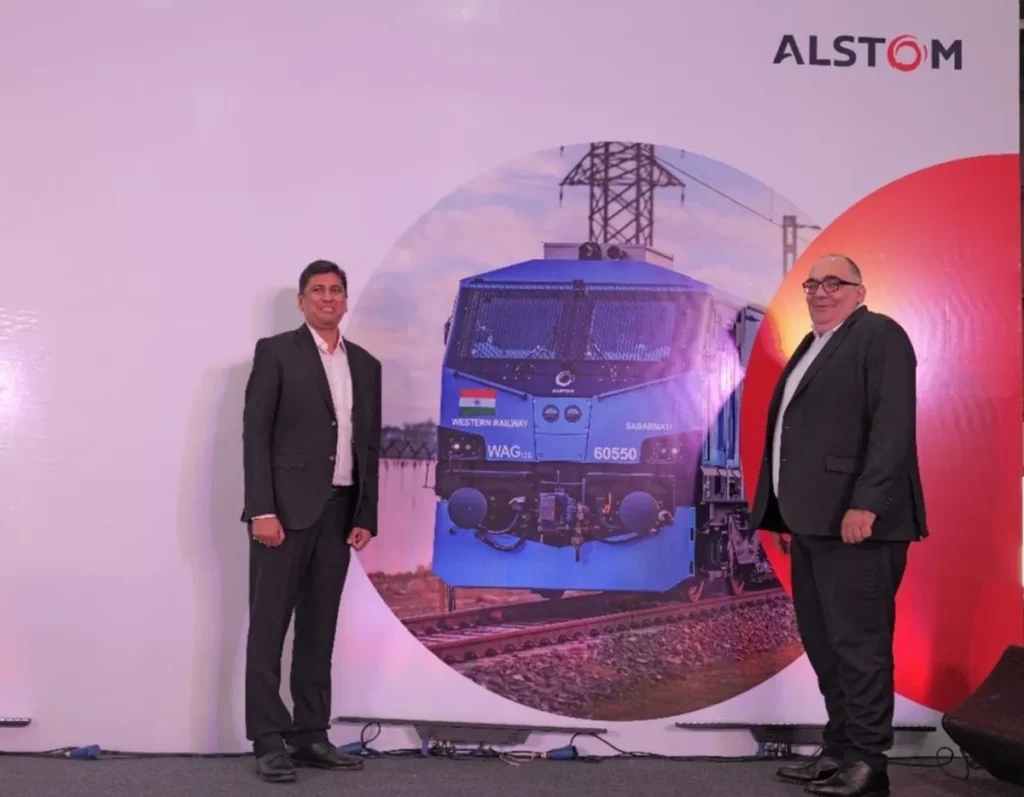
The venture is presented as a “Vikas Ka Dashak” — a decade built on localisation, innovation and green logistics within the Make in India and Atmanirbhar Bharat frameworks. On 26 November 2025, Alstom, a global leader in smart and sustainable mobility, marked 10 years of Madhepura Electric Locomotive Private Limited (MELPL), its public-private partnership with Indian Railways focused on India’s most powerful freight e-locos. Since the launch of this Make in India freight locomotives project, more than 550 indigenously built, double-section Prima T8 units rated at 12,000 HP (9 MW) have been delivered, a scale also highlighted by Rail Analysis India. The anniversary was celebrated at the state-of-the-art locomotive maintenance depot in Saharanpur, Uttar Pradesh.
“This is a moment of immense pride, celebrating a strong and enduring partnership that has truly transformed freight movement in India,” said Olivier Loison, Managing Director, Alstom India.
Alstom and Indian Railways partnership at Madhepura
The current phase of the Alstom and Indian Railways partnership dates back to 2015, when Indian Railways awarded a landmark 3.5 billion euro contract. Under this agreement, Alstom is supplying 800 fully electric, double-section WAG-12B 12,000 HP locomotives capable of hauling around 6,000 tonnes, alongside 13 years of associated maintenance. This landmark 3.5 billion euro contract, also covered by Railway Supply, underpins the present MELPL programme. These Indian Railways 12,000 HP freight locomotive units are produced at one of the country’s largest integrated greenfield manufacturing facilities in Madhepura, Bihar.
Don’t miss…Amtrak Thanksgiving travel: book early for busy holiday
At this Madhepura greenfield manufacturing facility in Bihar, Alstom has progressively raised localisation to more than 85%. As a result, the Madhepura Alstom electric locomotive factory has reinforced India’s domestic manufacturing strength and helped the country become the sixth nation in the world to build such powerful freight locos indigenously. For Alstom, the MELPL scheme has also created a platform to showcase Alstom MELPL WAG-12B locomotives as a flagship solution for high-power freight operations.
Reflecting on this decade-long journey, Olivier Loison notes that the collaboration has brought India’s most powerful freight locomotives into service while fostering a world-class industrial ecosystem and a robust base of local talent and technology. He describes the programme as a powerful engine for Make in India and Atmanirbhar Bharat, pointing to a deep-rooted local supply chain and more than 10,000 skilled jobs created across the country. The focus now is to build on this legacy, drive a green logistics revolution and continue positioning India as a hub for world-class rail solutions.
The first e-loco from the contract entered commercial service in May 2020. By October 2020, the Ministry of Railways and the Commissioner of Railway Safety / RDSO had certified these WAG-12B 12,000 HP locomotives to operate at speeds up to 120 km/h. During the latest festive season, they were also deployed in passenger service to meet surging travel demand, underlining their flexibility.
Depots, maintenance and training support
To secure high availability of MELPL electric freight locomotives and lower maintenance costs, Alstom has built two ultra-modern, state-of-the-art maintenance depots in Saharanpur and Nagpur, using predictive technologies. These Saharanpur and Nagpur maintenance depots are supported by Prompt Response Teams (PRT) across India, made up of trained specialists equipped with tools and critical spare parts.
Training remains a core element of the project’s lifecycle support. So far, more than 22,000 Indian Railways staff based in Nagpur, Saharanpur and Sabarmati have been trained under this programme. This ensures that teams across the network can safely and efficiently operate and maintain the new freight locomotives and associated systems.
Technical strengths of MELPL electric freight locomotives
Under the MELPL contract, an integrated greenfield industrial site covering 250 acres has been established in Madhepura, with a production capacity of 120 locomotives per year. Designed to international standards of safety and quality, the site underpins the scale of the Make in India and Atmanirbhar Bharat initiatives in heavy rail engineering.
From a technical standpoint, MELPL electric freight locomotives are equipped with Insulated Gate Bipolar Transistor (IGBT) propulsion systems and regenerative braking, which helps reduce energy consumption. The e-locos are engineered to emit less heat and traction noise, improving the environmental footprint of freight services. Built for India’s 1,676 mm broad gauge network, they are designed to take smooth turns even on sharp curves, ensuring stable operation on demanding routes.
The locomotives were developed at Alstom’s Engineering Centre in Bengaluru and use an eight-axle configuration to enhance traction and performance. Prima T8 technology allows reliable operation across a wide temperature range, from −50 °C to 50 °C, which is critical for Indian operating conditions. With these units, Alstom has introduced new comfort features to Indian freight operations, including climate control systems, air conditioning, facilities for food preparation and storage, and onboard toilets. Spacious driver cabins give pilots a more ergonomic and comfortable working environment during long-haul freight runs.
Localisation, skilled jobs and socio-economic impact in India
Beyond technology, the project’s localisation, skilled jobs and socio-economic impact in India are central to its story. The Alstom–Indian Railways joint venture has created more than 10,000 direct and indirect jobs in several states. At the same time, Alstom is investing in community development around its sites, supporting 21 villages in and around Madhepura and Saharanpur through programmes in education, healthcare, women’s empowerment and skilling.
Working with partners such as the American India Foundation (AIF), SEEDS Impact and the Learning Links Foundation (LLF), Alstom reports that it has already touched the lives of more than 30,000 people. These activities reinforce how a Make in India freight locomotives project can combine industrial output with long-term social benefits.
Alstom has been associated with India’s progress for more than 100 years. Today, as the country’s leading multinational provider of sustainable mobility, it offers a broad portfolio tailored to customer needs, from cost-efficient mass-market platforms to advanced technological innovations. Closely linked to India’s wider “Rail Revolution”, MELPL electric freight locomotives and the broader Alstom and Indian Railways partnership continue to support both the freight transformation and the growth of passenger rail across the country.
News on railway transport, industry, and railway technologies from Railway Supply that you might have missed: