Melbourne Metro Tunnel opening: how it will reshape travel
28.11.2025
Melbourne Metro Tunnel opening will test how far Australia’s newest metro-style line can shift the way the city moves. From Sunday November 30, the long-awaited tunnel starts carrying passengers on a limited timetable, ahead of full operations in February 2026.
This is reported by the railway transport news portal Railway Supply.
Construction began in 2017, and the project marks the first major reshaping of Melbourne’s rail network in decades. Metro Tunnel Melbourne is intended to increase Melbourne public transport capacity and reliability by adding new rail connections to some of the city’s busiest destinations, as previously covered by Railway Supply. Yet travel behaviour is only slowly catching up: car dependence in Melbourne remains high, confidence in public transport has slipped, and commute times continue to creep upwards.
Like other large Australian cities, Melbourne is caught between two futures. One is a more sustainable, public-transport-centred city; the other is a car-led city reinforced by daily routines and road-focused habits. The tunnel is a crucial investment toward the first path, but the real test of the Melbourne Metro Tunnel impact on public transport will be what happens after the initial launch period.
Don’t miss…MBTA Fairmount Line battery-electric trains move ahead
Melbourne Metro Tunnel opening: what changes on day one
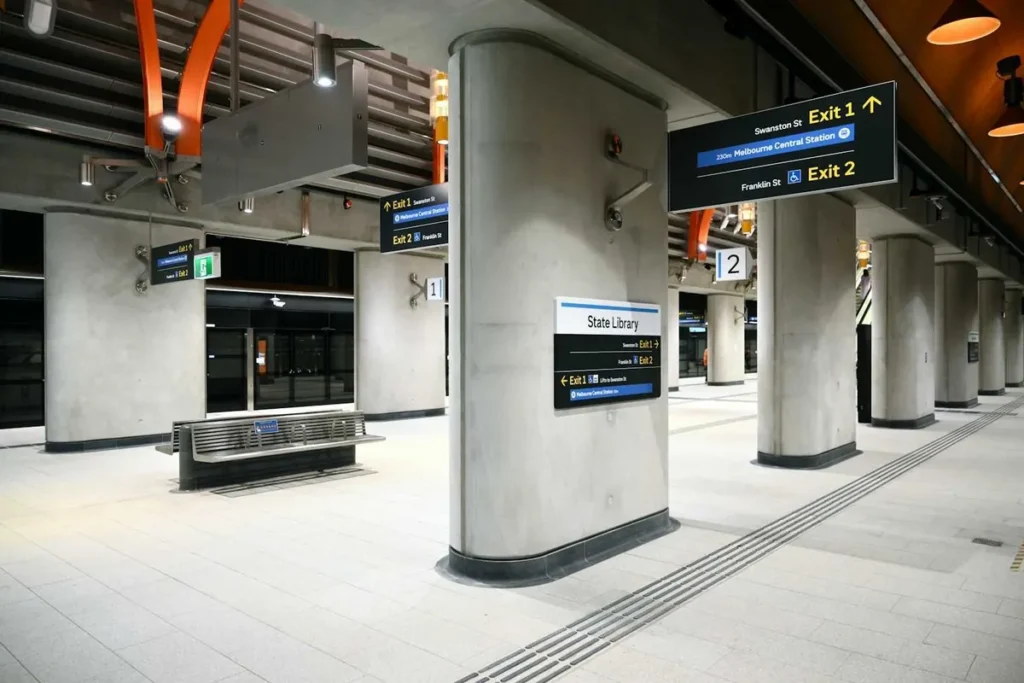
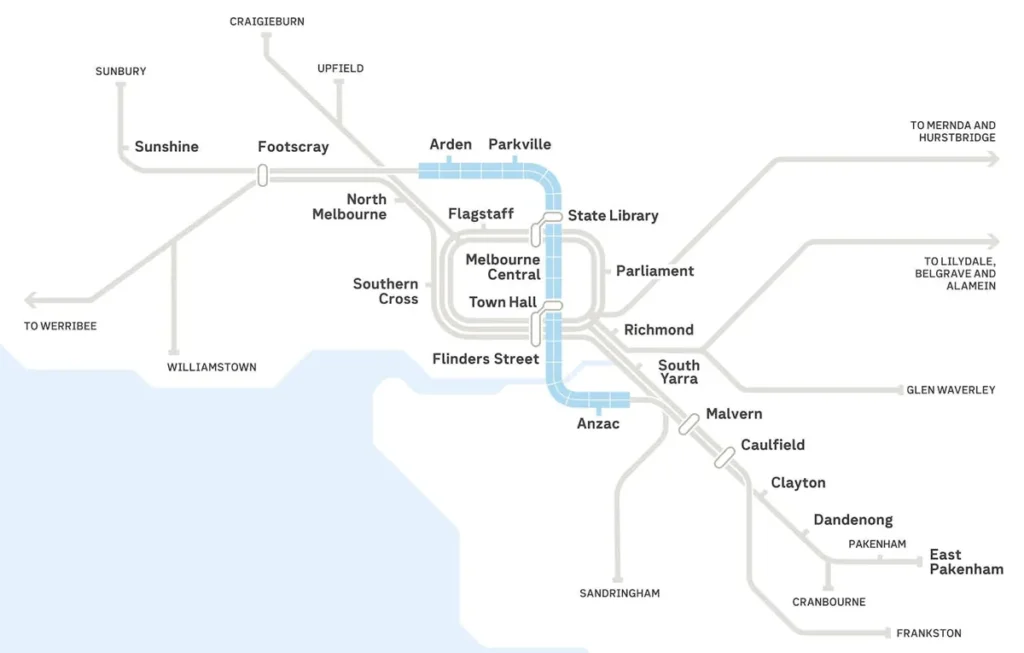
From November 30, new train services begin running through the tunnel and stopping at all five new underground stations: Arden, Parkville, State Library, Town Hall and Anzac, according to the official Metro Tunnel project page. For many passengers, the Melbourne Metro Tunnel new stations will cut the time and effort needed to reach the hospital and university precinct around Parkville and Arden.
At first, these services operate alongside the existing timetable. Passengers on the Cranbourne, Pakenham and Sunbury lines can continue using their current City Loop trains or switch to a Metro Tunnel service by changing at key interchange stations. A full timetable change is planned for 1 February 2026, when all trains on these lines will run through the tunnel instead of the City Loop.
These very visible changes set the tone for the next decade of network improvements. At the same time, the tunnel is meant to act as the backbone for future expansions, including Airport Rail and the Suburban Rail Loop, anchoring a more metro-style network instead of a purely suburban system.
Why the new tunnel matters for Melbourne’s network?
Operationally, the Metro Tunnel gives planners more flexibility in how they manage services across the network. Taking some lines out of the City Loop should reduce the risk that delays cascade from one line to another and make it easier to add trains where demand is strongest. This moves Melbourne closer to the operating principles of successful metro systems overseas and illustrates one way Australian cities can modernise legacy suburban rail.
New infrastructure can redraw the rail map overnight, but everyday travel habits tend to shift more slowly. Experience in London and Vancouver suggests that passengers respond gradually, as new patterns become familiar and prove reliable. Recent Melbourne travel data underline the scale of the task: car dependence remains high even as car ownership declines, and people still worry about cost, crowding, connections and safety. These concerns are especially strong in outer suburbs, where alternatives are limited and driving often feels like the only realistic option.
The Metro Tunnel is expected to improve performance on the Cranbourne, Pakenham and Sunbury lines, but rebuilding trust in public transport will require consistency over time. Reliability and frequency need to be maintained — not just showcased during the launch — if regular car users are to seriously consider switching modes.
Behaviour change, car dependence and what needs to happen next
The first months after opening will be critical. For everyday travellers, frequent and predictable services usually matter more than modest savings in travel time on individual trips. Safety and accessibility also strongly influence whether people choose public transport: good lighting, clear wayfinding and comfortable, intuitive interchanges all shape how the new stations are experienced.
At the same time, the tunnel’s full impact depends on wider reform. Improvements to the bus network, better tram priority at intersections and along key corridors, and stronger first- and last-kilometre connections will determine how many people can realistically move away from driving. The tunnel provides the spine of the system, but the rest of the network has to support it so that gains in capacity and reliability translate into real behaviour change.
Over the first few months, several indicators will show whether Melbourne public transport capacity and reliability are improving in practice. Crowding on the busiest corridors may ease gradually, with more noticeable changes expected from February when the new timetable begins and all trains on the affected lines shift to the Metro Tunnel. Ridership at Parkville and Arden stations, which serve hospitals and universities, will be closely monitored when students return early next year.
Network-wide travel times and on-time performance during peak periods will reveal whether the added capacity is improving stability. Early shifts in the share of trips made by public transport will indicate how quickly habits are changing and whether the tunnel is nudging people away from habitual car use.
Sydney Metro vs Melbourne Metro Tunnel: lessons and outlook
Sydney’s 2024 City and Southwest Metro opening offers a useful benchmark for Sydney Metro vs Melbourne Metro Tunnel comparisons. In its first year, the Sydney Metro City and Southwest M1 line delivered more than 66 million journeys, with more than 99% of trains running on time, according to Railway-News. Traffic across the Harbour Bridge fell, and many passengers shifted away from crowded Sydney Trains stations toward the more reliable metro option.
The key lesson for Melbourne is straightforward: when frequency and reliability are consistently high, travel behaviour can start to shift within months. If the tunnel delivers stable, metro-style operations, it could encourage a similar pattern of gradual but meaningful change in mode choice.
For Melbourne, the Metro Tunnel is therefore more than just another piece of infrastructure. It expands capacity, improves access to key destinations and enables upgrades that were impossible under the previous configuration. It also shows how Australian cities can begin adopting true metro-style networks instead of continually stretching older suburban rail.
Yet the broader picture remains that travel patterns still lean heavily towards driving. Infrastructure such as the Metro Tunnel Melbourne project changes what is possible, but everyday choices will still depend on how safe, reliable and convenient public transport feels. The Melbourne Metro Tunnel opening is a milestone, but its long-term impact will be judged by how it reshapes the way the city moves in the years ahead – and by what other Australian cities learn from its experience.
News on railway transport, industry, and railway technologies from Railway Supply that you might have missed:



