Mariyung platform extensions support South Coast 10-car rollout
In Australia, Mariyung platform extensions support the South Coast rollout, where trains from the 610-car fleet move from shorter formations toward 10-car operation in 2027.
An assumption that did not survive the network
When Transport for NSW specified the fleet, it chose train lengths that would limit the effect on stations and stabling. As a result, the business case for the New Intercity Fleet set a clear expectation. It assumed that “no platform extension would be required to operate the NIF”. Nor did it set aside capital for extra stabling. The Auditor-General for New South Wales recorded both points in a performance audit tabled in October 2025.
Two later variations changed that picture. First, in February 2019, Transport for NSW added 42 cars. Those cars turned 21 eight-car sets into 10-car sets for South Coast peak services. Then in September 2021 it ordered 56 more for the Central Coast. The order therefore grew from 512 cars to 610.
Lengthening those trains carries a cost. According to the same audit, 10-car sets cannot use every underground platform. They also need capital works on platforms and stabling. The fleet business case never covered that spending. Enabling works had meanwhile grown well before that point. By September 2016, shortly after the August contract award, their estimated capital cost had risen by 55 per cent to A$1.1 billion.
| Step | Date | Cars | Reported figure |
|---|---|---|---|
| Expressions of interest called | August 2014 | 520 planned | A$2.8 billion announced |
| Supply contract executed with RailConnect NSW | August 2016 | 512 | A$1.3 billion for the rolling stock; A$2.9 billion for the programme |
| Variation for South Coast peak capacity | February 2019 | 554 | A$130 million added to the contract; A$180 million to the programme |
| Variation under More Trains, More Services Stage 3A | September 2021 | 610 | A$221 million added to the contract |
| Programme estimate in internal budget reporting | November 2024 | 610 | A$4.5 billion |
How the order and reported costs changed: two variations added 98 cars. Over the wider period, the programme’s estimated total capital cost rose from A$2.9 billion at contract award in August 2016 to A$4.5 billion in TfNSW internal reporting in November 2024. The later total included several cost factors beyond the additional cars. The A$2.8 billion announced in 2014 is not a directly comparable programme figure: it covered 520 planned cars, contingencies and client costs, but excluded the maintenance facility and other enabling works. Figures are nominal Australian dollars. Source: Audit Office of New South Wales, Rail rolling stock procurement, performance audit tabled 21 October 2025.
Three lines, three different limits
On the Central Coast and Newcastle Line the position is now clean. Since 30 June 2025, 19 Mariyung trains have been fully deployed there. Moreover, every one of the line’s 38 stations can take a 10-car formation.
The Blue Mountains Line tells a different story. Services began on 13 October 2025, and 14 trains are now fully deployed. Yet some platforms still fall short. Blacktown, Linden, Leura, Hazelbrook, Blackheath and Faulconbridge are among the stations too short for 10 carriages. Doors on selected front carriages therefore stay shut there.
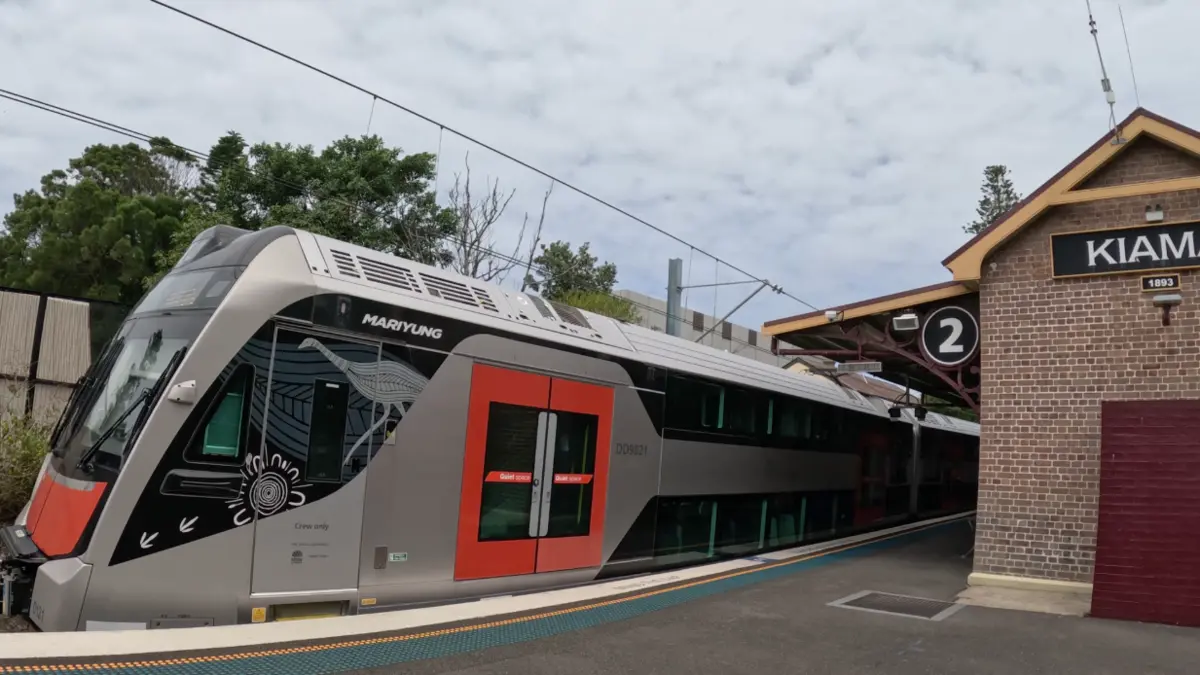
The South Coast Line is the last to convert. Its first Mariyung service left Kiama on 14 April 2026. That came after 12 months of trials, plus enabling work on track and stations. Seven sets started that month, rising to 16 trains by 2027. Four-car and six-car sets come first, eight-car sets later in 2026, and 10-car formations in 2027.
| Line | First passenger service | Trains deployed | Reported formation or platform constraint | Next step |
|---|---|---|---|---|
| Central Coast and Newcastle Line | 3 December 2024 | 19, fully deployed from 30 June 2025 | None reported: all 38 stations accept a 10-car formation | Not stated |
| Blue Mountains Line | 13 October 2025 | 14, fully deployed | Six listed stations have platforms too short for 10 carriages; selected front-carriage doors remain closed | Not stated |
| South Coast Line | 14 April 2026 | 7 at the start, 16 planned by 2027 | Phase one runs 4-car and 6-car sets | 8-car later in 2026, then 10-car in 2027 |
Where each line stands: all 38 Central Coast and Newcastle stations accept 10-car trains; Blue Mountains 10-car services already operate with selected front-carriage doors kept closed at shorter platforms; South Coast 10-car operation is planned for 2027 under the announced phased rollout. Sources: Transport for NSW, Mariyung Fleet project page (reviewed 24 July 2026); NSW Government ministerial releases of 27 June 2025, 13 October 2025 and 14 April 2026.
Mariyung platform extensions across the corridor
Meanwhile the enabling programme continues under the Rail Infrastructure Upgrades project. It covers changes inside the rail corridor: train stopping markers, platforms and lighting. Stabling yards and provisioning sites sit in the same scope. Early work is finished, and construction is under way at a number of sites. Meanwhile planning continues to fix the scope and start dates elsewhere. Transport for NSW has also published environmental impact assessment checklists for platform extensions. The named stations include Morisset, Penrith, Westmead, Austinmer, Strathfield, Sutherland, Hurstville, Coniston, Woonona and Lidcombe.
The Blue Mountains work was larger still. In 2020 Transport for NSW put route clearance on that line at A$149 million. That figure sat 72 per cent above the estimate made before contract award in June 2016. In addition, a sub-medium rolling stock standard arrived in 2018. It set a 50 km/h limit on prescribed track between Mount Victoria and Lithgow. That change let trains work the Ten Tunnels Deviation without single-line running.
What remains before the 2027 formation milestone
The remaining announced formation milestone is 10-car operation on the South Coast Line in 2027. Transport for NSW’s infrastructure programme includes the platform, track and stabling work needed to support the Mariyung operating model. For scale, a 10-car Mariyung seats 823 passengers, while a six-car set seats 500. The older stock has meanwhile gone. V-sets finished on the Central Coast and Newcastle Line at the end of June 2025. They then left the Blue Mountains Line in January 2026.
Suppliers stay in the picture for years yet. RailConnect NSW is a joint venture of UGL, Hyundai Rotem and Mitsubishi Electric Australia. Its 2016 contract also covers 15 years of maintenance and asset management. That term runs from delivery of the first train, with an option for five more. The work is based at Kangy Angy.
Among its recommendations, the audit says that by December 2026 Transport for NSW should have developed and embedded stronger assurance processes. The recommended processes should ensure that enabling and related works are included in project scope, cost and timeline at every project stage.


