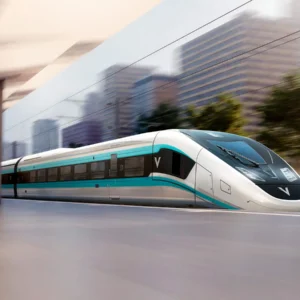
Japan L0 Series maglev: speed, costs and Europe hurdles
Japan L0 Series maglev targets 603.5 km/h. Here’s its cost, timeline and why bringing it to Europe or the UK is difficult.

This is reported by the railway transport news portal Railway Supply.
Japan L0 Series maglev is being built to push rail travel into new territory, as discussed by Euronews Travel. Developed and tested by Central Japan Railway Company (JR Central), the L0 Series is expected to reach speeds of up to 603.5 km/h, as outlined on JR Central’s SCMAGLEV site.
That headline speed would place it ahead of the only commercial maglev service in operation today: China’s Shanghai Maglev, which runs at up to 460.2 km/h. Europe’s fastest conventional trains sit lower on the scale. The French TGV and Italy’s AGV Italo, for example, have top operational speeds in the 306–354 km/h range.
Don’t miss…Khapri railway station upgrade: Rs4 crore facelift planned
Chuo-Shinkansen line: what it changes in Japan
On the current network, the Tokyo–Nagoya trip can take from about 1 hour 26 minutes to two and a half hours or more. The difference comes down to the service chosen—faster bullet train (Shinkansen) options versus the slower Kodama or Hikari trains.
The Chuo-Shinkansen line now being built for the L0 Series is intended to cut Tokyo–Nagoya to around 40 minutes. A Nagoya–Osaka service is also expected to be added later, linking Tokyo, Nagoya and Osaka into one larger, tightly connected region.
How fast is the L0 Series maglev train?
The L0 Series will use magnetic levitation (maglev), which lifts the train above the track. With the train floating rather than running on wheels, the carriages are propelled forward by an additional electric motor. Electricity and magnets do the work together, allowing the train to glide at speeds that standard rail cannot reach.
Once deemed commercially operational, the L0 Series is expected to cover Tokyo to Osaka in about one hour. Currently, that journey takes anywhere from roughly 2 hours 20 minutes to four hours depending on the service.
To give a Europe-based comparison, the same kind of performance would reduce the trip between London and Edinburgh to about 60 minutes—an itinerary that now takes roughly four to five hours and 45 minutes on UK trains.
Could Japan L0 Series maglev work in Europe?
The question is whether Japan L0 Series maglev could translate to markets like the UK or Europe. The text argues that the fit is not straightforward, because these markets typically focus equally, if not more, on user comfort, overall journey experience, luxury and accessibility—qualities often associated with slower, scenic rail travel.
An ultra-high speed option may only make sense on routes that are primarily functional and business-focused, such as London to Paris or London to Brussels.
Cost and infrastructure are another barrier. The project is described as massively expensive, with spending at around £52bn (€59.9bn) so far. It was originally scheduled for completion in 2027, but the plan has already slipped by eight years—an evolution also covered by Railway Supply, with a more realistic inauguration date now likely between 2034 and 2035.
A train like the L0 Series would also need purpose-built infrastructure, because it cannot run on existing lines. Much of the route would have to go through tunnels excavated specifically for this purpose. It is also more power-intensive than normal UK or European trains, which pushes costs higher, and it has a smaller capacity than most European trains—making it harder to break even in terms of costs.
News on railway transport, industry, and railway technologies from Railway Supply that you might have missed: