Brenner Base Tunnel Bores Break Through Austria–Italy Border
AUSTRIA–ITALY: Both main bores of the Brenner Base Tunnel have broken through at the national border, creating the first continuous cross-border railway connection through the future line’s twin tubes.
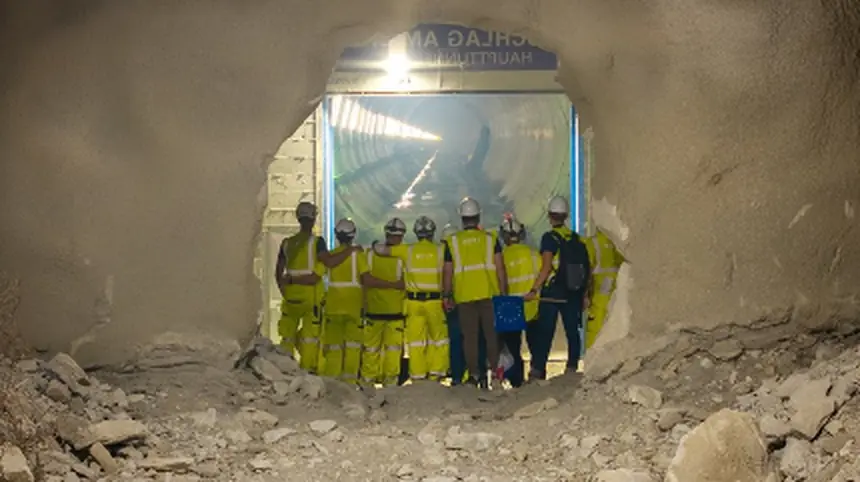
Twin bores meet beneath the Brenner Pass
The final rock was removed on 28 July 2026 in the H53 Pfons–Brenner construction section on the Austrian side. According to BBT SE’s official account of the breakthrough, the second opening was completed at 10:35, allowing project teams to cross into the Italian section underground.
The new openings connect H53 with the completed main tunnels of Italy’s H61 Mules 2–3 construction section about 1,400 metres below the Brenner Pass. The exploratory tunnel had already crossed the state border in September 2025; the two railway bores now add two further underground links between the countries.
The sections approached the border using different excavation methods. Tunnel boring machines Virginia and Flavia drove the Italian main bores, while crews on the Austrian side used conventional drill-and-blast excavation. Surveying data from the exploratory-tunnel breakthrough showed a deviation of only a few centimetres, and BBT SE said the main-bore alignment was more precise still.
Don’t miss…Newcastle–Sydney High-Speed Rail Adviser Appointed
Excavation continues toward Innsbruck
The cross-border breakthrough does not complete excavation across the entire railway system. Wilma and Olga, the last two tunnel boring machines working on the project, must continue north through the remaining main-tunnel sections toward Innsbruck. Once they finish, all railway tunnels in the system will be connected.
The latest project progress figures show that 220 km, or about 95%, of the planned 230 km tunnel system has been excavated. That total includes 114 km of railway tunnels, 57 km of exploratory or service tunnel and 49 km of access, rescue and logistics tunnels.
After excavation and installation of the inner shell, teams will still need to fit the infrastructure required for railway operations, including track, overhead lines and signalling.
A 55 km low-gradient railway under the Alps
The Brenner Base Tunnel design comprises two single-track main tubes running between Innsbruck in Austria and Fortezza in Italy. The tubes are positioned 40 to 70 metres apart and linked by cross passages every 333 metres.
The base tunnel itself extends for 55 km. Together with nine kilometres of the existing Inn Valley Tunnel south of Innsbruck, the future underground rail connection will cover 64 km. Its low-gradient alignment is intended for both passenger and freight trains, avoiding the steeper route over the Brenner Pass.
News on railway transport, industry, and railway technologies from Railway Supply that you might have missed: