Train control systems warning grows after GO near miss
Train control systems are back in focus in Canada after a TSB report examined a GO Transit near-miss incident. The case involved two commuter trains carrying more than 400 passengers.
The Transportation Safety Board of Canada released its investigation report on occurrence R24T0064 into the March 14, 2024, event at Aldershot station in Burlington, Ontario. An eastbound GO Transit train passed a red signal, ran through a switch and entered a track already occupied by a westbound train. Both crews stopped their trains before impact, with 549 feet left between them.
Why train control systems returned to focus?
TSB Chair Yoan Marier said the railway came close to a catastrophic outcome. In an official TSB news release, he said “a catastrophic collision involving 400 passengers was narrowly averted,” and connected the case to the need for physical fail-safe controls that can intervene when signal indications are not followed.
The TSB has called for a positive train control-type system, or similar protection, for more than 25 years. Marier also pointed to the need for stronger interim measures while such systems are being developed. The Aldershot station train incident showed how quickly a missed signal can turn into a collision risk.
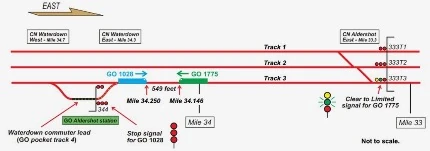
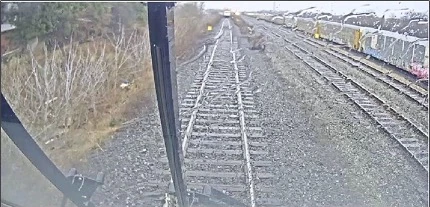
According to the investigation, eastbound train No. 1028 left Aldershot shortly after 5 p.m. at low speed. During departure, the engineer was adjusting the windshield wipers and his seat, while the conductor was reviewing trip information on a company-issued tablet. Neither crew member acknowledged the stop indication at mile 34.4. They also did not notice that the switch ahead was lined against their movement.
What happened between the two GO Transit trains?
The crew of train No. 1028 understood that something was wrong after hearing the sound of switch points being forced against the stock rail. They then realized the train had likely passed a stop indication, stopped the movement, made an emergency broadcast to trains in the area and contacted the rail traffic controller.
Westbound train No. 1775 was approaching on the same track at the same time. It was being operated from the cab car by an engineer trainee, with the engineer standing directly behind him. As the train travelled at 54 mph, its crew saw No. 1028 enter the track ahead. The trainee applied the emergency brake immediately, just as the engineer was reaching to do the same.
The engineer on No. 1775 then called the rail traffic controller to report the situation. The TSB report also pointed to expectations formed by routine operations. Train No. 1775 was five minutes late, and that had not happened during the month in which the crew of No. 1028 had been working that service. Because the westbound train had usually already passed, the crew of No. 1028 expected the same pattern and formed what the report called an “inaccurate mental model” that signal 344 would be permissive.
Safety steps after the TSB report
After the near miss, Alstom, the contract operator of GO Transit trains, changed its approach to rule violations. Any employee observed violating a rule became subject to enhanced proficiency testing for one year. That included additional ride-along trips and unannounced monitoring.
Metrolinx, the parent agency of GO Transit, also told crews that it would actively review in-cab video and/or audio. The purpose was to confirm rule compliance or identify other threats to safe operation.
The investigation also found problems with the recording devices on both trains. Because of that, the TSB informed Transport Canada that it might wish to ensure those recorders meet regulatory requirements. Transport Canada replied that it was in the process of strengthening its monitoring of those requirements.
The call for train control systems remains central to the case. For the TSB, the GO Transit near-miss incident was not only a local operating failure, but also another example of why Canada’s rail network needs stronger safeguards when human attention and signal compliance break down.