The Olympic Games, the metro, and Paris – is there a connection?
12.05.2024
Paris, the epitome of elegance and culture, has been the host to several historically significant events, including the Olympic Games, this is reported by the railway transport news portal Railway Supply.

The Olympics have always been an opportunity for the host city to upgrade infrastructure and improve the urban environment.
Paris previously hosted the Summer Olympic Games in 1900 and 1924, and after the 2024 Games, it will become the second city to host the Summer Olympics three times, after London.

During the 1900 Olympics and the World Exhibition in Paris, the city became a hub for innovation. It was when the first line of the Paris Metro was opened, significantly easing transportation for participants and spectators.
Alstom has signed a major contract to supply 103 MF19 metro trains for Paris
This event was not just a technical achievement but also a sign of urban infrastructure development.
The opening of Metro Line 1 in 1900 provided direct connection between Porte Maillot and Porte de Vincennes, where the Olympics were held that year.
Partially to accommodate the influx of spectators and visitors to the Paris Exhibition also taking place that year, officials signed ambitious plans to create a new railway solution.
Paris already had the Petite Ceinture – a circular railway line built between 1852 and 1869 for freight and, from 1854, passengers. However, it was insufficient for the city’s growing population.
As the Games and the World Fair approached, the Paris administration agreed to build a railway line directly under the streets to enhance the surface network.
It was significantly different from the London Tube; the tunnels were very close to the surface.
The project began in 1895 when Fulgence Bienvenüe, a French engineer later dubbed the “father of the metro,” and Edmond Huet designed a fully underground network using previous foundations developed by engineer Jean-Baptiste Berlioz (1841-1911).

Six railway lines were approved, the first three planned for March 30, 1900, coinciding with the Paris Exhibition from April 15 to November 12. The remaining three were scheduled for 1906.
Despite numerous technical issues, funding problems, and construction delays, the line was finally completed on July 19, 1900.
Passengers were transported around the city in three wooden carriages at a speed of 36 km/h. There were two fares: 25 centimes for first class and 15 centimes for second class, regardless of the route.
Unmanned trains in the Paris Metro
In the same year, architect and designer Hector Guimard designed entrances to the new stations. He was known for his Art Nouveau style and designed 167 access points over the next 13 years.

The Paris Metro quickly gained popularity, and by 1906, train speeds increased to 45 km/h.
Over the 120-plus years since the first metro train departed, much has changed. Passengers were once lowered underground using wooden escalators, and ticket punchers checked fares before turnstiles were introduced in 1973.
Today, the metro system boasts 16 lines spanning 227 km, with over four million trips made daily on weekdays, more than 300 stops, and a fleet of 740 trains and 3800 carriages.
However, perhaps the most significant recent change has been automation. Turnstiles are gradually being replaced by automatic doors, and traditional paper tickets are being phased out in favor of contactless payment.
Line 1 was converted to driverless operation from 2007 to 2011, and Line 4 is also in the process of automation.
The next chapter in this story comes full circle as Paris prepares to enhance its public transportation system again, gearing up for the massive influx of visitors to the Paris Olympics.

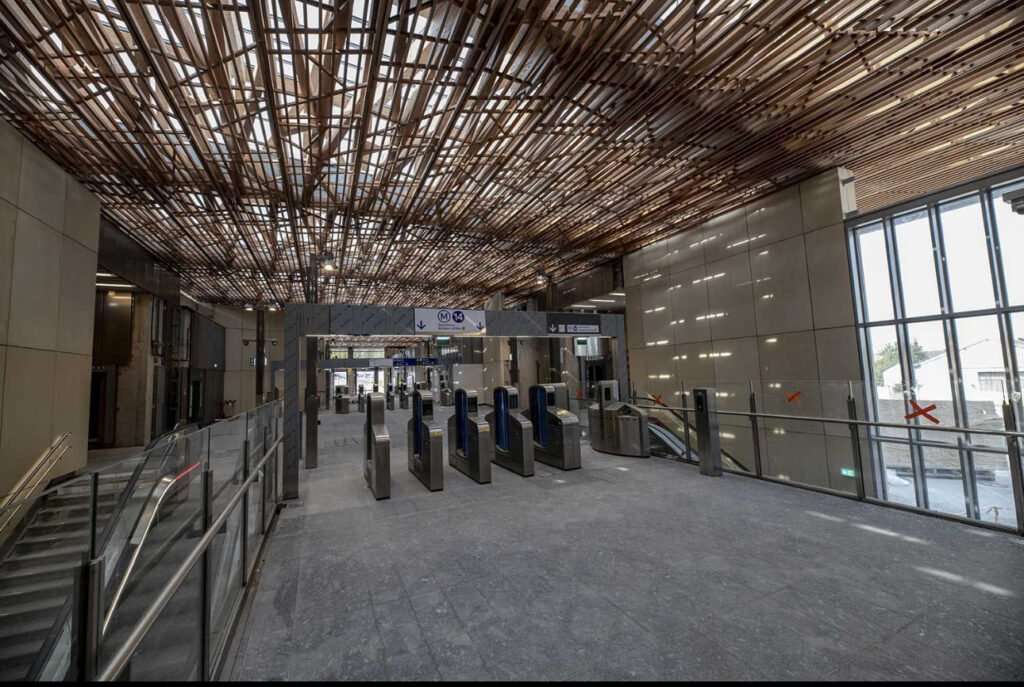
By the start of the Olympics, changes to the Paris Metro will be even more impressive, with Line 14 extended to Saint-Denis-Pleyel in the north and seven new stations added to Orly Airport in the south.

This expansion is part of even larger plans to develop Paris’ transportation infrastructure – the 200-kilometer urban railway network called the Grand Paris Express, which by 2030 will encircle the city, connecting it with the suburbs and featuring over 60 stops.
“Oh, sport! You are peace! You create good, kind, friendly relationships between peoples. You are harmony. You bring together people thirsty for unity. You teach multilingual, multicultural youth to respect each other. You are the source of noble, peaceful, friendly competition. You gather youth – our future, our hope – under your peaceful banners. Oh, sport! You are peace!” – Pierre de Coubertin.
Photo: ratp.info, wikipedia
Rail business, industry, and railway technology news from Railway Supply that you might have missed:
Modernization of the Paris suburban railway line
Find the latest news of the railway industry in Eastern Europe, the former Soviet Union and the rest of the world on our page on Facebook, Twitter, LinkedIn, read Railway Supply magazine online.Place your ads on webportal and in Railway Supply magazine. Detailed information is in Railway Supply media kit