The History of Rubber Manufacturing: Kyiv’s Industrial Path
22.05.2025
At the turn of the 19th and 20th centuries, rubber manufacturing emerged in Kyiv’s Demiivka district, laying the foundation for the region’s industrial growth and becoming a key part of Ukraine’s economy. This is reported by the railway transport news portal Railway Supply.

Origins of Rubber Manufacturing in Kyiv
In 1890, a branch of the “Provodnik” plant opened in Demiivka, specializing in telegraph cables and insulation materials. Two decades later, the “Triangle” factory began operating nearby with American investment. It produced rubber footwear, household goods, and military equipment. Together, these plants laid the foundation for the development of the city’s rubber industry.
Don’t miss…Container Corporation of India Signs MoU with GAIL
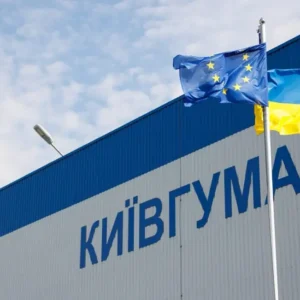
Following the revolution and World War I, production nearly ceased. However, in 1923, the State Rubber Products Plant No. 1 was established on the basis of these enterprises. It later became known as “Red Rubber Worker” and eventually evolved into “KYIVGUMA”.
In 1930, the plant officially gained the status of one of the first technical rubber manufacturers in the Ukrainian SSR. Initially, only 80 workers were employed, and products were transported by hand. In 1931, it joined the Main Rubber Directorate under the People’s Commissariat of Heavy Industry, which gave the factory a new push for development.

In the 1930s, workers from the “white” workshop, where surgical gloves were made, formed a labor commune. They shared earnings equally, supported one another, and showcased exceptional efficiency. Their model of collectivism became an example for future generations.
From War to Modernization of Rubber Manufacturing
During the Nazi occupation of Kyiv, the plant was partially destroyed, and much of its equipment was evacuated to Sverdlovsk. There, the evacuated equipment became the foundation of the Ural Rubber Technical Products Plant. It produced aviation components, surgical gloves, and special membranes for the front.
In 1944, the plant returned to Kyiv. At that time, only 26 employees remained. They manually cleared rubble, salvaged surviving machinery, and resumed production lines. By 1950, production volumes had exceeded prewar levels, and the product range had expanded significantly.
In the 1950s and 1960s, the factory underwent modernization—new technologies were introduced, laboratories were built, and vulcanization, dipping, and pressing methods were mastered. In 1958, the plant fulfilled its annual plan by June, reaching 140%. Notable contributions came from the department led by L.M. Mironova and workers like D. Medkov, I. Pavliuk, and I. Lapuza.
In 1963, the plant launched its own newspaper, “Rubber Worker.” It reflected the everyday life of the staff, featuring production news, employee interviews, and workplace achievements.

During the 1970s, the enterprise made a significant breakthrough in children’s products. It launched an automated production line for latex nipples and pacifiers with an annual capacity of up to 50 million units.
Between 1976 and 1980, the output of household and cultural goods grew by 50%. At the same time, labor productivity increased and production costs decreased. The plant repeatedly won prizes in all-Union competitions.
Today, rubber manufacturing in Kyiv remains a symbol of resilience, engineering excellence, and labor dedication. “KYIVGUMA” continues traditions established over a century ago and preserves unique technologies that have no analogues in Ukraine.
KYIVGUMA manufactures series of under-tie and under-rail pads for Ukrainian railways, CIS countries, and European railway consumers.
About the company:
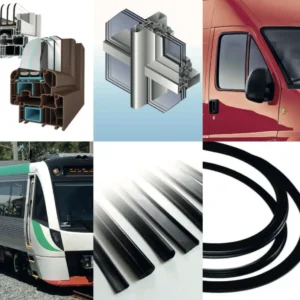
KYIVGUMA, a full-cycle company (provides services ranging from compound development and equipment design to their production). The product range includes more than 4,000 items.
On the basis of the enterprise there is a laboratory of physical-mechanical and chemical-analytical testing of materials and products, accredited by the National Agency of Ukraine for competence. KYIVGUMA not only manufactures rubber compounds or products that meet the technical parameters of the customer, the company independently develops formulations of mixtures. It ensures full compliance with all indicators ─ hardness, tensile elongation, strength, abrasion, ozone resistance, frost resistance, etc.
The production of KYIVGUMA meets the requirements of International and Ukrainian quality standards TUV SUD ISO 9001:2015, DSTU ISO 9001:2015.
News on railway transport, industry, and railway technologies from Railway Supply that you might have missed:
Find the latest news of the railway industry in Eastern Europe, the former Soviet Union and the rest of the world on our page on Facebook, Twitter, LinkedIn, read Railway Supply magazine online.Place your ads on webportal and in Railway Supply magazine. Detailed information is in Railway Supply media kit