Solar on Track: NCRTC’s New Phase of Green Innovation
13.11.2025
NCRTC’s new Solar on Track system at the Duhai depot turns a stretch of the Namo Bharat corridor into a compact power plant, and it quietly shows how rail infrastructure can also generate clean electricity.
This is reported by the railway transport news portal Railway Supply.
Solar on Track and NCRTC’s Clean-Energy Strategy
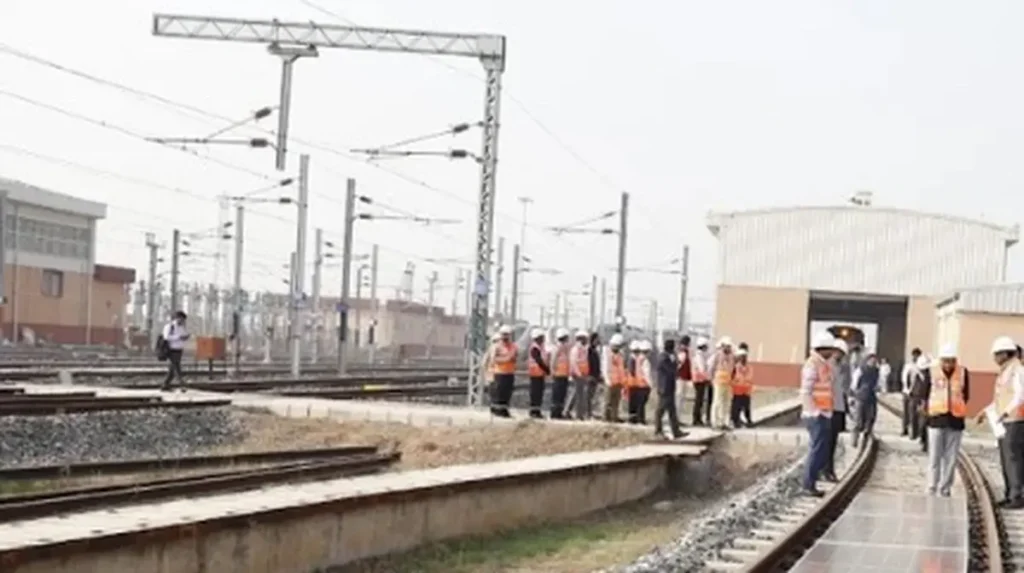
NCRTC installs rail-mounted solar modules along the Pit Wheel Track at Duhai and treats this pilot as more than a technical curiosity. For the corporation, it is a small but very visible test of future practice.
Don’t miss…Greece invests €90 million to modernize national railways
The installation uses 28 panels rated at 550 Wp each, adding up to about 15.4 kWp over roughly 70 metres of track. Engineers estimate annual production at 17,500 kWh, which nearly offsets 16 tonnes of CO₂ every year.
In real terms, that output will not transform the grid on its own, but it does prove a point: existing track space can carry energy hardware without demanding extra land. For many planners, that matters in dense urban regions.
NCRTC folds the pilot into a broader clean-energy plan. The organisation already operates about 5.5 MW of rooftop solar capacity across stations, depots, and offices, and it targets roughly 15 MW peak generation over the next phase.
At the same time, officials talk about sourcing around 70% of total energy demand from renewables over time. This figure may shift, but it sets a direction of travel that other transit agencies in India now watch closely.
Solar on Track Within India’s Wider Sustainability Framework
The pilot also sits inside a wider sustainability toolkit. NCRTC deploys rainwater harvesting, sewage treatment plants, and regenerative braking on Namo Bharat trains, so energy and water savings accumulate across multiple systems rather than in one showcase project.
Frankly, this layered approach reflects how modern transit operators now think. They combine incremental upgrades — smarter braking, efficient lighting, water reuse — instead of betting everything on a single flagship technology.
International lenders such as ADB, NDB, and AIIB back the wider RRTS programme, and they increasingly ask for hard climate metrics, not just construction milestones. As one planner put it, “we can see the cliff coming,” so projects must deliver real emission cuts.
For India’s transport policymakers, this pilot signals a modest turning point. It shows that rail infrastructure can host energy assets, and it gives NCRTC practical data to decide whether to repeat the model on future corridors or depots.
To be fair, the numbers remain small for now, and the real test will come if NCRTC scales the concept beyond one 70-metre stretch. Still, the pilot offers a template that other urban rail systems can adapt with relatively low disruption.
Source: railanalysis.in
News on railway transport, industry, and railway technologies from Railway Supply that you might have missed:
Find the latest news of the railway industry in Eastern Europe, the former Soviet Union and the rest of the world on our page on Facebook, Twitter, LinkedIn, read Railway Supply magazine online.Place your ads on webportal and in Railway Supply magazine. Detailed information is in Railway Supply media kit