Robotics in the Railway Industry: Autonomous Trains and Autopilot Systems
14.08.2024
Robotics is playing an increasingly significant role in the modern railway industry, bringing new technologies that greatly enhance operational efficiency, safety, and task accuracy. These technologies encompass a wide range of applications, from autonomous trains to robotic infrastructure maintenance, this is reported by the railway transport news portal Railway Supply.

Robotics in railway transport is not just a trend but a necessary step towards creating safe and efficient transportation systems for the future. The implementation of autonomous trains, autopilot systems, and smart monitoring systems allows for the optimization of railway operations, increasing safety and reducing human error.
Examples from various countries, such as Japan, Australia, and European states, demonstrate that automation is already having a significant impact on the development of the railway industry, opening up new opportunities for passenger and freight transport.
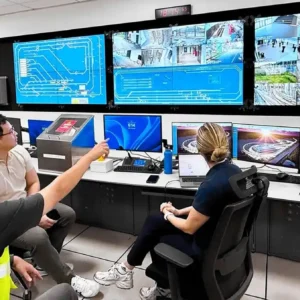
Modern technologies are gradually transforming railway transport, making it safer, more efficient, and autonomous. Robotics in this field includes a wide range of solutions aimed at automating train movement and control.
One of the main areas of robotics is the introduction of automatic train control systems, which significantly reduce human intervention in the management process. These systems vary in their level of automation and functionality but are all focused on improving safety, efficiency, and optimizing the railway network’s operation.

GoA4: Fully Autonomous Trains
Level 4 automation systems (GoA4), developed by Siemens and Alstom, allow trains to operate without a driver, handling all control functions independently. This technology is used, for example, in metro systems.
The Paris Métro has several automated lines, including Line 14 and Line 1. Line 14, known as “Météor,” was the first fully automated line in Paris. It is managed by the SACEM (Système d’Aide à la Conduite, à l’Exploitation et à la Maintenance) system, which automatically controls train speed, intervals, and stops. This line demonstrates how automation can improve the accuracy and safety of metro operations.
In Copenhagen, the metro operates on a GoA4 system, making it fully autonomous. Trains on Lines M3 and M4 are controlled without a driver. The system allows for high frequency and accuracy, as well as reduced operational costs.
In Singapore, the metro system actively uses ATO in conjunction with CBTC. The North-South and East-West lines, some of the oldest in Singapore, were upgraded to improve efficiency and train frequency. This automation has reduced train intervals and improved capacity.
The Hong Kong Metro uses CBTC to automate its train control system. Lines such as the MTR (Mass Transit Railway) demonstrate a high degree of automation, ensuring reliability and safety. Automated lines provide precise schedule adherence and reduce the likelihood of delays.
The Dubai Metro is fully automated. The train control system uses GoA4 technology, meaning trains are managed without drivers. The entire process, including train movement, stops, and interval control, is automated. This allows for high train frequency and minimizes human errors.
Fully autonomous trains not only enhance safety but also optimize transportation flows, which is particularly important for densely populated megacities. Despite the significant advantages, automation in metros also faces several challenges, including the need for high investments in infrastructure, system maintenance, and cybersecurity.
However, with technological advancements and accumulated experience, automated lines will become more widespread and effective, contributing to further improvements in urban transportation infrastructure.

ATO: Train Autopilot Systems
ATO (Automatic Train Operation) is a system integrated with CBTC (Communications-Based Train Control), which provides automatic train movement control. Companies such as Hitachi Rail and Bombardier (now Alstom) are actively implementing ATO in the metros of London and Singapore. This technology reduces train intervals, increases capacity, and ensures more accurate schedule adherence.
One of the most notable examples is the implementation of autopilot systems for trains. Both passenger and freight transport are becoming more autonomous.
In Australia, Rio Tinto, in collaboration with Wabtec (General Electric), developed and implemented the world’s first fully autonomous freight train, AutoHaul. This train can travel over 1000 km through the harsh conditions of the Pilbara region without human intervention. This breakthrough in robotics opens new horizons for railway transport in remote and challenging environments.
In Japan, JR East successfully operates freight trains controlled by autopilot systems. These systems allow trains to move along routes without a constant driver presence, reducing operational costs by optimizing fuel consumption and enhancing overall safety and predictability of movement.

European Train Control System (ERTMS)
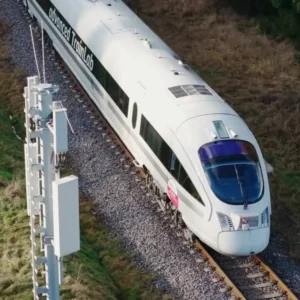
ERTMS (European Rail Traffic Management System) is a standardized European system developed by Thales, Siemens, and Alstom. It includes ETCS (European Train Control System) and GSM-R (Global System for Mobile Communications – Railway), enabling trains to travel at high speeds while maintaining a high level of safety. ERTMS is actively used on high-speed lines in Italy and Spain, facilitating the integration of railway networks across Europe.
Robotics and automation in railway transport offer numerous opportunities for increased efficiency and safety but also present challenges for the industry. Key issues include safety concerns, integrating new systems into existing infrastructure, and adapting to changing transport demands.
Modern technologies already demonstrate a significant impact on railway transport development, providing new solutions for optimizing passenger and freight transport. It is expected that robotics will become an integral part of railway systems in the future, contributing to the creation of safer, more efficient, and autonomous transportation solutions.
News from the railway business, industry, and railway technologies from Railway Supply that you might have missed:
Voith at InnoTrans 2024: Couplers and Cutting-Edge Technologies for Railways
Find the latest news of the railway industry in Eastern Europe, the former Soviet Union and the rest of the world on our page on Facebook, Twitter, LinkedIn, read Railway Supply magazine online.Place your ads on webportal and in Railway Supply magazine. Detailed information is in Railway Supply media kit