HyOrc enters U.S. market with multi-fuel engine technology
13.11.2025
HyOrc begins promoting its multi-fuel engine technology in the United States and launches a pilot project with Zeltech to test the system in real operations and, if results hold up, speed its way to market.
This is reported by the railway transport news portal Railway Supply.
How HyOrc and Zeltech plan their U.S. pilot?
The two companies have signed a memorandum of understanding, and the partners have set out shared objectives for the first phase of work.
Don’t miss…Coradia Max trains reshape Poland’s intercity market
They plan to introduce a power unit that can run on hydrogen, natural gas and other renewable fuels.
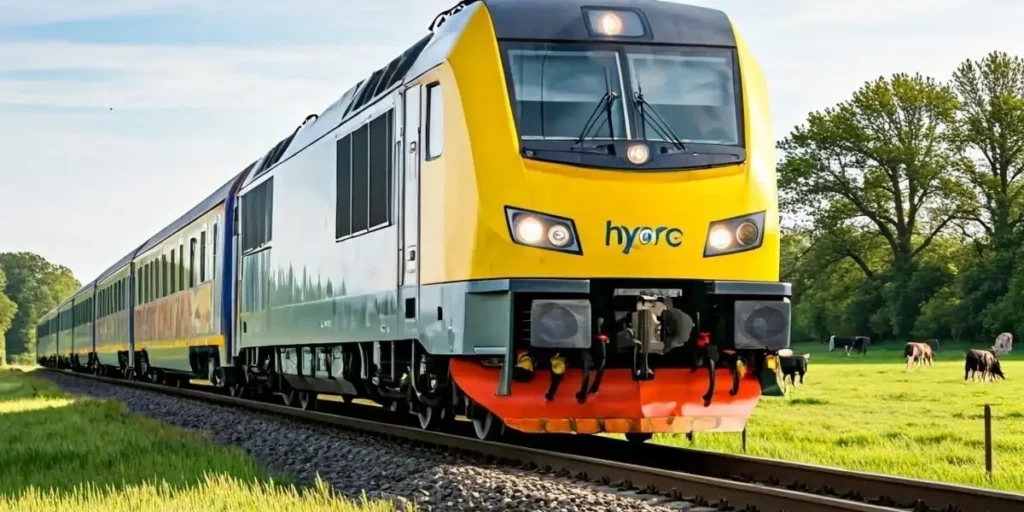
Together, the companies are preparing a locomotive for the pilot installation of the engine, so engineers are defining interfaces, control logic and test conditions.
This step sounds mundane, but in practice it determines how the prototype behaves once it is coupled to a real freight consist.
The partners also intend to seek grant support from the State of California, which has promoted low-emission transport programs for years.
To be fair, extra funding does not change the technology itself, but it could bring the pilot timetable forward and reduce financial risk for the operators involved.
Inside the engine, engineers use an organic Rankine cycle rather than hydrogen fuel cells.
The company reports thermal efficiency of about 45 percent and stresses that the design can adapt to different fuel blends over time.
Where HyOrc positions its technology in Europe?
At the same time, the company is expanding its work in Europe through cooperation with rail industry partners in Germany and Poland.
The focus there is the modernization of the TE109 mainline diesel locomotive, a familiar type on many networks in the region.
The project calls for a 2.8-megawatt power unit supplied from a 1,200-kilogram liquid-hydrogen tank.
According to the company, that configuration can provide roughly 700 kilometres of range between refuelling stops on suitable routes.
If the TE109 pilot performs as expected, the concept could scale into a broader fleet program, since locomotives of this series remain common across parts of Europe.
For many operators, the attraction lies in cutting emissions while extending the service life of existing assets.
The company also points to an earlier retrofit of a British Class 66 locomotive, where it estimates a payback period of about seven years.
Even without subsidies, that figure still gives decision-makers a concrete basis for comparing this option with other decarbonisation strategies.
Looking ahead, the company plans to deepen cooperation with locomotive manufacturers and freight operators, so that multi-fuel hydrogen solutions move from one-off pilots to regular procurement discussions.
For now, the U.S. pilot with Zeltech is the next test of that strategy.
News on railway transport, industry, and railway technologies from Railway Supply that you might have missed:
Find the latest news of the railway industry in Eastern Europe, the former Soviet Union and the rest of the world on our page on Facebook, Twitter, LinkedIn, read Railway Supply magazine online.Place your ads on webportal and in Railway Supply magazine. Detailed information is in Railway Supply media kit