GO Transit fare evasion fines rise to $200 for a first offence
Metrolinx put a steeper graduated penalty structure into force on 8 September 2026, and the new GO Transit fare evasion fines start at $200 for a first offence — nearly six times the $35 the operator had charged since 2022. The same schedule applies to UP Express, the airport service linking Union Station and Toronto Pearson.
What changed on 8 September
Under the revised Schedule “A” to Metrolinx By-law No. 7, a rider who fails to show a valid ticket when directed now faces $200 for a first offence, $300 for a second and $400 for a third. A fourth offence, previously handled as a court matter, becomes a $500 administrative fee. A fifth offence draws a Provincial Offence Notice with a set fine of $600, established by the Chief Justice of the Ontario Court of Justice. A sixth or subsequent offence brings a Part I summons and a fine of up to $1,000 on conviction.
| Offence | Until 7 September 2026 | From 8 September 2026 |
|---|---|---|
| First | $35 | $200 |
| Second | $50 | $300 |
| Third | $100 | $400 |
| Fourth | Provincial Offence Notice, set fine $200 | $500 |
| Fifth | Provincial Offence Notice, set fine $200 | Provincial Offence Notice, set fine $600 |
| Sixth and subsequent | Provincial Offence Notice, set fine $200 | Part I summons, court-determined fine up to $1,000 |
Source: Metrolinx, Schedule “A” to By-law No. 7 as approved 25 June 2026, and the operator fine pages for GO Transit and UP Express.
The cost of not paying on time
The headline figures are only a starting point. A $25 late payment fee, introduced in February 2024, applies to administrative fees left unpaid after 15 days, and the June by-law extends it to the new fourth-offence tier. A further $20 collection fee applies once a file goes to a collection agency. On the schedule published by UP Express, a first-offence notice therefore reaches $225 if paid between 16 and 74 days and $245 after 75 days; a fourth-offence notice reaches $545. Separate fees remain in place for a dishonoured payment, at $30, and for failing to attend a hearing officer appointment, at $100.
Why Metrolinx raised the penalties
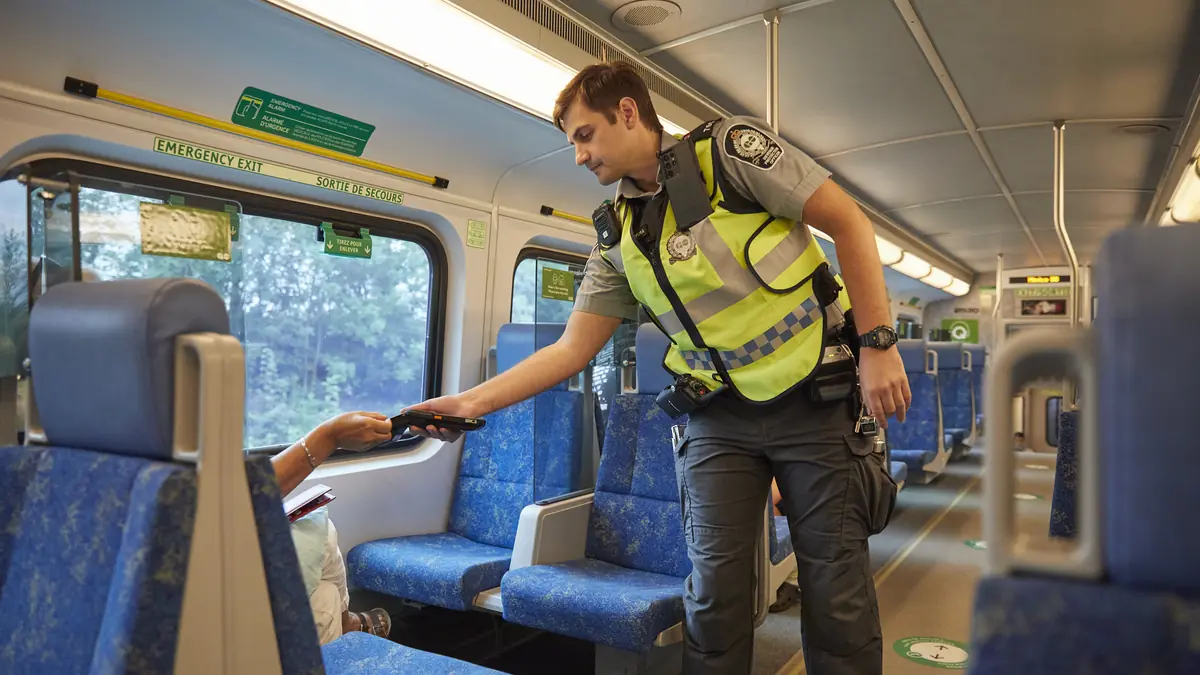
The case put to the board rests on enforcement volume rather than on the size of the fine alone. Revenue Protection officers carried out 1,557,243 on-board inspections in fiscal 2025/26, up 29.90 per cent from 1,198,823 the year before, and the network-wide fare evasion rate fell from 5.30 to 5.02 per cent over the same period.
| Measure | FY 2024/25 | FY 2025/26 | Change |
|---|---|---|---|
| On-board inspections | 1,198,823 | 1,557,243 | +29.90% |
| Fare evasion rate | 5.30% | 5.02% | −0.28 percentage points |
Metrolinx values every one-percentage-point absolute reduction in fare evasion at $4,276,598 in recovered revenue. Source: Chief Operating Officer’s report to the Metrolinx board, 25 June 2026.
Staff were explicit that deterrence works through detection rather than through severity. The report states that the “certainty of being caught is a more powerful deterrent than the severity of punishment”, and argues that graduated penalties mainly signal that repeated non-compliance carries escalating consequences. It also concedes a ceiling: inspection output cannot rise much further with the current staffing complement.
What the agency expects to collect
Metrolinx issued 77,443 Notices of Violation in fiscal 2025/26. At the old rates that represented roughly $3.04 million in face value, of which $2.31 million was actually paid. Repricing the same volume to $200, $300 and $400 lifts face value to about $16.97 million, a 461 per cent increase. Staff modelled collection at 40 to 60 per cent of the new amounts, on the assumption that riders are less willing to pay larger sums, and put expected collected revenue at $6.79 million to $10.18 million a year — an uplift of $4.48 million to $7.87 million. The $500 fourth-offence tier was excluded from that comparison, because those cases are currently issued as Provincial Offence Notices and do not contribute to notice revenue.
How the change was made
The mechanism is a by-law, not legislation. Chief Operating Officer Sean Fuller brought the amendment to the board on 25 June 2026, and the board repealed and replaced By-law No. 7 the same day, with effect from 8 September. The Government of Ontario had announced in April 2026 that Metrolinx would raise the penalty structure; the transit provisions of the province’s Building Homes and Improving Transportation Infrastructure Act concern fare alignment and a unified fare payment system, not fare enforcement penalties.
The September start date reflected lead times rather than legal delay: ticket stock had to be reprinted and fine amounts changed across internal systems and payment portals. The higher set fine at the fifth-offence tier required a separate application to the Chief Justice of the Ontario Court of Justice under the Provincial Offences Act. A public communications campaign ran over the summer ahead of the change.
What riders are told to do
The operator’s advice is unchanged in substance. The GO Transit fines page tells customers to pay before boarding and frames the increase as protection for the network rather than as a revenue measure: “Fare evasion affects everyone”, it says. A rider who receives a Notice of Violation has 15 days to pay it or to request an administrative review through the Metrolinx customer portal, with a response taking up to 30 days. A Provincial Offence Notice or a summons is handled by the courts, outside the Metrolinx screening and hearing process.