High-Speed Trains: Advanced Inspections Ensure Safety During Travel Rush
01.02.2025
High-speed trains play a crucial role in China’s transportation system, especially during peak travel seasons. To maintain safety and efficiency, advanced robotic inspections help streamline operations and ensure reliability. This was reported by the railway transport news portal Railway Supply.

Robotic Inspections Improve High-Speed Trains’ Safety Standards
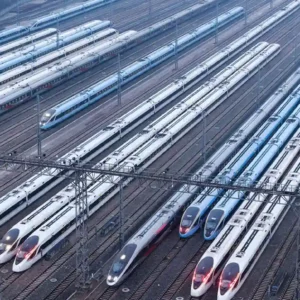
High-speed trains arrive at Nanjing South Railway Station, a critical transportation hub in Jiangsu province. Technicians and robotic inspectors stand by, prepared to conduct comprehensive safety inspections throughout the night.
Don’t miss…Azerbaijan Railways Advances Digital Transformation with ADB Grant
Robots equipped with laser radar smoothly navigate tracks, adjusting height and angle for optimal efficiency. Advanced imaging devices analyze train components, transmitting real-time artificial intelligence assessments for immediate safety evaluations.
During the 40-day Spring Festival travel rush, China’s railway system faces enormous passenger traffic and operational demands. Authorities estimate 510 million passengers will travel, requiring 14,000 daily train operations.
Ensuring passenger safety requires rigorous inspections every three days to maintain high-speed train reliability. Automated inspection technology plays a key role in expediting this process with increased efficiency.
A standard high-speed train consists of eight carriages requiring detailed checks for 10,000 components. Technicians assess bolt tightness, detect oil leaks, and monitor mechanical wear with precision tools.
Manual inspections demand two inspectors working over two hours to complete necessary assessments. Automated robotic systems reduce inspection times to one hour, with human oversight lasting only ten minutes.
“Robots enhance efficiency by tripling inspection speeds while improving working conditions for employees,” said Qi Zhengang, a senior railway inspector. Enhanced automation accelerates safety processes without compromising accuracy.
Smart robotic inspectors are not exclusive to Jiangsu but also deployed in Jinan, Beijing, and Shanghai. High-speed railway safety nationwide benefits from widespread implementation of artificial intelligence technology.
AI Technology Enhances Maintenance for High-Speed Trains
Diverse high-tech solutions strengthen safety across China’s extensive high-speed railway network. Authorities employ drones and smart monitoring systems to optimize maintenance procedures efficiently.
Electricity remains the primary energy source for China’s high-speed trains, demanding advanced infrastructure for power stability. The Haogang substation in Guangdong utilizes drones to monitor electrical performance.
Drones equipped with infrared, ultraviolet, and sonic imagers inspect the Guangzhou-Shenzhen-Hong Kong railway section. These high-tech devices convert invisible electrical currents into visual data for efficient assessments.
“Cutting-edge drone technology reduces maintenance time from thirty to fifteen minutes,” said Tan Chuanbin, a substation employee. This advancement ensures railway safety amid rising energy demands.
Artificial intelligence-driven drones monitor geological hazards and unstable rock formations along mountainous railway routes. These systems prevent potential disruptions and mitigate risks affecting railway operations.
Southwestern provinces like Guizhou and Sichuan employ drone technology to enhance railway safety. Smart monitoring systems play a crucial role in preventing disruptions along high-risk terrain.
China’s high-speed rail system has experienced unprecedented growth in recent years. The total operational railway length increased from 8,358 kilometers in 2010 to 48,000 kilometers by 2024.
Continual advancements in railway technology drive China’s high-speed train infrastructure development. Innovation remains a fundamental force shaping the future of high-speed transportation across the country.
“China’s railway expansion depends on continuous technological progress and AI-driven innovations,” said Duan Wei, deputy chief at the Huai’an railway section. He emphasized the importance of evolving safety measures.
Future railway technology will integrate artificial intelligence and the Internet of Things for real-time monitoring. Predictive warning systems will enhance safety standards and prevent potential train malfunctions.
Authorities remain committed to ensuring passenger safety through advanced inspection systems. Intelligent robotics and AI-powered monitoring promise a more efficient and secure railway experience.
Source: www.chinadaily.com.cn
News on railway transport, industry, and railway technologies from Railway Supply that you might have missed:
Don’t miss…Namo Bharat Trains Offer Exclusive 10% Discount for Digital Travelers
Find the latest news of the railway industry in Eastern Europe, the former Soviet Union and the rest of the world on our page on Facebook, Twitter, LinkedIn, read Railway Supply magazine online.Place your ads on webportal and in Railway Supply magazine. Detailed information is in Railway Supply media kit