
East River Tunnel Line 2 Reopens on Rebuilt Direct-Fixation Track
In the United States, East River Tunnel Line 2 returned to service on 17 August after Amtrak rebuilt its interior, replacing ballasted track with direct fixation.
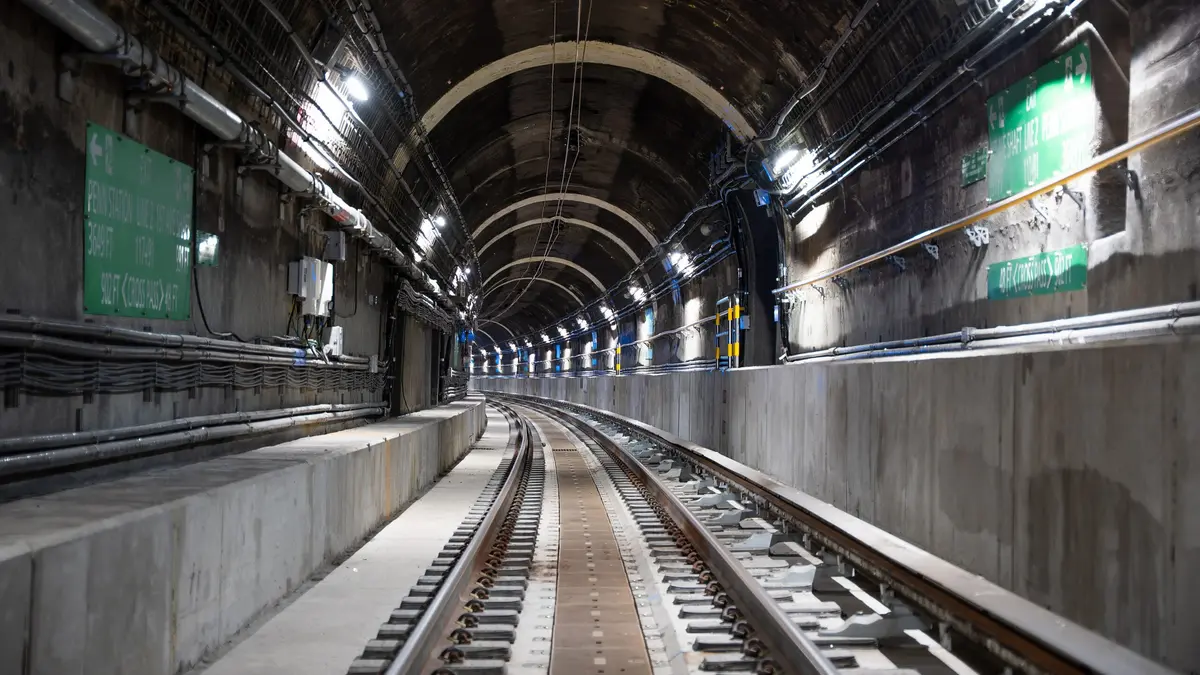
The reopening completed the first phase of Amtrak’s rehabilitation of the two East River Tunnel tubes damaged by Superstorm Sandy.
Crews began by emptying the old tube. Amtrak’s June progress update puts the removals at 24,000 linear feet of running rail and 12,000 feet of third rail. Ballast came out at 8,100 tons, along with 8,000 timber ties.
Crews then removed approximately 24,000 linear feet of benchwall throughout the tunnel, representing about 20,000 cubic yards of concrete. The work stripped the tunnel down to its concrete liner.
What replaced the ballast and the 1910 bench walls
Direct fixation holds the rail on a concrete base instead of bedding it in ballast. Amtrak’s project fact sheet says the conversion improves drainage integration, while its June 2026 update also identifies improved ride quality as a benefit. The walkways changed shape as well. The original tube carried two tall bench walls. Now there is a high wall on one side and a low wall opposite. Amtrak set out that layout in December as a way to improve emergency egress. It also lets staff reach the underside of a stopped train. In December 2025, Amtrak projected that the completed Line 2 would contain approximately 14,000 cubic yards of new concrete.
The rebuilt tube also contains new signalling, drainage, standpipe, communications and traction-power systems, together with heat and smoke detection. Outside the east portal, meanwhile, a steel utility bridge provides a route for signal and traction-power cables over the Long Island Rail Road tracks. Crews set it in place during a 55-hour weekend closure. Four signal huts, assembled by an Amtrak team in Lancaster, Pennsylvania, hold the electronics for the new signalling.
| Tunnel element | Before the rebuild | After the rebuild |
|---|---|---|
| Track form | Ballasted track | Direct-fixation track system |
| Bench walls | Two high walls, one on each side | One high wall, one low wall |
| Inside the bench walls | Concrete holding steel, rebar, cables and terracotta conduits | New cable conduits |
| Drainage | Blocked drainage systems, found once the tube was stripped | New drainage system, integrated with the track form |
| Electrical conduits | Conduits in poor condition, found once the tube was stripped | New conduits |
| Tunnel systems | Decades-old systems, taken out when the outage began | New signals, traction power, communications and standpipe systems |
Scope: the Line 2 tube only, during the closure that ended on 17 August 2026. Compiled by Railway Supply from the Amtrak East River Tunnel Rehabilitation Project fact sheet of 21 January 2025 and the Amtrak project updates of 18 December 2025 and 18 June 2026.
What the demolition uncovered
Stripping the tube to its concrete liner gave crews access to areas that had been hidden for decades. Amtrak reported blocked drainage systems, deteriorated conduits and widespread water infiltration. For the railroad, those findings are the case against patch repairs. The age, density and composition of the concrete made demolition especially difficult. The benchwalls contained concrete, rebar, terracotta conduits, cables and steel. Crews used hydraulic rock splitters and robotic demolition machines to complete the work. At peak, about 350 people were on site each day. Round-the-clock access helped too, because night and weekend windows would have stretched the same job out.
How New York challenged the full-closure method
The full-closure method drew objections before construction began. Governor Kathy Hochul urged Amtrak to consider a repair-in-place approach using night and weekend work instead of closing a tube continuously for more than a year.
On 22 May 2025, immediately before the long-term outage began over Memorial Day weekend, Hochul convened Amtrak and MTA leaders. She later said Amtrak had agreed to provide additional shift crews, enhanced inspections and an operational response plan. Amtrak also accepted her request to use experience from Line 2, including third-party consultants, when determining the approach to Line 1. Hochul nevertheless maintained her opposition to a full shutdown.
Hochul said in May 2025:
“I continue to believe this work could be accomplished without a full shutdown.”
Line 1 next, and the dates behind the 2027 target
Line 1 is scheduled to close this autumn for the same scope of work. Hardening work comes first, meant to keep the open tubes reliable while it is out. Amtrak says the $1.6 billion programme sits inside budget and still finishes at the end of 2027. Three of the four tubes remained available during the Line 2 outage. Together the four carry more than 450 Amtrak, LIRR and NJ TRANSIT trains a day. The route runs between Penn Station and Queens.
The return date itself moved twice in the final year. In December 2025 Amtrak was still naming July 2026 for the resumption of service. By June 2026 that had become early August. Trains ran on 17 August. The experience gained in Line 2 will now inform the efficiency, sequencing and construction methods used for Line 1.
| Amtrak document | Published | Date given for Line 2 |
|---|---|---|
| Project fact sheet | 21 January 2025 | 2026, first tube reopens |
| Project update, “From Demolition to Renewal” | 18 December 2025 | July 2026 |
| Project update, “Moves Closer to Service Restoration” | 18 June 2026 | Early August 2026 |
| Press release on the first phase | 17 August 2026 | Service restored, 17 August 2026 |
Each entry is the date named in that document at the time it appeared; the column does not show revisions made later. Compiled by Railway Supply from Amtrak publications.


