Amtrak Cascades Airo Trainsets Set to Add Seats After 2025 Capacity Cut
In the United States, Amtrak Cascades Airo trainsets will enter revenue service on 30 September, with two sets carrying passengers and a third held in reserve.
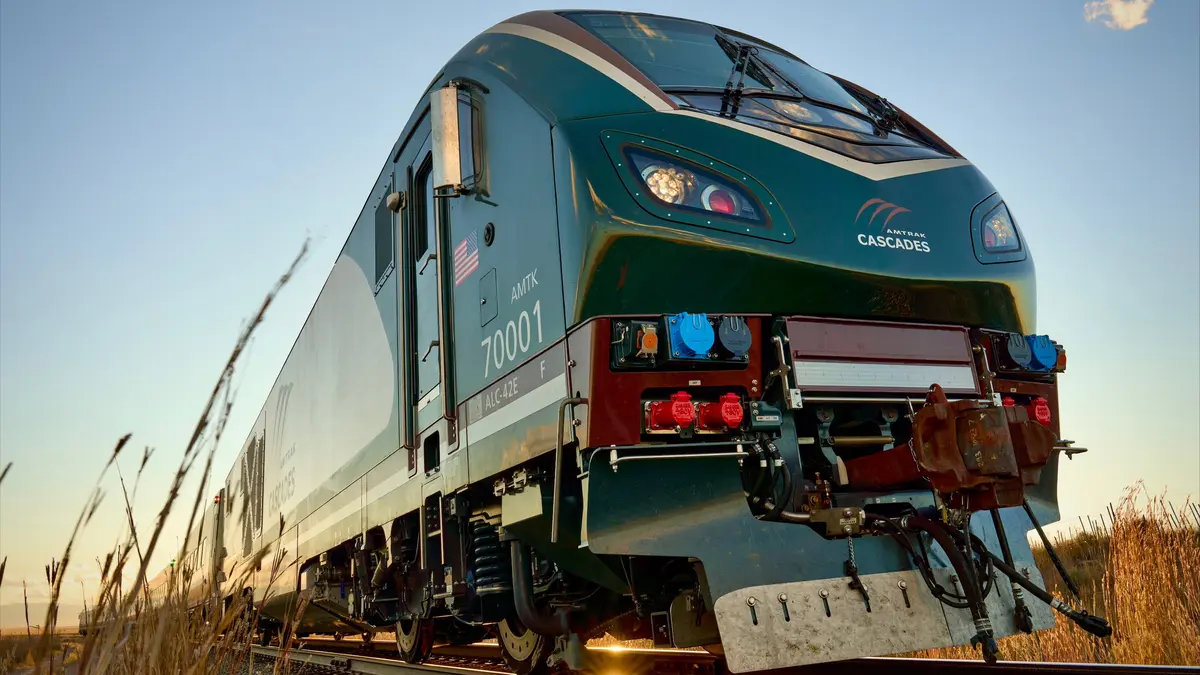
WSDOT announced the date on 10 September during a meeting of the Puget Sound Regional Council Transportation Policy Board. The initial assignments will cover one Seattle–Vancouver, B.C. round trip and one Seattle–Eugene round trip.
For the corridor, one immediate effect will be more seats. Each new set carries more than 300 passengers. The two Talgo Series 8 sets owned by Oregon seat roughly 250. Also, the corridor has run shortened consists for much of the past year. The extra capacity will therefore arrive after a measurable loss.
| Equipment | Seats per trainset | Status |
|---|---|---|
| Airo trainset | More than 300 | Eight on order for the corridor, together with two locomotives and a spare cab car |
| Talgo Series 8 | About 250 | Two sets owned by the Oregon Department of Transportation, 13 cars each |
The Airo fleet will lift the top seat count of a Cascades trainset above 300, compared with about 250 on the Talgo sets it will join.
Capacity, not demand, held the corridor back in 2025
Ridership fell 8% in 2025, to 916,000. WSDOT linked the setback to the equipment shortage that followed Amtrak’s withdrawal of Horizon cars in late March because of corrosion concerns. Lower-capacity Amfleet replacements reduced seating capacity by 20% for the rest of the year while demand remained high. Ticket revenue fell only 2.7%, to $39.9 million.
| Year | Riders |
|---|---|
| 2016 | 817,000 |
| 2017 | 811,000 |
| 2018 | 802,000 |
| 2019 | 824,000 |
| 2020 | 172,000 |
| 2021 | 251,000 |
| 2022 | 427,000 |
| 2023 | 746,000 |
| 2024 | 993,000 |
| 2025 | 916,000 |
Even with 20% fewer seats from late March, 2025 stayed the second-busiest year of the decade on the corridor.
Two other numbers moved the other way. Farebox recovery on Washington-supported trains rose from 52.9% to 54.5%. At WSDOT’s direction, Amtrak moved to aggressive pricing and revenue management after capacity fell. Meanwhile, on-time performance climbed from 49% to 61% across the same year. Seattle-Portland carried 58% of riders in 2025, and the Vancouver, B.C.-Seattle segment carried 20%.
Eight trainsets, and why the launch waited for three
The Cascades order covers eight trainsets, two locomotives and a spare cab car. The first set reached Seattle on 16 May and the second on 23 August. Trainset seven left the factory on 13 August. WSDOT said service could begin once three fully tested sets were in the region and onboard and mechanical staff had completed training.
Siemens builds the equipment. Cascades is the launch corridor for a national programme of 83 Airo trainsets. All eight Cascades sets are due to complete manufacturing in 2026. Northeast Regional sets, by contrast, should begin revenue service in 2027.
King Street Yard sets the pace for the wider fleet
Each Airo runs as one trainset rather than a rake of separate cars. That shifts what a depot has to do. At its King Street Yard in Seattle, Amtrak is building a maintenance and inspection facility of nearly 100,000 square feet. The building holds two bays, plus a separate service and cleaning bay. That work is scheduled for completion in 2027.
Related investments are under construction, under contract, in procurement or in planning at six Amtrak yards, including Seattle.
For now, the timetable stays as it is. Amtrak Cascades runs six Seattle-Portland round trips each day. Two more link Seattle with Vancouver, B.C., and two link Portland with Eugene.


