City Rail Link records 72,500 boardings by 5pm on first weekday
In New Zealand, Auckland Transport counted about 72,500 rail-network boardings by 5pm on Monday 14 September, the City Rail Link’s first weekday of passenger service.
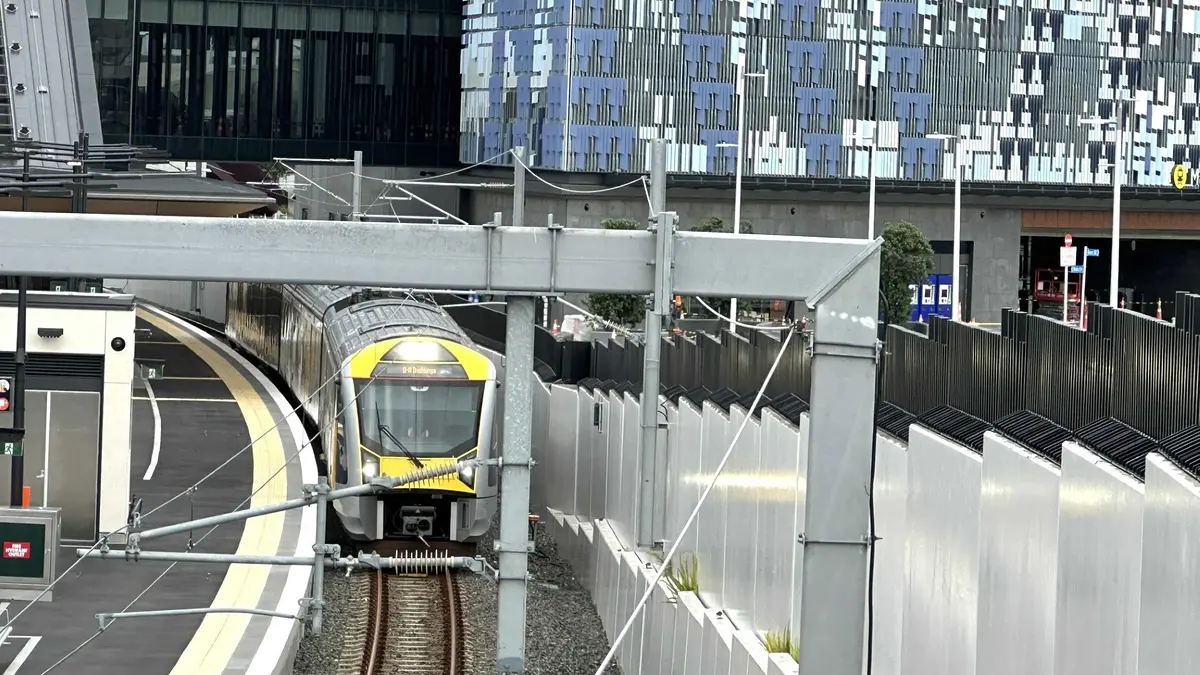
That was roughly 25,000 more than by the same time a week earlier. In a 10.17am update, the agency said trains had so far achieved 99% punctuality, meaning they arrived at their destination within five minutes of the scheduled time.
First weekday morning peak produces about 25% more boardings
Early data showed about 24,000 boardings by 9am. A week earlier, the same point of the morning had produced roughly 19,000. Consequently, the peak ran about 25% above the pre-opening baseline. The first service of the new weekday timetable left Pukekohe at 5.06am and reached Karanga-a-Hape at 6.15am.
Auckland One Rail, which operates the city’s suburban services, had 84 trains in service, operated by 200 drivers and supported by 150 train managers. More than 100 customer service staff and ambassadors worked across the stations, while more than 100 security staff were also present. Teams concentrated on Karanga-a-Hape and Maungawhau, where passengers change between the East-West, South-City and Onehunga-West lines.
Opening Sunday set a patronage record
Passenger services began a day earlier, on Sunday 13 September, with the first weekday timetable following on Monday. The first train to reach a new underground station left Ōtāhuhu at 4.57am. It pulled into Karanga-a-Hape at 5.22am, on schedule. More than 400 people had gathered at Ōtāhuhu before dawn to ride it.
Demand then ran far above a normal Sunday. Counters registered about 61,000 boardings by 5pm. That figure was more than three times the equivalent count a week before. Auckland Transport later put the full day at roughly 70,000 boardings. It called the day the busiest Sunday in the history of the city’s rail network.
| Measurement point | Estimated boardings | Same point, previous week |
|---|---|---|
| Sunday 13 September, by 5pm | About 61,000 | Not published; the current count was more than three times the count recorded at the same time on 6 September |
| Sunday 13 September, full day (early estimate) | About 70,000 | Not published; the current estimate was at least three times the previous Sunday’s total |
| Monday 14 September, by 9am | About 24,000 | About 19,000 |
| Monday 14 September, by 5pm | About 72,500 | About 47,500 (Railway Supply calculation from two rounded Auckland Transport figures) |
All values are boardings across the whole Auckland rail network, not entries to the new underground stations. Sunday and Monday figures rest on separate counting points, so the two days are comparable only against their own equivalents a week earlier. Source: Auckland Transport service updates of 13 September 2026 and operational updates of 14 September 2026.
Cable fire at Waitematā halted trains through City Rail Link
Yet the launch was not trouble-free. Services through the tunnels stopped at about 6am on Sunday after smoke and a small electrical fire were discovered in a lighting cable inside a panel above a platform at Waitematā. The project turned the downtown station from a terminus into a through station. Auckland Transport said the fire was unrelated to City Rail Link systems.
Staff evacuated Waitematā, while Te Waihorotiu and Karanga-a-Hape were evacuated as a precaution under standard safety procedures for when trains cannot run through the tunnels. Fire and Emergency New Zealand crews extinguished the fire and gave clearance at 6.23am. Services resumed within an hour. Trains detoured around the three stations during the disruption, and the network then needed time to bring services back into sync with the timetable.
Before opening, the agencies had rehearsed this kind of incident in detail. The programme covered 15 live exercises, with more than 1,400 volunteers acting as passengers. Around 200 personnel and more than 50 emergency-service vehicles took part. Scenarios included station fires, train failures in tunnels, derailments, onboard medical incidents and complex evacuations across multiple stations.
Initial timetable still holds frequency in reserve
The opening timetable does not use the maximum frequencies planned for the network. As Railway Supply reported before the opening, Auckland Transport built the initial timetable around a five-minute peak interval through the city centre. Elsewhere the interval averages about ten minutes, while the three lines run every 15 minutes off-peak. The agency intends to raise peak frequencies outside the centre once it gains more confidence operating the new pattern. The first two days therefore measure demand against the initial service level rather than against the maximum frequencies planned for the network.


