Amtrak rejects Transcontinental Chief over business case
02.01.2026
Amtrak rejects Transcontinental Chief after looking over a private proposal that promised a single, continuous New York City–Los Angeles run—rather than the familiar coast-to-coast trip that takes about three days and requires two separate train rides.
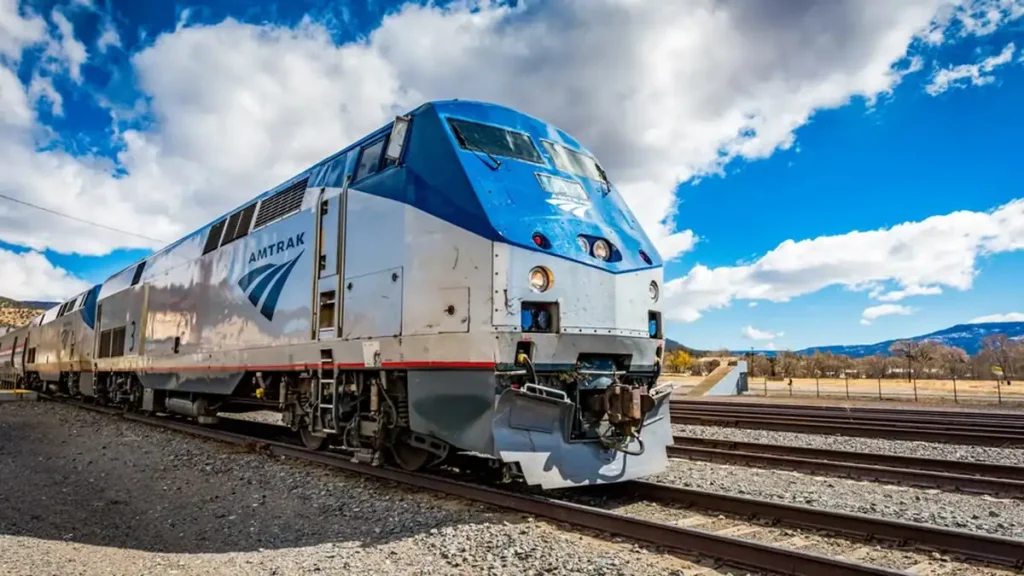
This is reported by the railway transport news portal Railway Supply.
The pitch came from AmeriStarRail (ASR). Amtrak, however, answered with a firm “no,” pointing to what it sees as a missing business foundation.
Don’t miss…Northumberland Line extra carriages urged after demand surge
ASR described the idea as a more convenient NYC–LA continuous train route and linked it to major national events. In an open letter, AmeriStarRail’s Chief Operating Officer, Scott Spencer, said the “Transcontinental Chief” could be operational by May 10, 2026—timed, he argued, for America’s 250th birthday and the 2026 FIFA World Cup. Even with that framing, online discussion suggested many riders were glad the proposal did not move forward.
Why Amtrak rejects Transcontinental Chief?
Days before Christmas, Amtrak turned down the AmeriStarRail (ASR) proposal. In a statement to FOX43, Amtrak said the Delaware-based group was “lacking a fundamental business case to support its lofty proposal.” The company also said it is “not considering” ASR’s plan of combining freight and passenger routes to develop a New York City–Los Angeles service—a decision also summarized in Railway Supply.
Spencer disputed how the process unfolded. He argued that if Amtrak is serious about attracting private investment in a joint venture, it needs “serious meetings and discussions,” and he said Amtrak never did that. As he put it, Amtrak had only the open letter to go on because ASR shared the pitch publicly rather than through a private negotiating process.
Still, Spencer said he remains optimistic. He pointed to a Dec. 4 Board of Directors meeting where an Amtrak board member said the company was “very anxious to explore” private partnerships. Spencer has said he now wants to work with Congress, the U.S. Department of Transportation, and the Federal Railroad Administration to get Amtrak on board. He has also expressed hope that the transcontinental service could operate by 2028, as Los Angeles hosts the Summer Olympics.
What AmeriStarRail’s Transcontinental Chief proposal included?
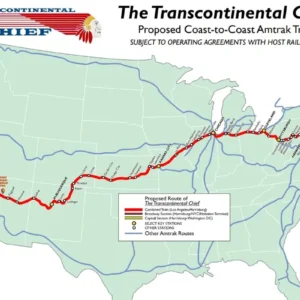
AmeriStarRail presented the “Transcontinental Chief” as a way to streamline long-distance travel by effectively replacing two existing Amtrak services: the Southwest Chief (Chicago–Los Angeles) and the Pennsylvanian (New York City–Pittsburgh). The central promise was a continuous 72-hour trip between New York City and Los Angeles on a single train.
ASR also highlighted engineering and infrastructure incompatibility along the corridor between the coasts, then offered a workaround: start the service in Hoboken, New Jersey. The company cited Hoboken’s outdoor low-level platforms as a better fit for its operating plan than Manhattan’s Penn Station, which has higher platforms and narrow, low-hanging tunnels under the Hudson River.
In outlining the route concept, ASR listed major stops as:
- Hoboken, NJ (for riders coming from New York, NY)
- Harrisburg, PA
- Pittsburgh, PA
- Cleveland, OH
- Chicago, IL
- Kansas City, MO
- Albuquerque, NM
- Los Angeles, CA
As part of the same open-letter pitch, ASR described a broader vision for the Northeast Corridor (NEC), saying it could address common passenger pain points. In the letter to Amtrak President Roger Harris, the company claimed its “proprietary operating techniques” would help prevent chronic train delays and service disruptions, referencing what it called Amtrak’s previous “inefficient operation of lengthy trains for mail and express services.”
Passenger reactions and concerns about a hybrid freight plan
The pushback didn’t only come from Amtrak. In online discussions—especially in r/transitcommunity and r/trains—Redditors largely supported Amtrak’s rejection and questioned whether ASR’s proposal was fully formed. Some commenters argued that AmeriStarRail regularly promotes big ideas that don’t progress, and they referenced other pitches, including a NextGen Acela rival described as the U.S.’ first-ever high-speed coach train service—also ignored by Amtrak.
One point that drew particular skepticism was the freight-passenger concept itself. Commenters noted that ASR had even proposed doing the Transcontinental Chief with long-haul truckers—loading a long-haul truck onto a flatbed while the driver rides as a passenger—an approach discussed in a FreightWaves report. In that framing, the “Transcontinental Chief” becomes not just a passenger service, but a hybrid passenger train that also carries trucks.
Others compared the proposal to an earlier Amtrak experiment: the Heritage Transcontinental Sleeper. That through-car service began operating in the 1970s and ran between New York City and Los Angeles using the Sunset Limited and Crescent trains. It was fully phased out by the 1990s, with commenters citing the labor-intensive, time-consuming car switches required in rail yards and the high operational cost that came with those moves.
The passenger experience had drawbacks, too. Riders could stay in bed while the car was switched, but the process involved a 4- to 6-hour layover and could bring midnight or early-morning noise. The full coast-to-coast offering was also described as underutilized, with many passengers traveling only parts of the overall route rather than the entire trip.
ASR’s pitch aimed to eliminate the switching problem, but critics pointed to a different risk: higher maintenance costs tied to heavy-load friction on freight railroads if trucks are part of the consist. Against that backdrop, the latest decision—Amtrak rejects Transcontinental Chief and says it is not considering the plan—landed with many riders as a strategic choice rather than a lost opportunity.
News on railway transport, industry, and railway technologies from Railway Supply that you might have missed:
Find the latest news of the railway industry in Eastern Europe, the former Soviet Union and the rest of the world on our page on Facebook, Twitter, LinkedIn, read Railway Supply magazine online.Place your ads on webportal and in Railway Supply magazine. Detailed information is in Railway Supply media kit