Amtrak Rejects AmeriStarRail’s “Transcontinental Chief” Proposal: What It Means And What Comes Next
10.01.2026
Amtrak rejects Transcontinental Chief proposal after reviewing AmeriStarRail’s privately pitched coast-to-coast service concept, as outlined by Railway Supply.
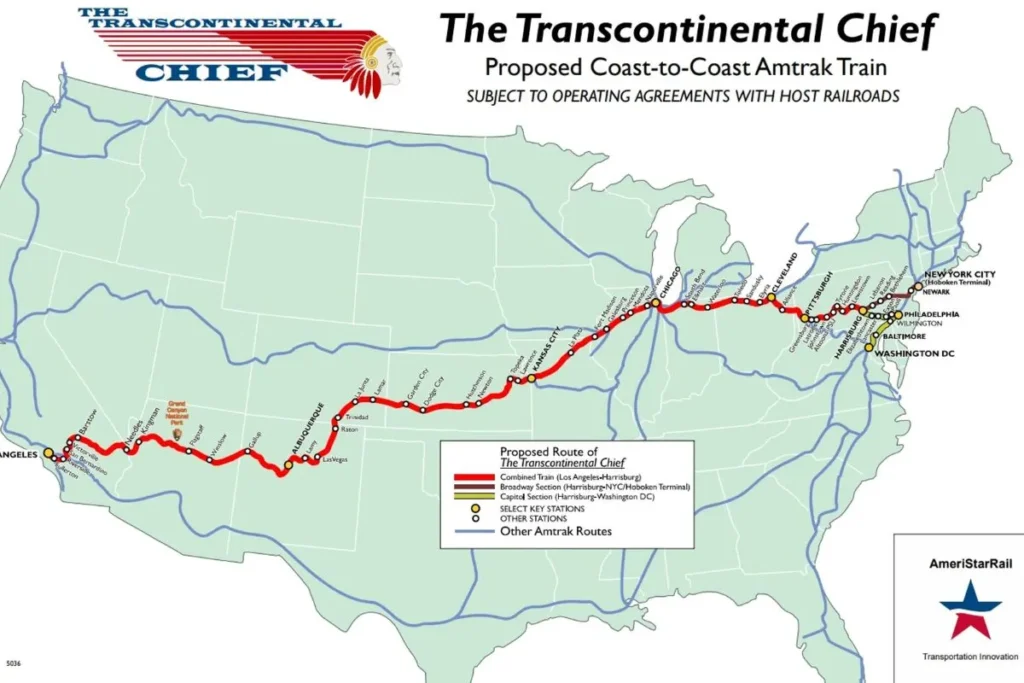
The plan was framed as a single New York–Los Angeles passenger rail service with an under-72-hour travel time and additional service elements. Amtrak said the concept was “lacking a fundamental business case,” and AmeriStarRail says it will seek help from Congress and federal agencies to bring the two sides back into talks.
Key points at a glance
- Amtrak says it reviewed the AmeriStarRail Transcontinental Chief concept and rejected it because it lacked a “fundamental business case.”
- The under-72-hour coast-to-coast train concept was promoted as a New York–Los Angeles run, with Harrisburg included and service described for multiple Pennsylvania communities.
- Coverage described an Auto Train-style vehicle-carrying element and a hybrid freight-and-passenger approach that Amtrak said it is not considering.
- AmeriStarRail argues the proposal cannot move forward without Amtrak and says it will pursue Congress and federal agencies involvement to bring Amtrak back to talks.
What AmeriStarRail proposed for a New York–Los Angeles passenger rail service?
AmeriStarRail presented the “Transcontinental Chief” as one continuous coast-to-coast trip meant to be more direct than today’s multi-train options. The company described a New York–Los Angeles schedule of under 72 hours and placed Harrisburg, Pennsylvania within the plan. Railway Supply’s coverage also said the concept would extend service to more than a dozen other communities in Pennsylvania.
Reports also made clear this was not framed as a standard long-distance passenger train. FreightWaves and other outlets described an Auto Train-style vehicle-carrying element—moving passenger vehicles alongside travelers—along with service components that went beyond a passenger-only proposal.
AmeriStarRail has said it could move quickly by relying on existing equipment. In descriptions tied to earlier Trains.com coverage from July 2025, the company referenced Amtrak locomotives and passenger cars, plus TTX flatcars and auto carriers. Related documentation referenced a potential May 10, 2026 target as part of that pitch.
Why Amtrak said the plan lacked a “fundamental business case”?
The clearest explanation attributed to Amtrak has stayed consistent across coverage. In a statement reported by FOX43, Amtrak said the proposal was “lacking a fundamental business case to support its lofty proposal.” That wording was then repeated in later reporting, including FreightWaves and Railway Supply’s follow-up.
Amtrak also did not frame the decision as something that could be resolved with revisions. In the same FOX43 reporting, the company said it was not considering the combined approach for developing a New York–Los Angeles service described in the proposal. In practical terms, that left little ambiguity about how Amtrak viewed the concept as presented.
This is also where readers searching for why Amtrak rejected Transcontinental Chief keep landing: the publicly stated rationale focused on fundamentals and viability rather than a generic “too ambitious” label.
What comes next: Congress and federal agencies involvement?
After the rejection, AmeriStarRail’s stated next step is to move beyond a direct back-and-forth with Amtrak. As summarized in reporting, the company says it will lobby Congress and federal agencies to encourage Amtrak to re-engage and reopen negotiations—an approach also described by FreightWaves.
That shift changes the story from a service concept pitch into a governance and policy debate. The open question is whether any federal actors take steps that materially influence Amtrak’s position; the coverage referenced in the original material does not confirm such a change in the late-December and early-January window.
Why this proposal drew extra attention?
One reason the “Transcontinental Chief” concept drew attention is that it was presented as more than an additional service layered onto the existing map. Trains.com reported the plan would have replaced two named services—the Southwest Chief and the Pennsylvanian—with the proposed “Transcontinental Chief” service.
A replacement scenario naturally raises questions about timetables, equipment availability, and operational tradeoffs. Those are the kinds of issues that typically sit inside a “fundamental business case,” which is what Amtrak cited when it rejected the proposal.
What we know and what we don’t know yet?
What we know from reported statements and summaries:
- Amtrak rejected the proposal and cited the absence of a “fundamental business case.”
- The plan was presented as a New York–Los Angeles train under 72 hours, with reporting describing an Auto Train-style vehicle-carrying element.
- AmeriStarRail says it will seek congressional and federal involvement to bring Amtrak back to negotiations.
What remains unclear based on what is publicly described:
- A detailed, independently validated financial model, including ridership assumptions, pricing, operating costs, and how risks would be allocated.
- The practical details of how vehicle carrying would work at terminals and stations across a multi-day, coast-to-coast route.
- Whether any lawmakers or federal agencies will take concrete steps that change Amtrak’s stance; the referenced coverage does not confirm such a shift.
Was this proposal approved for launch in 2026?
No. Coverage referenced a proposed May 10, 2026 target date as part of AmeriStarRail’s pitch, but Amtrak rejected the proposal.
Did Amtrak reject it because it was “too ambitious”?
Amtrak’s reported reason was the lack of a “fundamental business case,” not “ambition” in general.
Was it a standard passenger-only long-distance train?
Reporting described vehicle-carrying/Auto Train-style features and a hybrid concept that Amtrak said it is not considering.
Would it have changed existing Amtrak services?
Yes. Trains.com reported it would have replaced the Southwest Chief and the Pennsylvanian with the proposed service.
What does AmeriStarRail want Congress to do?
As summarized in reporting, AmeriStarRail’s position is that congressional and federal involvement is needed to bring Amtrak back to negotiations.
Timeline of the story so far
- June–July 2025: Coverage and supporting documents described the AmeriStarRail Transcontinental Chief concept, including equipment assumptions and a May 10, 2026 target mentioned in proposal materials.
- Dec. 23, 2025: FOX43 reported that Amtrak rejected the proposal, citing a missing business case.
- Dec. 26–28, 2025: FreightWaves and Trains.com summarized and expanded on the reported details and implications.
- Jan. 2, 2026: Railway Supply published a follow-up recap and context piece on the rejection and AmeriStarRail’s response.
News on railway transport, industry, and railway technologies from Railway Supply that you might have missed:
Find the latest news of the railway industry in Eastern Europe, the former Soviet Union and the rest of the world on our page on Facebook, Twitter, LinkedIn, read Railway Supply magazine online.Place your ads on webportal and in Railway Supply magazine. Detailed information is in Railway Supply media kit