Victoria targets 21-tonne axle loads across regional rail lines
Released on 16 September, the Victorian Rail Freight Plan 2026-2036 calls for a 10-year maintenance and upgrade plan to bring regional lines to a minimum 21-tonne axle load (TAL).
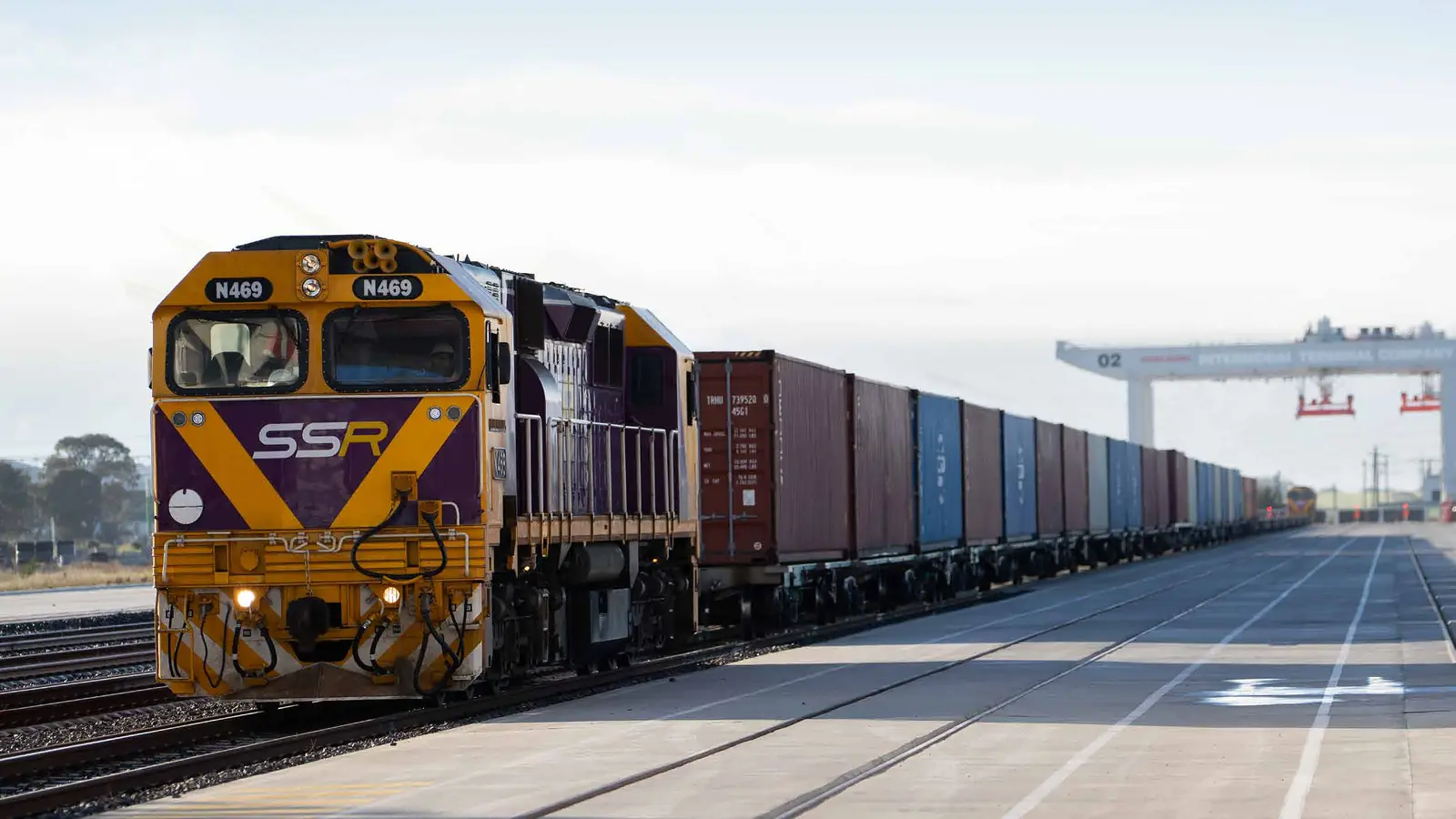
Ports and Freight Minister Melissa Horne launched the plan, which the Victorian Freight Plan 2025-30: Victoria Delivers listed as a commitment when it was published in August 2025. The Department of Transport and Planning (DTP) groups the plan’s 10 actions under three objectives: more predictable availability of the network, stronger weight for freight access in network and project decisions, and support for private investment in rail freight.
| Action | Objective | What DTP will deliver |
|---|---|---|
| 1 | Network predictability | A 10-year maintenance and upgrade plan to lift the regional network to at least 21 TAL |
| 2 | Network predictability | Regular public reporting on plan indicators through an online dashboard |
| 3 | Network predictability | A program to make rail freight data easier to share across access, operations, maintenance and planning systems |
| 4 | Freight access in decisions | A Freight Rail Disruption and Service Continuity Management Framework |
| 5 | Freight access in decisions | Freight punctuality indicators and an updated Freight Access Arrangement in MR5 |
| 6 | Freight access in decisions | A review, with industry, of the Rail Access Guidelines and maximum access prices following completion of the MR5 process |
| 7 | Freight access in decisions | A cross-agency committee on freight network planning and performance |
| 8 | Private investment | A Rail Freight Concierge service offering operators early, non-binding advice |
| 9 | Private investment | A corridor-based network vision prepared with industry, backed by an economic and commercial assessment of each corridor |
| 10 | Private investment | Continued work with the Port of Melbourne and shuttle operators on port rail access compared with road |
The plan groups seven of its 10 actions under network predictability and freight access, and three under private investment. None of the actions carries a funding commitment. Source: Freight on track: The Victorian Rail Freight Plan 2026-2036, Department of Transport and Planning, pages 27–31.
Axle load target and network funding
The axle load commitment heads the plan’s list of actions. DTP says a long-term funding strategy for regional maintenance and upgrades, including passing loops and signalling, will lift efficiency and capacity over time. Priorities are to be set by an economic and commercial assessment of each freight corridor, and the share of the network rated 21 TAL is one of the indicators the plan will track.
A separate action asks DTP to prepare a long-term network vision with industry, corridor by corridor. It will weigh options such as 23-tonne axle loads on major lines, gauge standardisation, new holding tracks and passing loops, and the reopening of closed lines. The plan describes further standardisation of the broad-gauge network as unlikely in the medium term because the work is highly capital intensive.
The plan itself contains no new funding commitment. Its stated aim is to create the conditions for private and network investment to grow, without committing funding. According to the government, $598 million has gone into regional freight lines since 2020, a total that counts $127 million from the 2026-27 State Budget.
The 21-tonne target in the Murray Basin Rail Project
Victorian freight policy has aimed for this standard before. The 2015 business case for the Murray Basin Rail Project planned to convert standard-gauge branch lines to 21 TAL. In a March 2020 audit, the Victorian Auditor-General’s Office found that the Murray Basin route to key export ports still carried a 19-tonne limit for most standard-gauge operators. It added that 21 TAL was achievable only with specific wheel and wagon configurations because of the Ararat to Maryborough section. The audit does not cover works completed after 2020.
Freight access on the metropolitan network
Most of the remaining actions deal with how freight trains obtain paths on track shared with passenger services. Industry told DTP during consultation that disruptions and uneven network performance hold them back from committing more freight to rail.
DTP will draw up a Freight Rail Disruption and Service Continuity Management Framework. It will require consultation with operators so that disruption timing is aligned with freight paths and industry operating cycles, including the avoidance of peak harvest periods. The next Metropolitan Rail Franchise, known as MR5, is to include new indicators on the punctuality of freight movements in Melbourne and an updated Freight Access Arrangement. Following completion of the MR5 process, DTP will review the Rail Access Guidelines and maximum access prices with industry.
A cross-agency committee will oversee freight network planning and performance. A Rail Freight Concierge service inside DTP will give operators early, non-binding guidance on train paths and network capability.
Port shuttles and the Dandenong South terminal
The $58 million Port Rail Shuttle Network, a joint federal and state initiative, links the Port of Melbourne with suburban intermodal terminals. Shuttle trains began running between the port and the Intermodal Terminal Company’s Somerton terminal in November 2025, and the plan expects services from Altona and Dandenong South to follow. Salta Properties will start building its Dandenong South terminal in 2027, the government said.
| Terminal | Operator or developer | Status |
|---|---|---|
| Somerton | Intermodal Terminal Company | Shuttle trains to the Port of Melbourne running since November 2025 |
| Altona | SCT | Shuttle services expected to start progressively |
| Dandenong South | Salta Properties | Rail spur to the site boundary finished in September 2022; terminal construction due to start in 2027; shuttle services expected later |
Only the Somerton terminal has shuttle trains running to the port; Altona and Dandenong South are still to follow. Sources: Victorian Rail Freight Plan 2026-2036, page 18; Victorian Government statement of 16 September 2026; Salta Properties, 9 September 2022.
The plan notes that shuttles from Melbourne’s south-east will have to run within an increasingly congested metropolitan network. Its final action commits DTP to keep working with the Port of Melbourne and shuttle and terminal operators so that rail access to the port is efficient and fair compared with road.


