Saudi Arabia Qatar high-speed rail: 785 km Riyadh–Doha plan
14.12.2025
Saudi Arabia Qatar high-speed rail plans, outlined by The Media Line, set out a 785-kilometer, all-electric route between Riyadh and Doha. The project is expected to bring travel time down to roughly two hours and carry up to 10 million passengers a year across a desert corridor.
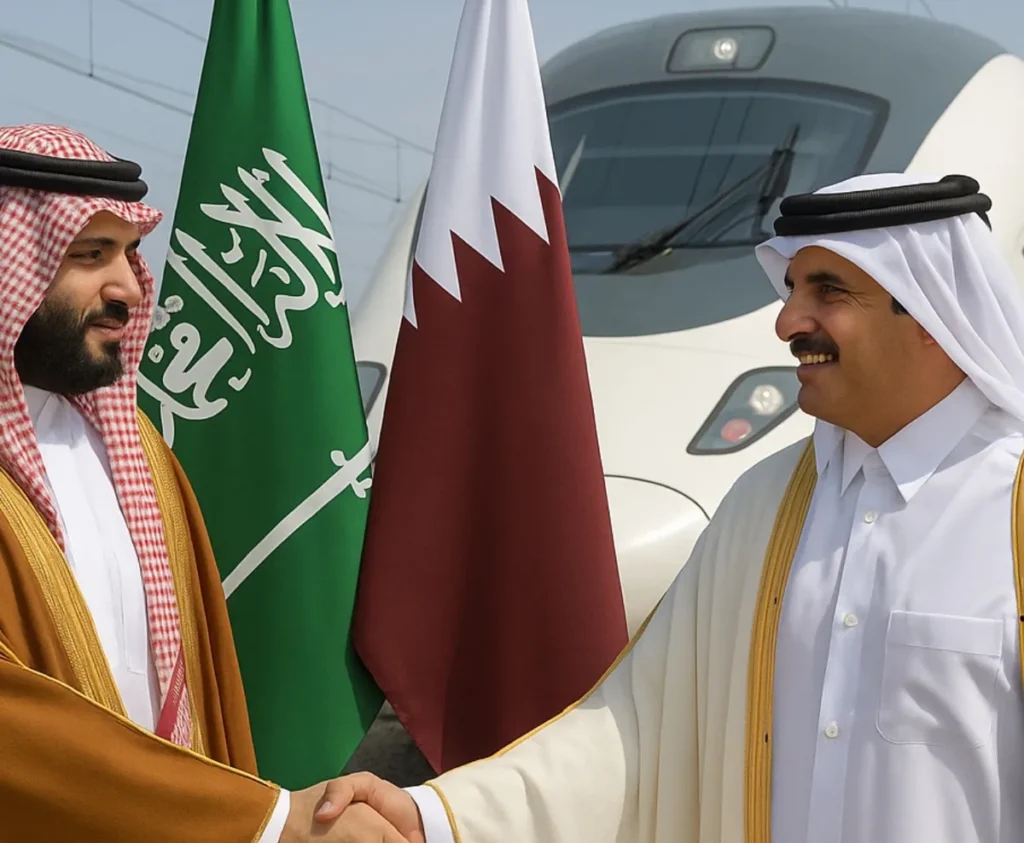
Riyadh–Doha high-speed rail agreement and route
The agreement was reached at a senior-level meeting in Riyadh attended by Saudi Crown Prince Mohammed bin Salman and Qatar’s Emir Sheikh Tamim bin Hamad Al Thani.
This is reported by the railway transport news portal Railway Supply.
It was then formally executed by Saudi Transport Minister Saleh Al-Jasser and Qatari Transport Minister Sheikh Mohammed bin Abdulla bin Mohammed Al Thani, reflecting closer bilateral coordination on major infrastructure.
Don’t miss…Secaucus–Jersey City Transitway advances to Phase 2 design
Project planners frame the Riyadh Doha high-speed rail project as a broader mobility shift, not just a faster trip between capitals. Their projections include annual ridership of more than 10 million passengers, the creation of about 30,000 jobs, and lower transport-related carbon emissions as travelers move from road and air to electric rail.
Design speed, desert heat, and airport-to-airport connections
Design work for the Riyadh–Doha high-speed electric railway centers on operating speeds of up to 300 kilometers per hour and reliable performance in extreme heat that can reach 50°C (122°F). The plan also includes intermediate stops in eastern Saudi Arabia, including Dammam and Hofuf.
Officials have indicated the line will directly link King Salman International Airport in Riyadh with Hamad International Airport in Doha, a point also covered by Railway Supply. The aim is to connect long-distance rail with two international air hubs and integrate intercity travel with onward flights.
Timeline, economic impact, and Haramain High Speed Railway experience
The railway is expected to be completed within six years and is forecast to generate an economic impact of approximately $30 billion for the combined Saudi and Qatari economies. Technical specifications and onboard amenities have not been released, but officials have indicated the system is expected to match or exceed the performance standards of existing Saudi high-speed rail lines, as reported by International Railway Journal.
Engineers are expected to lean on experience from the Haramain High Speed Railway, which operates in Saudi Arabia under harsh desert conditions, including sandstorms, high winds, and wide temperature swings. Similar solutions are anticipated for the new corridor, such as reinforced track beds, sand mitigation systems, and rolling stock adapted for prolonged exposure to heat.
News on railway transport, industry, and railway technologies from Railway Supply that you might have missed:
Find the latest news of the railway industry in Eastern Europe, the former Soviet Union and the rest of the world on our page on Facebook, Twitter, LinkedIn, read Railway Supply magazine online.Place your ads on webportal and in Railway Supply magazine. Detailed information is in Railway Supply media kit