RAIB landslip monitoring warning prompts urgent safety review
22.12.2025
The RAIB landslip monitoring warning urges urgent action after concerns that some lineside monitoring equipment on Network Rail infrastructure may not detect slope failures in certain circumstances, as set out in GOV.UK’s Urgent Safety Advice 01/2025.
This is reported by the railway transport news portal Railway Supply.
RAIB says the issue came to light as it published initial findings into a potentially fatal accident two months ago.
The advice is aimed at Network Rail, other infrastructure managers, and companies that supply or monitor the relevant equipment. RAIB says duty holders should promptly review the slope failure detection risk and, where needed, put mitigations in place.
Don’t miss…High speed train kills elephants in Assam, India
RAIB warning on landslip monitoring systems
In the RAIB landslip monitoring warning, the investigation branch says some systems used trackside may not reliably support operational decisions when conditions shift quickly, a concern also reflected in industry coverage such as Railway Gazette International. The safety message was issued alongside early findings from a derailment investigation, which RAIB says shows why monitoring performance and alerting arrangements matter.
Shap Summit derailment and West Coast Main Line disruption
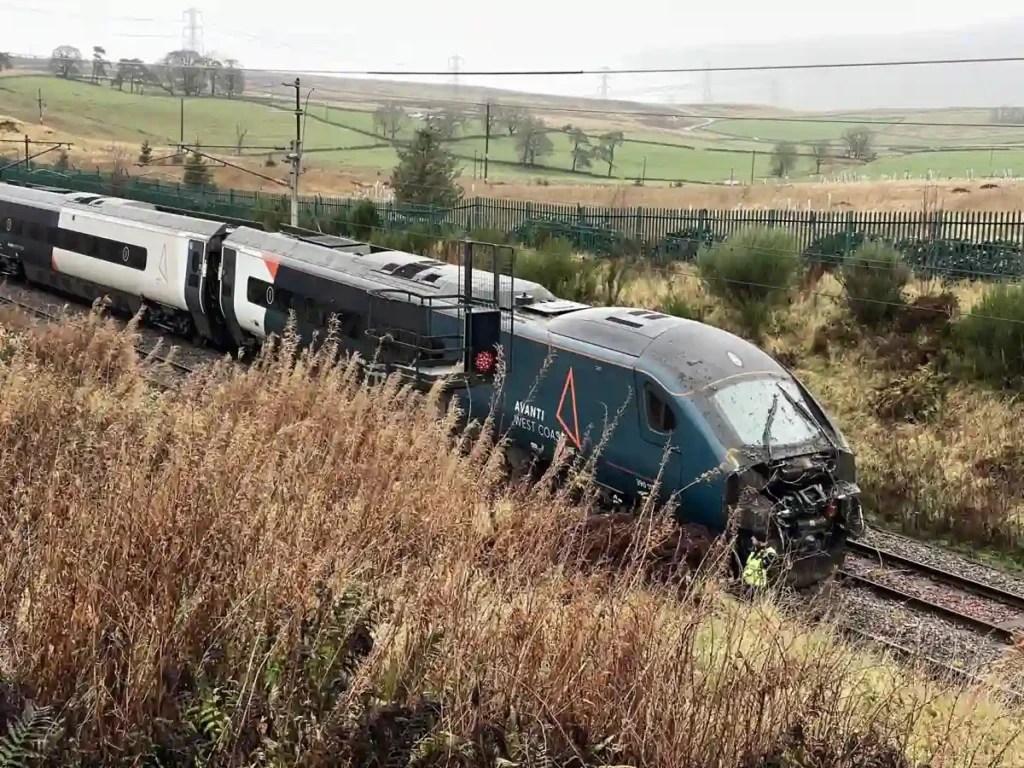
The warning follows RAIB’s preliminary findings into the Shap Summit derailment in the North of England. The incident blocked the West Coast Main Line, a critical mixed-traffic route linking London with the Midlands, North West England and Central Scotland.
At around 06:10 on 3 November 2025, an Avanti West Coast passenger train — the 04:28 Glasgow Central to London Euston service — struck landslip debris between Penrith North Lakes and Oxenholme Lake District stations, as previously covered by Railway Supply. RAIB says the train was travelling at around 83mph (133k/ph) when it hit material that had been washed onto the track.
The impact lifted the first bogie off the rails and the train ran derailed for approximately 560 metres. Nine staff and 86 passengers were on board. Four people were injured, and significant damage was caused to the train and railway infrastructure.
Why the monitoring equipment did not alert?
RAIB found the landslip was caused by a period of heavy and sustained rainfall. A drainage channel running across the cutting slope above the failure site could not accommodate the volume of water present, leaving the material below saturated and triggering the landslip.
The cutting slope had remote ground-movement monitoring equipment installed to detect movement in the earthwork. At the time of the accident, the system was recording data and reporting to its online monitoring service. However, it had not been formally entered into operational use, so it was not sending ground movement monitoring equipment alerts to Network Rail’s control centre. RAIB notes that similar systems are in operational use elsewhere on the network.
When set up for Network Rail slope monitoring, the equipment is mounted on steel spikes at two-metre intervals along the base of the slope. Movements are reported through four colour-coded ground-movement sensors alert thresholds:
- Green (information): 10–30 mm
- Amber (major): 30–60 mm
- Red (severe): 60–90 mm
- Black (critical): more than 90 mm
RAIB found that around four hours before the derailment, the sensors nearest to the landslip began to show minor movement. The readings stayed below the threshold needed to trigger a green alert, and this continued for around two hours. At about 04:30 — when RAIB believes the landslip occurred — the two sensors in the path of the debris were tipped over and buried by the sliding material.
RAIB concluded that events happened too quickly for the sensors to determine and transmit enough movement to generate an alert. It also found the sensors’ wireless signal could not pass through the material covering them, preventing communication until the site was later cleared.
The RAIB landslip monitoring warning says these limitations raise concerns about how some monitoring systems support safety decision-making during severe conditions. RAIB has urged Network Rail, other infrastructure managers, and equipment suppliers to urgently review the risks identified and consider what additional mitigations may be required.
News on railway transport, industry, and railway technologies from Railway Supply that you might have missed:
Find the latest news of the railway industry in Eastern Europe, the former Soviet Union and the rest of the world on our page on Facebook, Twitter, LinkedIn, read Railway Supply magazine online.Place your ads on webportal and in Railway Supply magazine. Detailed information is in Railway Supply media kit