Morocco’s High-Speed Rail Project: A Game-Changer in Transport
02.12.2024
The National Office of Railways (ONCF) advances Morocco’s high-speed rail project with a new partnership. China Gezhouba Group has secured a contract to construct six viaducts, solidifying its role in the Kénitra-Marrakech rail line development. This was reported by the railway transport news portal Railway Supply.

New Partnerships Propel Morocco’s High-Speed Rail Project
With its latest contract win, the China Gezhouba Group strengthens its foothold in global infrastructure. The firm, a subsidiary of the China Energy Engineering Group, specializes in large-scale projects and emerged victorious among four contenders. This lineup included two Moroccan firms and another Chinese company.
Don’t miss… Skoda Group: Trams for Bergam
The ONCF’s decision underscores a strategic move to enlist top global players. The 2.32 billion MAD ($230 million) contract covers viaducts named Ikkem, Cherrat, Nfifikh, Dir, Maleh North, and Maleh South. The budget, significantly lower than ONCF’s initial estimate of 2.76 billion MAD ($274 million), reflects effective cost management.
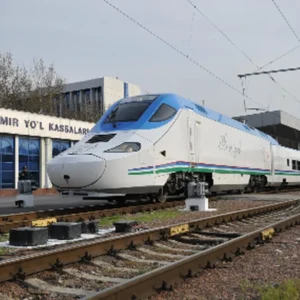
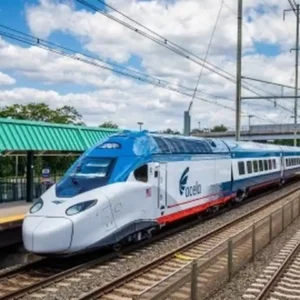
This ambitious rail project supports Morocco’s preparations for co-hosting the 2030 World Cup. It involves constructing a 365-kilometer rail line between Kénitra and Marrakech. In addition, upgrades to existing infrastructure focus on the Casablanca hub, ensuring seamless intercity travel.
Further emphasizing quality, ONCF entrusted China Railway No. 4 Engineering (CREC 4) with civil works valued at 3.4 billion MAD ($337 million). Similarly, Shandong Hi-Speed Engineering Construction oversees earthworks and related tasks in a 4.3 billion MAD ($426 million) agreement. TGCC handles a fourth section, managing structures over a 51-kilometer span for 2.83 billion MAD ($280 million).
Enhancing Connectivity with Morocco’s High-Speed Rail Project
Complementary to this, ONCF issued tenders for critical project components. A notable 3-billion-MAD ($297 million) tender addresses superstructure installation, including tracks, catenaries, and civil works. Responsibilities encompass laying rails, sleepers, ballast, and cables essential for train operations.
Innovative solutions shape the project’s trajectory, as demonstrated by a 102-million-MAD ($10 million) tender. This contract involves a mobile rail welding workshop integrated into a container, ensuring efficient deployment. Such advancements underscore the project’s cutting-edge approach.
Further contracts reflect the project’s scale and complexity. A 373-million-MAD ($37 million) agreement covers civil engineering between Casa Sud and Oasis stations. This section includes road bridges over the Casablanca highway and National Route 1. It also involves three railway bridges over key urban boulevards.
These intricate works must be completed within 30 months, highlighting ONCF’s rigorous timeline. Additionally, a 73-million-MAD ($7 million) contract focuses on improvements between Rabat Agdal and Ain Atiq stations. Tasks include bridge extensions and the construction of a new railway crossing.
The high-speed rail’s commercial launch, scheduled for November 2029, marks a significant milestone. By enhancing mobility and supporting the 2030 World Cup, this project cements Morocco’s position as a regional transport leader.
Source: mobile.telquel.ma
News on railway transport, industry, and railway technologies from Railway Supply that you might have missed:
Don’t miss… Driverless Metro in Greece: A New Era in Urban Transport
Find the latest news of the railway industry in Eastern Europe, the former Soviet Union and the rest of the world on our page on Facebook, Twitter, LinkedIn, read Railway Supply magazine online.Place your ads on webportal and in Railway Supply magazine. Detailed information is in Railway Supply media kit